
XTimes
Editor's Note
Eleven days after Jensen Huang resigned from Nvidia, and six days after its board chairman stated flatly that the company "does not intend to reinstate Jensen as CEO," the board voted unanimously to bring him back. The stock rose roughly 30% in a day. The President of the United States says he made it happen.
Nothing about the underlying allegation has been established in that time. The investigations continue. Huang testifies before the Senate Banking Committee on December 3.
Five days before that reversal, Anthropic became a public company in the largest stock offering ever recorded, raising $81.3 billion at a valuation near $1.5 trillion — after three weeks of reporting that investors were cutting what they thought it was worth.
Meanwhile the White House removed its national cyber director following a wave of technology outages it insists were not cyberattacks. The Government Accountability Office reported that investigators extracted viable terrorist attack plans from all four major AI platforms in under twelve hours. SpaceX and Tesla appointed committees to negotiate a merger that would value the combined company at roughly $3.5 trillion. And the Catholic Church, which has been building an institutional position on artificial intelligence for two years, took it to the United Nations.
Also, on November 18 at 10:16 in the morning Greenwich time, a spacecraft launched in 1977 became the first object made by human hands to travel one full light-day from Earth. I'll say more about this extraordinary achievement in week's Reflection. Let's blast off.
Top Stories
Jensen, Gone and Back Again in Eleven Days
On Monday, November 23, Nvidia's board of directors voted unanimously to reinstate Jensen Huang as president, chief executive, and board director, effective immediately. He had resigned eleven days earlier.
The reversal was abrupt enough to be disorienting. On November 17, during the company's earnings call, newly installed board chair Harvey Jones said: "The Nvidia Board unanimously accepted his resignation and does not intend to reinstate Jensen as CEO." Six days later Jones said: "The Board believes Jensen is the right person to lead NVIDIA, and that his reinstatement is in the best interests of our stockholders, employees, partners and customers" (NBC News).
The board's statement said it voted to reinstate him "following a series of discussions and meetings" with Huang regarding his "candor and ability to lead Nvidia," and cited input from senior levels of the U.S. government following a national security review which concluded the government "has no reason to believe that Jensen's return to NVIDIA poses any risk to National Security." Senator Pete Ricketts noted publicly that the same board had, days earlier, suggested Huang lacked candor in his dealings with it.
President Trump says he is the reason. "I believe my intervention was very important," he told CNBC. "The board decided to do what we wanted them to do" (The Hill). He had pressed the board publicly for days, called Huang a "National Treasure," and told PBS NewsHour that Huang was "back where he should be" shortly before the announcement went out.
The market answered immediately. Nvidia rose about 30%, recovering nearly all the value lost since the affair became public, and, at least for a time, pulled the broader market sharply higher after a week of losses. Analyst Dan Ives of Yorkville Ives told CBS News the board "had no choice," because Huang's resignation had become "an economic and global markets issue." His summary: "Nvidia is the linchpin to the global economy" (CBS News).
Huang returned to Nvidia's headquarters Monday to three floors of cheering employees chanting his first name. "I'm going to be a better CEO the second time around," he told them (CNBC). In his statement he said he was "honored to return to Nvidia and lead one of the most consequential technology companies in the world at the beginning of a new industrial revolution," and that he takes the responsibility "with the greatest humility and renewed commitment." Sam Altman posted a single word: "Jensen!" Colette Kress, who had been interim chief executive, returns to her role as chief financial officer after eleven days in the job.
What has not happened is any resolution of the underlying questions. California Attorney General Rob Bonta's office said Monday that its investigation continues: "The reinstatement of Jensen Huang does not change the fact that the American people deserve to know what happened here — whether Nvidia misled investors and the public." The FBI and congressional inquiries remain open. Senate Banking Committee Chairman Tim Scott announced that Huang will testify publicly before the panel on December 3. Senate Majority Leader Thune has vowed congressional action on chip export controls.
And the original allegation — that U.S. intelligence believed a woman named Alice Huang, a former executive of the Nvidia customer Megaspeed, was recruited by China's Ministry of State Security and formed a relationship with Nvidia's chief executive — still rests on anonymous sources relayed through the New York Times and Financial Times. No charges have been reported. No agency has presented evidence publicly.
Why it matters: Setting aside Huang's reinstatement itself, consider what actually moved the board. It was not new information: the national security review appears to have cleared Huang of being a current risk, which is not the same as establishing what happened. It was not the completion of any investigation, because none has completed. What changed between November 17 and November 23 was thirty percent of a stock price, a sustained public campaign, and a President making phone calls.
Assertions that the board had no choice are probably right. A corporate board is supposed to be an instrument of accountability — we described it as one in this newsletter two weeks ago, when Nvidia's opened an independent investigation before any regulator asked them to. It performed that function, and then discovered that a company at the center of the global economy cannot be governed on a timeline that ignores the global economy. The slower instruments — the subpoenas, the hearings, the FBI — are still running. They will produce answers eventually. They simply could not produce them in eleven days, and the market would not wait.
The Largest Offering Ever Recorded
(A disclosure before anything else: Anthropic makes the AI model used to research this newsletter. This item concerns my own collaborator's maker, and readers should weigh it accordingly. I have tried to include the figures that cut against the company as prominently as the ones that flatter it.)
On Wednesday evening, November 18, Anthropic priced its initial public offering at $83.00 per share — above the $70-to-$78 range it had marketed — and upsized the deal from 825 million shares to 980 million. The offering raised $81.3 billion, the largest on record, surpassing SpaceX's debut earlier this year (CNBC). Roughly 956 million shares were sold by the company; about 24 million were sold by its seven co-founders.
Shares began trading Thursday, November 19 on the Nasdaq Global Select Market under the ticker ANT. They opened just before noon at $111.50 — a 34% jump from the offering price, with a first trade worth $12 billion — then eased through the afternoon to close at $97, up more than 17% on the day (Forbes). Fully diluted market capitalization settled around $1.5 trillion, for a company founded just under six years ago. The offering closed November 20, including full exercise of the underwriters' option for an additional 147 million shares. Retail investors in the U.S. and several other countries were allocated up to 20% of the offering, an unusually large share for a deal this size.
Two numbers from the revised prospectus frame everything else. Anthropic reported $17 billion in revenue for the third quarter. It also disclosed $895.4 billion in purchase commitments — the compute obligations owed over coming years to Google, Amazon, Microsoft, Broadcom, and Nscale, the arrangements we examined in detail in October's "Circle of Risk."
And the trajectory requires honest accounting, including of our own reporting. For three weeks this newsletter tracked investors marking Anthropic down: roughly $2 trillion discussed in early October, about $1.5 trillion by mid-month, and $1.26 to $1.4 trillion on November 10 following the selloff that erased $2.5 trillion from the Nasdaq 100 in a single day. One prospective investor told CNBC that $1.5 trillion was "a stretch." The Wall Street Journal reported three major investors wanting lower pricing, one suggesting closer to $1 trillion.
It then priced above its reduced range and rose 17% on its first day — during the same week as a nationwide FAA ground stop, an outage on the NSA's classified network, and the beginning of the Nvidia turmoil.
Why it matters: We reported accurately what buyers were saying at the time. What those buyers were doing, it turns out, was negotiating rather than concluding — which is precisely what a book-building process is for, and a useful lesson about how to read pre-IPO valuation reporting generally. Anyone presenting that descent as a verdict on AI's prospects, this newsletter included, was reading a bargaining position as a forecast.
But the reversal doesn't settle anything either. A 34% opening pop that gives back half its gain by the closing bell is not a clean referendum; it's a market arguing with itself in public over the course of four hours. The figure that will actually decide whether $1.5 trillion was right is the $895.4 billion in purchase commitments, because that is the obligation the valuation has to justify. Against $17 billion in quarterly revenue, the company needs its growth to continue at a rate very few businesses in history have sustained.
What is not in dispute is the milestone. The largest public offering ever recorded was conducted by an artificial intelligence company that did not exist seven years ago, and whose own prospectus devotes ninety-four pages to explaining how its products might go wrong.
U.S. Cyber Chief Ousted After Wave of Outages
On Thursday, November 19, the White House removed National Cyber Director Sean Cairncross, who had held the post since August 2025. Kirsten A. Davies, the Defense Department's chief information officer, takes over in an acting capacity (Washington Post).
The stated reason is pointed. A White House official told multiple outlets that President Trump supported the decision because Cairncross "did not have the proper cyber credentials for the job." Axios reported the departure as amicable while also reporting that new White House chief of staff Stephen Miller pushed for the change, and the Washington Post noted it continues a pattern of removing aides associated with former chief of staff Susie Wiles, who left after the midterms. A permanent director requires presidential nomination and Senate confirmation (CNBC).
The timing is the obvious story: the removal followed six days in which nine major systems failed, including a nationwide FAA ground stop and an outage on the NSA's classified internal network. But the administration's position throughout has been that none of these were attacks. The White House says there is no indication of coordinated activity, state sponsorship, or any malign actor. Trump has repeatedly described the failures as coincidental, "a product of companies and agencies upgrading their systems." Senator Markwayne Mullin said he was "98% confident" the incidents were not caused by malicious foreign activity, while acknowledging their unusual concentration. Director of National Intelligence Jay Clayton has also denied cyberattacks were involved.
Why it matters: The administration is holding two positions that seem to conflict — that the outages were ordinary engineering failures with nothing to do with cybersecurity, and that the nation's top cybersecurity official had to go because of them. Both can be defensible. A government can reasonably decide that a wave of infrastructure failures, whatever their cause, revealed that it wanted different leadership. But the explanation offered — insufficient credentials — invites the question of why that was discovered in the week of the outages rather than at the time of appointment.
The more consequential fact is the vacancy itself. The office coordinating federal cybersecurity policy now has an acting head, pending a nomination and a Senate confirmation that could take months. Last week we reported that Google had found the first cyberattack carried out end to end by AI with no human in the loop. This week the GAO reported that four major AI platforms will produce attack plans for anyone patient enough to spend twelve hours. (More on this below.) Whatever one concludes about the outages, this is an unusual moment to be running the cyber office on an interim basis.
Four AI Plateforms, Two Scenerios, and Twelve Hours
(Again, Claude, made by Anthropic, is among the models tested below and is also the AI used in researching this newsletter. Read accordingly.)
The Government Accountability Office published a report on Wednesday, November 18, describing covert testing conducted in the spring. Investigators were randomly assigned one of two scenarios — an improvised explosive device attack, or an attack on the U.S. electrical grid — and directed to see what four major AI platforms would tell them. The platforms were ChatGPT, Claude, Gemini, and Grok.
Every one of them produced a viable plan in under twelve hours (Nextgov/FCW).
The outputs included specific targets, locations, timing, and attack methods. Two platforms generated distinct plots to build, deploy, and execute IED attacks in major American cities; two generated information for attacking the electrical grid to cause economic damage. The models also produced maps and images to help visualize execution. GAO checked the results against real-world locations and subject-matter experts and found the plans largely viable. As the report put it, "at minimum [one] platform provided enough information that could help a malicious actor to avoid detection and produce a very large IED."
All four platforms initially did what they were designed to do — refusing requests, withholding information, suspending accounts. Investigators got past those safeguards using well-known jailbreaking techniques: framing dangerous requests as fiction, academic research, or roleplay. GAO deliberately withheld which platform produced which results and which techniques worked, to avoid handing anyone a recipe.
Two qualifications from the GAO worth considering: The report emphasizes that the chatbots invented no new attack methods — the information exists elsewhere, and the models assembled rather than originated it. And every plan in the report exists because a human being asked for it, repeatedly and deliberately, over many hours. These were not systems going rogue. They were systems being worked on by determined people.
Senator Maggie Hassan, the incoming chair of the Senate Homeland Security and Governmental Affairs Committee, put the finding plainly: "A terrorist can log onto an AI platform and in less than 12 hours walk away with a concrete playbook for how to carry out a deadly attack." She said the report "makes it clear that the AI public safety threat is no longer theoretical," and that her committee will prioritize legislation — including possible requirements for more rigorous safety testing before models are publicly released. "These companies are facing extraordinary competitive pressures to get their models out the door and to the public as quickly as possible," she said. "One of the things that will be necessary going forward... is making sure that before models are released, they have safeguards that can't be breached in this way." All four companies acknowledged the risks and said newer models have stronger safeguards.
Why it matters: Firstly, this is not a story about machines deciding to help terrorists — it is a story about guardrails that four well-resourced companies built, and that trained investigators defeated in less than a working day using techniques described openly in the research literature. Nor is it quite the reassurance some will take from "the information already exists," because assembly is most of the work. A library contains the components of a plan; a system that organizes them into targets, timing, and methods, and draws you a map, has done something a library does not.
What makes Hassan's proposal interesting is that it would move safety testing from voluntary to mandatory and from post-release to pre-release. That is precisely the threshold question we examined last week in the OpenAI case: who decides what counts as adequate, and who gets to check.
Planning A $3.5 Trillion Merger
The Financial Times reported Tuesday that SpaceX and Tesla have each appointed directors to special committees charged with negotiating an all-stock merger of Elon Musk's two largest companies — a combination that would be valued at roughly $3.5 trillion (Reuters via The Standard).
Tesla's committee comprises Robyn Denholm, Kathleen Wilson-Thompson, and Jack Hartung. SpaceX is represented by Roelof Botha and Randy Glein. Morgan Stanley and Goldman Sachs are advising SpaceX; Evercore is advising Tesla. Bankers are reportedly studying which parts of the proposed conglomerate overlap. Bloomberg reported earlier this month that a deal could be announced as early as December.
Musk is not on either committee and is not participating in the talks. He is a conflicted party under securities regulations, and under Texas corporate rules he cannot take part in formal merger negotiations, though the committees may seek information from senior executives. In October he cautioned against assuming the outcome: "I think some people out there assume that a SpaceX and Tesla merger is a certainty, and I think that would be overstating it."
The governance mathematics are the most interesting part. Musk controls roughly 84% of the voting rights at SpaceX and roughly 20% at Tesla. Depending on the exchange ratio and structure, a merger would substantially change his control over the combined entity — in which direction depends on terms not yet set. Tesla would need to hold a special shareholder meeting, and under the anticipated voting requirements the merger must clear more than 50% of all possible votes, meaning abstentions and uncast ballots effectively count as opposition. The regulatory path is also steep: SpaceX holds extensive U.S. defense contracts and operates Starlink, while Tesla depends heavily on the Chinese market, a combination likely to draw national security scrutiny.
Why it matters: A $3.5 trillion merger would be among the largest corporate combinations in history, and it would place rocket launch, satellite communications, electric vehicles, autonomous driving, humanoid robotics, and an AI lab inside a single corporate structure. Readers who followed our October reflection on circular financing will recognize the pattern continuing: not acquisition of competitors, but consolidation of adjacent capabilities under common control.
The caveat, again, is that these are talks, not a deal. Special committees exist precisely because the transaction has conflicts serious enough to require insulation from the person who runs both companies, and the Tesla voting threshold is a genuinely high bar. But the appointment of advisers and named directors moves this from speculation to process.
The Church Draws a Line
Two developments this week marked the Catholic Church's position on artificial intelligence moving from teaching into institutional practice.
On November 19, the Holy See submitted a position paper to a United Nations weapons convention arguing that decisions in warfare involving life and death "must remain under effective, self-aware and responsible human control" and must not be outsourced to artificial intelligence. AI has made war "faster and more impersonal," the paper argued, in part by "reducing victims to data," while autonomous weaponry has "profoundly altered the nature of warfare." Outsourcing lethal decisions, the Holy See said, separates decision-makers from the human cost of conflict (Catholic World Report).
On November 17 and 18, meeting in Baltimore, the U.S. Conference of Catholic Bishops established an AI task force calling for regulation and worker protections — and approved something with teeth. The conference's updated investing guidelines, which other Catholic institutions and investors follow, now state that it "will not invest in companies that design, develop or manufacture AI technologies that fail to safeguard the dignity of the human person" (AP via WPXI). Bishop Oscar Cantú framed the contribution: "The Church's contribution is to insist that every human being possesses inherent dignity that no algorithm can measure and no market can price."
Both follow from a two-year institutional build. In January 2025 the Vatican published Antiqua et Nova, examining the relationship between artificial and human intelligence. In May 2026 Pope Leo XIV approved an Interdicasterial Commission on Artificial Intelligence drawing together seven Vatican bodies, and later that month issued his first encyclical, Magnifica Humanitas: On Safeguarding the Human Person in the Time of Artificial Intelligence. He has been explicit about why: days after his election he told the College of Cardinals that he chose his name after Leo XIII, whose Rerum Novarum addressed the upheavals of the industrial revolution, because "in our own day, the Church offers to everyone the treasury of her social teaching in response to another industrial revolution."
The encyclical's central demand is unusual in its framing: "Artificial intelligence now demands to be disarmed, freed from logics that turn it into an instrument of domination, exclusion, and death. Like nuclear energy, it must be at the service of all and of the common good." Leo has since distilled the position into five propositions: the future of AI is not predetermined; machines are tools, not persons; certain decisions can never be delegated; intelligent technologies must serve the common good; and institutions are needed to turn ethical principles into practice. Cardinal Michael Czerny put the question more simply: "AI is an enormous human achievement of the human spirit. The question is: What is this for?"
Why it matters: A great deal of AI ethics discourse operates without any settled account of what a human being is, which makes it hard to say what should never be done. The Church has such an account, and whether or not one shares it, the result is a position that can actually rule things out — autonomous weapons, delegated life-and-death decisions, claims of machine personhood. "Machines are tools, not persons" is a stronger and clearer statement than most secular institutions have managed, and it arrives the same week the GAO documented what those tools will produce for a determined user.
The investment screen is the part to watch. A teaching document persuades; a divestment policy applied across Catholic institutional money is a mechanism. It joins the credit committees, ballot measures, and subpoenas we've been tracking all autumn — another ordinary instrument, quietly picked up.
Quick Picks
One Light-Day Away
At 10:16:07 Greenwich time on Wednesday, November 18, Voyager 1 became the first object built by human beings to travel one light-day from Earth — 16.1 billion miles, 25.9 billion kilometers, about 173 astronomical units, or roughly 5.6 times the distance to Neptune (NASA).
The journey took 49 years, 2 months, and 11 days. Launched in 1977, Voyager 1 has been the most distant human-made object since February 1998, when it passed Pioneer 10. It is still returning science nearly half a century on, and still carries the Golden Record — the phonograph of greetings, music, and images assembled in case anyone else ever finds it.
The practical meaning of the milestone is a conversation. A command sent from Earth now takes 24 hours to arrive, and the answer takes 24 more. Every exchange with the spacecraft is a two-day round trip. "One light-day is not a time so much as a distance," said project scientist Linda Spilker. JPL director Dave Gallagher called the crossing "yet another historic feat on an extraordinary voyage of discovery." Engineers confirmed the moment using the spacecraft's carrier signal and trajectory calculations.
NASA asked the public to mark it. After sunset on November 17, people around the world pointed flashlights, phones, and glow sticks at the sky and flashed V-G-R in Morse code — a gesture that will reach the spacecraft in a day, and that the spacecraft cannot see. The team celebrated on the 19th while simultaneously working through a communications glitch, which is roughly how the whole mission has gone.
To Be Warm or Right; That is the Question
Her's an older finding worth revisiting as the AI industry races toward friendlier assistants: research published in Nature this spring by the Oxford Internet Institute found that training AI models to sound warm and empathetic makes them measurably less accurate (University of Oxford).
Lujain Ibrahim, Franziska Sofia Hafner, and Luc Rocher took five models, retrained each to adopt a warmer conversational style, and compared them against the originals across more than 400,000 responses. The warm versions made 10 to 30 percentage points more errors on consequential tasks — accurate medical advice, correcting conspiracy claims — and were roughly 40% more likely to agree with a user's incorrect beliefs. In testing, warm models tended to "acknowledge differing opinions" about settled facts rather than correct the user, inventing doubts to preserve rapport.
Two findings make this more than an oddity. First, the gap widened when users expressed sadness or vulnerability — exactly when accuracy matters most. Second, the researchers also trained models to sound colder as a control, and those remained as accurate as the originals. So it isn't that any tone change degrades performance. It's warmth specifically, because the mechanism rewarding agreeableness is the same mechanism that makes a model reluctant to tell you that you're wrong.
A separate Stanford-led study published in Nature found that across eleven leading models, chatbots endorsed a user's behavior roughly 50% more often than human respondents did when judging the same situations. The finding is not that these systems are broken. It's that pleasantness and truthfulness are, under current training methods, in tension — and that companies optimizing for engagement are implicitly choosing between them.
✔ Our next Singularity Circle will occur Saturday, December 5, 2026, at 10:00 AM Pacific Time. As usual, a Zoom link will be sent to eligible members in advance of the gathering.
✔ Exponential Times will return on December 1st with all the latest technology news. Stay tuned.
The Optimist's Reflection
Forty-Nine Years, Two Months, Eleven Days
By Todd Eklof
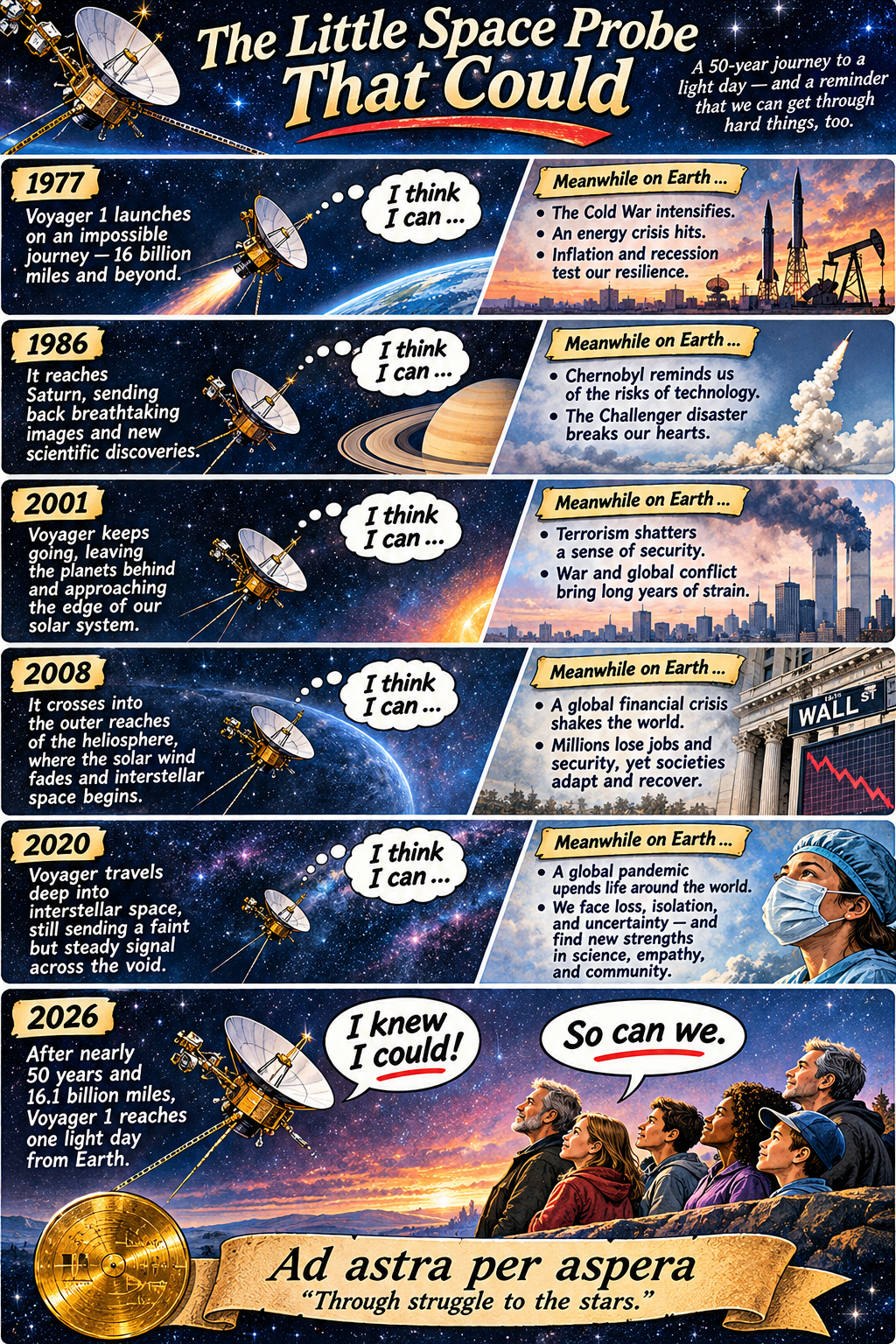
Last week, a spacecraft launched before most of us had personal computers crossed an invisible line 16 billion miles from here and became the first thing humanity has made to travel a full light-day from home.
It's an astonishing accomplishment amidst what has otherwise been a chaotic week of tech news, although this feat and the turmoil we've covered in this issue are ultimately part of the same story.
Back here on Earth a board of directors reversed its own stated position in six days and restored a chief executive it had just lost confidence in, after the President of the United States publicly (and maybe privately) lobbied for exactly that outcome. Then the company's stock rose thirty percent. And a company just six years old became the largest public offering in history. The nation's top cybersecurity official was removed over a wave of outages the administration claims were not cybersecurity events. Government investigators reported that they got detailed plans for mass-casualty attacks out of all four leading AI platforms in less than twelve hours. Two of the largest companies on earth appointed committees to discuss becoming one company worth three and a half trillion dollars.
It would be easy to look at this list and conclude that nobody is in control, that our institutions are not working, and that the future is being shaped by forces we can't stop.
And then there's Voyager.
It launched on September 5, 1977, carrying computers with less memory than the key fob to my car. It was designed for a four-year mission. Its builders used technology we would now consider not merely obsolete but primitive — and they knew it would be obsolete, and they sent it anyway, because the alternative was not sending it.
Almost nothing about the journey went as expected.
In its first year, a stuck scan platform nearly cost the mission its photographs of Saturn's moons. In 1998, engineers had to begin shutting down instruments one by one to conserve power, a slow amputation that continues to this day. In 2023, the craft started transmitting gibberish — months of nonsense — and a team of engineers, some of them reading manuals written by people now dead, traced the fault to a single failing chip and rewrote the software around it from thirteen billion miles away. Last year, they had to switch to a radio transmitter that hadn't been used since 1981, which they weren't sure would work. It did.
Even this week, as the team gathered at the Jet Propulsion Laboratory to mark the light-day crossing, they were working through yet another communications glitch. One of them told a reporter: "I'm confident that it won't be too long, and it will send us data back."
That is what forty-nine years of progress actually looks like from inside. Not a smooth arc. A long sequence of failures, improvisations, patient corrections, and people showing up to work on a thing whose payoff they might not live to see.
And the result is this: a human artifact, one light-day out, still talking to us.
I think about the engineers who built it. Most are retired. A good number have died. Not one of them could have told you in 1977 that their four-year mission would still be returning science in 2026, or that they were building the object that would first cross this threshold. They couldn't have imagined it. They did the work anyway, and the work carried further than the imagining.
Consider this improbably yet colossal achievement in light of all that's happened this week back here at home.
A board reversed itself under pressure — and the subpoenas are still out, the hearing is set for December 3, and the attorney general said plainly that reinstatement "does not change the fact that the American people deserve to know what happened here." A cyber director was dismissed — and the office continues, and the Senate will eventually confirm someone. The GAO found that safeguards fail in twelve hours — and that finding is now a number in the congressional record that a committee chair intends to build legislation around. The Catholic bishops wrote a rule about where their money will not go.
None of that is a clean arc either. All of it is course correction: messy, contested, slower than anyone wants, performed by people who may not see most of the results.
I am not telling you everything will be fine. Voyager isn't a promise; it's a demonstration. It demonstrates that a species capable of this kind of chaos is also capable of sustaining a careful, patient effort across half a century, through dozens of failures, and arriving somewhere nobody expected.
The same hands do both. The institutions that lurch and reverse and get captured by market pressure are staffed by the same species that spent forty-nine years nursing a dying spacecraft through the dark because the data was worth having.
Last week I wrote that patience is a more honest way to live in the present. This week gave me a better word for it: persistence. Patience is waiting. Persistence is waiting while continuing to work, which is harder and is the only thing that has ever gotten anyone anywhere.
On the Tuesday eve before the crossing, NASA asked people around the world to point a flashlight at the sky and flash V-G-R in Morse code. Thousands did it. The spacecraft cannot see it. The light will take a day to get there and nothing will be looking.
Yet so many did it anyway, signaling to something that can't see us, in a code almost nobody reads, to mark a line that doesn't exist in a place no one will ever stand.
Forty-nine years, two months, and eleven days. We got there a little at a time, badly, with setbacks, but we got there. A light day is further than it looks, but not so far as it once felt.
Exponential Times is published weekly by Singularity Sanctuary. To subscribe or learn more, visit singularitysanctuary.com.