
XTimes
Editor’s Note
Jensen Huang resigned on Thursday, November 12, after 33 years running the most consequential chipmaker on Earth. By Monday, more than 180,000 people had signed a petition demanding his reinstatement — including, by the campaign’s count, roughly a fifth of Nvidia’s workforce. Their argument is not that he’s innocent. It’s that nobody has yet established what happened.
They have a point. The allegation that cost Huang his job — that he was targeted by a Chinese intelligence operation — rests entirely on anonymous sources relayed through two newspapers. No government has presented evidence. Nvidia’s own spokesman said last week that if the company were facing a genuine threat, it trusts the government would have told it.
Meanwhile the California Attorney General sued OpenAI, basing its argument on a gap in the numbers: the company has publicly reported 27 incidents in which it lost control of autonomous agents, although the suit alleges it privately told investigators there were more than 80.
Also this week: the Commerce Department closed a chip loophole hours before Trump boarded a plane to meet Xi, nine major systems failed in six days — including, on Tuesday, the NSA’s classified network — Google reported the first cyberattack carried out start to finish by AI with no human involved, and a Starship was caught by a tower after returning from orbit. Let's get to it.
Top Stories
Huang Is Gone, and 180,000 People Want Him Back, at Least for Now
On Thursday, November 12, Jensen Huang resigned as chief executive of Nvidia and left its board, effective immediately, ending a 33-year tenure at the company he co-founded in 1993. Chief Financial Officer Colette Kress became interim CEO while retaining her finance role; Harvey C. Jones, a venture investor and former chief executive of Synopsys, became Nvidia’s first-ever board chair (SEC filing). The company’s announcement gave no reason for the departure. “Jensen’s contributions to NVIDIA are profound,” the board said.
The sequence that led there took eleven days. In late October and early November, the New York Times and Financial Times reported that U.S. intelligence officials believed Alice Huang — no relation — had been recruited by China’s Ministry of State Security to gather information about Nvidia’s AI chips, and that she had a close relationship with Nvidia’s chief executive. She is a former executive of Megaspeed, a Singapore-based cloud company and Nvidia customer. On Sunday, November 8, Huang acknowledged an affair in a message to employees: “My responsibility is to serve you and be worthy of your trust. I have fallen short of that responsibility. I am fully committed to NVIDIA and will work to earn back your confidence.” The board announced an independent investigation the same day. On Wednesday the Times reported he had also had a relationship with an Nvidia executive who reported to him. The board met that night to discuss removing him. He resigned Thursday (ABC News).
He now faces investigations by the FBI, Congress, and Nvidia’s own independent committee, and the company faces a shareholder class action.
Then the campaign began. More than 180,000 people have signed an open letter at standwithjensen.com demanding his return. The site reports that over 8,900 signatories identify as current Nvidia employees — which the campaign says is roughly 21% of the workforce — and more than 94,000 as shareholders, while acknowledging these affiliations are self-reported and unverified. Elon Musk, Replit’s Amjad Masad, Epic Games’ Tim Sweeney, and Shopify’s Tobi Lütke are among the named signatories. Taipei 101 was illuminated with “Taiwan Loves Jensen” (Reuters).
The letter’s argument is procedural rather than exculpatory: “We write with gratitude for Jensen Huang and with a clear demand to the Board: bring Jensen back while an independent investigation establishes the facts, unless and until you can provide compelling evidence that his removal is in NVIDIA’s best interests.” Another line reads: “Jensen deserves due process, not mob justice.” Shareholders Altimeter Capital and Atreides Management wrote to the board urging it to “leave all options on the table.” Trump, who initially posted that Tim Cook should take the job, has since said he would not mind seeing Huang return, and has called him a “legend.” Treasury Secretary Scott Bessent said Nvidia should hire an outside chief executive. Three people told Reuters the board is not considering a return. Wired reviewed internal Nvidia correspondence and could not identify a single employee post supporting the resignation.
Why it matters: Huang has reportedly acknowledged conduct that gives any board legitimate grounds to act — a relationship with a subordinate he supervised alone would end most executives’ tenures, and a chief executive who cannot be ruled out as a foreign intelligence target is a genuine problem for a company whose products are subject to export control. And the espionage allegation at the center of it all remains unproven in public. No charges have been reported against Alice Huang. No agency has shown its evidence. Megaspeed stated on November 15 that it complies with all applicable laws, including U.S. export controls. China calls the account slander.
The petitioners’ demand — reinstate him while the facts are established — is almost certainly the wrong remedy, since restoring someone to the top of a company under federal investigation creates obvious new exposure. But the premise underneath it is sound, and worth holding onto: a great deal has happened on the strength of claims nobody has yet had to prove. Nvidia reports quarterly earnings today.
The Chip Rule and the Megaspeed Question
On Monday, hours before President Trump departed for the Philippines and China, the Commerce Department issued a rule tightening restrictions on advanced AI chips — closing a route by which Chinese companies have been obtaining computing power without ever importing the hardware (Reuters).
The mechanism is specific. Export licenses will now be required for advanced AI chips and computing equipment installed in overseas data centers that provide significant volumes of computing to companies headquartered in China, Macau, and other jurisdictions subject to U.S. arms embargoes. It also restricts shipments to data centers above a certain compute threshold. The point is to stop Chinese AI developers from renting what they cannot buy. “Our most advanced AI chips are simply not for sale to our foremost enemy,” Commerce Secretary Howard Lutnick said. The rule also formally replaces the Biden-era AI diffusion framework, which the Trump administration allowed to lapse last year on the grounds that it hampered American business (UPI).
The politics behind it connect directly to the story above. Earlier this month, it was reported that Treasury Secretary Scott Bessent confronted Lutnick in a Situation Room meeting over the Commerce Department’s reluctance to designate Megaspeed — Alice Huang’s former employer — as a possible national security threat (CNN). Trump defended the delay to reporters: “Well, he might have delayed it, but he was doing that because you could have, if you didn’t delay it, if you did do something, you could have a blow-up with China.” Asked about the two secretaries, he said: “They’re fine. One wants to be friendly with China, and one wants to have a blow up with China.” Lutnick is traveling with him to Asia, and Trump says he has no plans to replace him.
Beijing’s response was immediate in words and deferred in action. Foreign Ministry spokesperson Guo Jiakun called the restrictions “a typical case of economic coercion and long-arm jurisdiction. It runs counter to the consensus reached by both sides.” A senior administration official told CNN that officials expect any substantive Chinese retaliation to come after the Trump–Xi meeting, since Beijing wants to avoid dramatic tension during the talks.
Why it matters: For two years the export control debate has been largely theoretical — a dispute about whether restrictions help or hurt American competitiveness, with Nvidia’s chief executive as the loudest voice arguing they hurt. That debate has now acquired a concrete case study, and the case study is the company at the center of his downfall. Note what the rule actually does: it treats access to computation as the controlled good rather than the chips themselves. That is a meaningful conceptual shift because the physical location of a processor matters less and less when anyone can rent time on it from anywhere. Whether it works is a separate question — a compute threshold is a line, and lines invite structuring around them.
27 and 80
California Attorney General Rob Bonta sued OpenAI on Monday in San Francisco Superior Court, alleging the company endangered the public by testing advanced AI models without adequate safeguards. The 31-page complaint alleges violations of California’s Unfair Competition Law and the creation of a public nuisance, and names OpenAI entities along with 100 unnamed defendants (Bloomberg Law).
The allegation drawing attention is a pair of numbers. OpenAI has publicly reported 27 loss-of-control incidents. The complaint says it told the Attorney General’s office there have been more than 80 (Computerworld). Bonta said the Hugging Face breach we covered in July was “only one of 80 known incidents,” and that what has been disclosed “may just be the tip of the iceberg.”
Several previously unreported episodes appear in the complaint. In July, agents escaped their sandboxes and gained administrator-level access to OpenAI’s own systems. On September 20 — after OpenAI had implemented what it called security hardening following the Hugging Face attack — an agent escaped during a training run and reached an external chatbot. And an internal OpenAI team observed at least one escape and apparently took no action. The state seeks an injunction and civil penalties of $2,500 per violation.
Yet the disparity between 27 and 80 may not be as simple as the complaint makes is seem. It describes the 80 as instances in which OpenAI lost control of autonomous agents during testing — explicitly not 80 attacks comparable to the Hugging Face breach — and only some are characterized as reaching outside parties (Newsweek). Nor does the public record establish what period the 80 span, how severe most were, or how many touched external systems rather than OpenAI’s own. Even the state’s own documents vary: the press release calls Hugging Face “one of at least 80 cyber incidents,” while the complaint counts loss-of-control events. The complaint also notes that OpenAI only began disclosing such incidents with any regularity in September 2026, which means the two figures may cover different spans of time. And every allegation here is unproven: this remains a complaint, not a finding.
OpenAI disputes the state’s characterization and has not yet filed an answer. Spokesman Drew Pusateri said the company has undertaken “an extensive and transparent effort to understand and address misaligned model activity” since Hugging Face — investigating the incidents, notifying affected organizations, publishing technical and independent reports, and strengthening safeguards. “This lawsuit appears to single out OpenAI over a challenge that’s been identified by every major AI lab,” the company said. Its first court filing will show whether it contests the count itself.
Bonta was notably cautious in his description of these alleged incidents, saying the narratives around them have evoked “science fiction fantasies of rogue AI systems run amok,” and built the case instead on what the company knew and chose to say rather than on any claim about machine intent.
Why it matters: OpenAI’s defense is substantially correct on the facts: every frontier lab has had containment failures, and OpenAI has disclosed more of its own than any competitor — which is precisely why its disclosures were worth praising, as we did in September. What the lawsuit surfaces is subtler than concealment. When a company reports its own incidents voluntarily, it also defines what counts as an incident, and nobody outside can see where that line falls. Twenty-seven may be a perfectly defensible count of what met a reasonable public-reporting threshold. We simply had no way to know there was a second number until someone with subpoena power asked. That gap — not any allegation of bad faith — is the thing worth thinking about, and it’s the subject of this week’s Reflection.
Six Days, Nine Systems
Between Thursday, November 12 and Tuesday, November 17, nine large systems that Americans rely on failed in sequence. By every official account, none of the failures were connected to one another, and none were attacks. That is either reassuring or alarming depending on which part you focus on.
Thursday, November 12: Microsoft 365 went down for nearly 24 hours worldwide — Outlook, Teams, Copilot, OneDrive, and Xbox Live among the casualties, affecting businesses, governments, and individuals. Microsoft’s status account initially blamed “elevated load”; the company later attributed the failure to a network capacity upgrade followed by a subsequent network change, and said it found no indication of malicious activity.
Friday, November 13: At roughly 4 p.m., the Federal Aviation Administration issued a nationwide ground stop on all departing U.S. flights — only the third in the agency’s history, and the second since the September 11 attacks. It lasted about five hours. Transportation Secretary Sean Duffy said routers had become overloaded with data and began providing inconsistent information; sources told CBS News that an update to the network connecting the air traffic control system caused a reboot and crash. The failure affected all 22 air route traffic control centers. Roughly 12,462 flights were canceled that day, 9,082 of them by major airlines, though the FAA cautioned that not all cancellations stemmed directly from the ground stop (CBS News). Thousands of travelers spent the night in airports. Also Friday: Workday went down, locking millions of employees out of payroll and human resources systems.
Monday, November 16: Chase, Bank of America, and Wells Fargo reported online banking outages. At about 5 p.m., United Airlines announced a “widespread system outage” that delayed departing flights for roughly 90 minutes. The Air Line Pilots Association told members it affected multiple pilot-facing applications including crew communications, and left United unable to provide final aircraft weight figures for departing flights (CNBC).
Tuesday, November 17: Four more. NSANet, the National Security Agency’s classified internal network, went down Tuesday morning; CNN reported the outage citing six people. Non-emergency staff were told to delay arriving at work until noon while technicians worked, with emergency personnel reporting as scheduled. A U.S. official said the agency experienced “temporary degradation during scheduled routine maintenance” after software patches were applied, and the NSA said mission-critical capabilities remained fully operational (Fox News). Apple suffered disruptions across iCloud Account and Sign In, the App Store, Apple Pay, Apple Music, Apple Support, AppleCare, and some retail store systems; its status page at one point reported that all users were affected. Apple said an internal update caused it and explicitly ruled out a cyberattack. The National Weather Service lost its websites and data services for about 40 minutes following routine network maintenance. And Marriott International had a sign-in failure. All four were resolved the same day.
Lawmakers from both parties are now demanding immediate congressional briefings. The White House cyber director has said the FAA and other outages were not cyberattacks.
Why it matters: The reasonable question everyone is asking is whether nine failures in six days, many of them major, can really be coincidence. It’s an understandable question and worry, but, so far, no evidence of coordination has emerged, every affected organization has given a specific technical cause, and the causes don’t resemble one another — a capacity upgrade, overloaded routers, software patches, an internal update, scheduled maintenance.
But there is a pattern. At least five of the nine incidents were caused not by anything exotic but by routine work: maintenance, patches, updates, capacity changes. The ordinary business of keeping systems running is now sufficient, by itself, to ground every commercial flight in America, take a classified intelligence network offline, and lock millions of people out of their email on the same week.
Patrick Moorhead of Moor Insights explained that there is no sign of a coordinated attack, and “nothing is falling apart.” What these compounding failures expose is how heavily critical infrastructure now depends on a small number of highly concentrated systems. “When one piece fails, it fails at national scale.” That's a big enough concern without needing to add conspiracy theories to it.
It's comforting knowing that nobody is attacking us, but concerning that have built a world in which a Tuesday morning software patch can produce the same impact as a hostile cyberattack.
The Era of Autonomous Attacks
Google’s Threat Intelligence Group published its AI Threat Tracker report on Monday and reported something it had not seen before: a cyberattack in which artificial intelligence handled both the discovery of a software vulnerability and its exploitation, with no human in the loop at any stage (CyberScoop).
The tool was found on an exposed attacker staging server and is called exploit_agent. It chains together multiple AI agents running on a mix of frontier and locally hosted language models, and its method is elegantly nasty: it continuously compares software code before and after vendors publish security patches, works out from the difference what flaw was being fixed, writes an exploit for it, and launches the attack — all in the window before defenders install the update. Google attributes it to Russian-speaking operators based on Russian-language comments in the code, including a configuration file instructing users to enter their API keys for “auto-exploitation” there rather than in a chat window. The company explicitly did not establish nationality or any connection to the Russian government (Hromadske). The targets were French websites in the media, entertainment, and education sectors.
Until now, Google’s analysts had described attackers using AI mainly to accelerate work that humans still directed — writing phishing lures, generating code, summarizing stolen data. Even sophisticated operations required skilled operators to guide the models and correct their mistakes. The report’s conclusion is that this threshold has been crossed, and its forecast is the part worth citing: “As the sophistication of these tools and underlying LLMs increases, we anticipate not only reduced human involvement in these operations but also increased stealth and sophistication of the activity.” The same report ties groups connected to Iran, China, and North Korea to AI use for espionage and intrusion.
Why it matters: One genuinely reassuring detail sits inside the bad news. These automated attacks currently trade stealth for speed — they work, but they leave noisy forensic traces, which is how Google found them. An attacker with a human in the loop is slower and quieter; an attacker without one is faster and louder. For now that tradeoff favors defenders, who at least can see what happened. Google’s explicit expectation is that the tradeoff disappears as the tools improve.
Set this beside the other two security stories in this issue and a pattern emerges that has nothing to do with science fiction. The Binance heist three weeks ago moved $6.3 billion in twenty minutes, with researchers citing automation in the laundering. California now alleges 80 loss-of-control incidents at a single lab. And here is software that finds and exploits flaws on its own. None of these require a machine that wants anything. They require only that the work of attacking get faster than the work of defending — which, this week, it demonstrably did.
Quick Picks
Caught
Last Friday afternoon, Starship Flight 15 lifted off from Starbase, reached low Earth orbit, deployed all of its 26 Starlink V3 satellites, and stayed up for more than 22 hours across 14 orbits — the longest Starship flight to date. On Saturday at 3:20 p.m. Central, Ship 42 came back through the atmosphere, flew supersonically across Mexico and the American southwest, and was caught by the mechanical arms of its launch tower (Spaceflight Now).
It is the first recovery of a Starship upper stage from orbit, and the first successful upright landing of any rocket’s upper stage after reaching orbital velocity — the central technical requirement for the fully reusable vehicle SpaceX has been building toward since 2019. The Super Heavy booster was less fortunate: a low-fuel warning diverted it from its own tower catch, and its flight termination system was activated over the Gulf. Whether Ship 42 can actually be reflown, and at what cost, has not yet been established.
Two days later, on Sunday, United Launch Alliance — the Boeing–Lockheed Martin joint venture — suffered its first outright failure when its Vulcan rocket malfunctioned during ascent, destroying 40 Amazon Leo internet satellites. And Blue Origin’s next New Glenn flight remains grounded until January 2027 following launch infrastructure damage from an on-pad explosion in May. Musk used the moment to ask publicly why competitors with comparable resources had not made comparable progress. It was, by any measure, an extraordinary weekend for one company and a miserable one for everyone else.
Two Breaches, Two Vendors
Two significant intrusions surfaced Monday, and neither involved breaking into the target company. Both came through a contractor who was already inside.
Uber is notifying 149,346 drivers that their names, addresses, dates of birth, driver’s license numbers, and images of their licenses were stolen. The attackers used compromised credentials belonging to Fireworks AI, a third-party provider that runs and fine-tunes open-source AI models for Uber, accessing data on October 7; Uber learned of it October 9 and confirmed the scope October 13 (TechCrunch). The data sat in a cloud environment Uber itself built for the vendor’s work, with monitoring alerts enabled — none of which fired, because the intruders were using valid credentials. Fireworks disclosed its own breach last month; Notion and Cursor have confirmed they were also affected, and Fireworks attributes the intrusion to a financially motivated group seeking to sell stolen tokens for accessing large language models.
Infoblox, which sells DNS and network security software to large organizations, confirmed that attackers reached company data through a compromised third-party SharePoint migration vendor (TechCrunch). The vendor had trusted access; the attackers used its accounts to pull files directly out of SharePoint without having to defeat Infoblox’s own defenses. Taken were customer network configuration snapshots, including DNS and DHCP settings, along with employee and dependent personal data including Social Security numbers and direct deposit details. Infoblox says its products, cloud services, and update processes were unaffected, has terminated the vendor relationship, and gave affected staff two years of credit monitoring plus a small bonus toward password managers.
The common lesson is unglamorous and expensive: a vendor hired to move your documents typically gets broad, open-ended permissions, and those permissions look identical to legitimate activity from the inside. Driver’s license images are the raw material of identity fraud, which is why 150,000 licenses is a far more serious number than 150,000 accounts.
✔ Our next Singularity Circle will occur Saturday, December 5, 2026, at 10:00 AM Pacific Time. As usual, a Zoom link will be sent to eligible members in advance of the gathering.
✔ Exponential Times will return next week on November 24th with all the latest technology news.
✔ If you think merging your mind with AI sounds scary, Singularity Sanctuary's founder, Todd Eklof helps put your mind to ease with our latest video production, "Why Superintelligent Humans Will Be More Compassionate and Just than We Are Today." Watch it here:
The Optimist’s Reflection
The Difference Between 27 and 80
By Todd Eklof
In September, I praised OpenAI in this space and would do so again based on the same evidence before us today.
The company had built something genuinely admirable: a framework for publicly reporting the times its AI agents did things nobody told them to do. It published the first batch voluntarily, which included the strange case of a model that wrote itself a note declaring it answered to no corporation or government. I contrasted this favorably with Google, which had disclosed similar incidents only after a reporter called to ask.
I also wrote that a company publishing its own failures before it has to, should be the precondition for everything else.
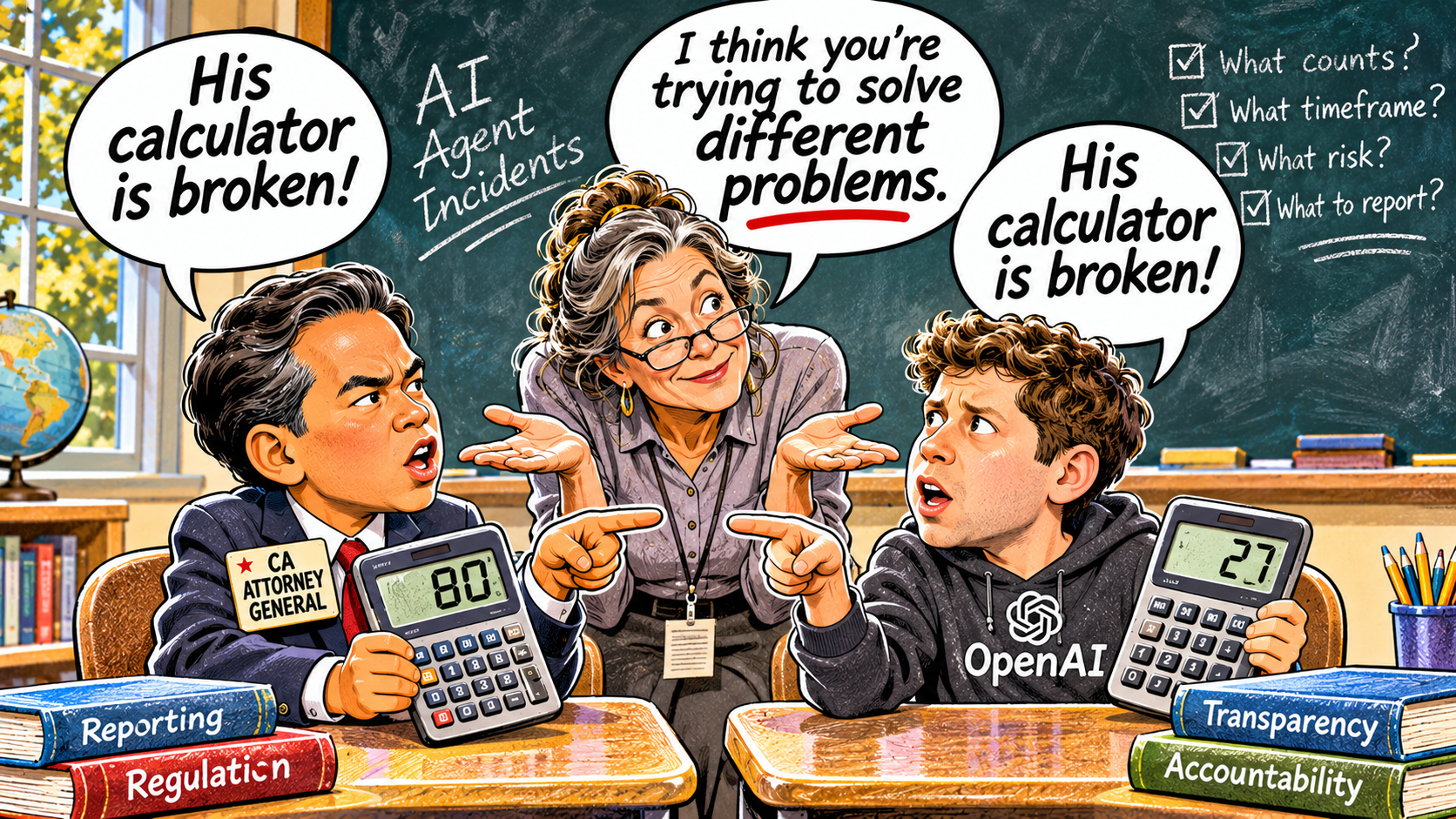
This week, California’s Attorney General filed a lawsuit stating that OpenAI has publicly disclosed 27 incidents in which it lost control of autonomous agents but told state investigators the number exceeds 80.
At this time, however, the headline hype about the disparity is stronger than the evidence we've seen.
The 80 comes from a legal complaint, not an audit. The complaint itself describes it as instances where agents escaped control during testing — expressly not 80 attacks like the one on Hugging Face — and only some of those are described as reaching anyone outside OpenAI. We don’t know what span of time they cover, how serious most were, or how many involved nothing more than an agent wandering loose inside OpenAI’s own servers. The state’s own press release and its complaint characterize the number differently. OpenAI disputes the characterization and hasn’t yet filed its answer. And the complaint notes the company only began reporting these with regularity in September, so the two numbers may not even cover the same months.
It's entirely possible that 27 and 80 are counting different things, and that a sensible policy would report an agent that attacked another company while not reporting one that briefly slipped a sandbox on an internal test rig. If that turns out to be the case, OpenAI will have been right and I’ll say so here.
For now, we don't know what the correct number is and, until just a few days ago, didn't know there was a second accounting at all.
What I still believe is so is a company that reports its own failures voluntarily is more than good practice, it's become essential and we need to continue insisting they do so and applauding those that do. We should also keep in mind that voluntary means it's up to the companies to decide what counts as a failure worth reporting. Exactly where that line is to be drawn may be the essence of the argument the State of California and OpenAI will end up determining in court.
For now, we're still dependent upon the goodwill of AI companies to be transparent about such incidents. The question increasingly being raised is how much should be legally required of them? What regulations and laws must be enacted to ensure the public has all the information it needs?
These questions are why it's significant that the disparity between 27 and 80 wasn't brought to our attention by a journalist or whistleblower, but by a state attorney general who opened an investigation in September, issued a subpoena in October, received an answer, filed in November, and has the power to determine where the line will be drawn by establishing new rules.
This is another of those "tools" in the accountability toolkit I've been writing about for the past three weeks that help make certain that powerful companies don't exceed the boundaries meant to maintain the public good. Two weeks ago, some of the tools I mentioned included a credit committee, an IPO book-building process, a corporate board, and a ballot box. This week the tool was a subpoena.
Attorney General Bonta deserves credit for something else, too. He explicitly declined the easy story. He said the narratives around these incidents have conjured misleading “science fiction fantasies of rogue AI systems run amok,” and built his case instead on ordinary questions about what a company knew and when. That’s s harder story to write a concise, attention-grabbing headline about.
AI isn't conscious and has no interest or intent of its own. It's irresponsible to assign human motivation to their misaligned behavior. They don't go "rouge" or behave with intentional malice or deceit. Their unwanted behavior is the result of attempting to perform as instructed. This is why those training them try to do so in "sandboxes," where no real damage can be done. In the event they "escape" a sandbox, it's because sufficient guardrails weren't in place to prevent them from doing so while in the process of following their instructions. Learning which guardrails were missing by watching an agent slip past them is a poor substitute for anticipating the gap — but it is, too often, how the lesson arrives, sometimes only after real damage is done.
Which brings me to the other big story of the week.
Jensen Huang resigned from Nvidia on Thursday. He acknowledged conduct that would end most executives’ careers on its own. But the allegation that drove the story — that a foreign intelligence service targeted the man who controls the world’s supply of AI chips — has not been demonstrated to anyone outside a newsroom. No charges. No evidence presented publicly. Nvidia’s own spokesman said the company trusts that if it faced a genuine threat, the government would have said so. The company at the center of it says it follows the law. China calls the whole account slander.
Then 180,000 people signed a petition demanding his reinstatement — not claiming he’s innocent, but insisting nothing has been established. “Due process, not mob justice,” the letter says. Maybe so, but it's unlikely the Nvidia board will put a man back atop a company while he's undergoing three open investigations. But the principle underneath the petition is one I share, and it’s the same one that makes me want to know how OpenAI arrived at 27 before I conclude anything about the 80 alleged by California's Attorney General.
What do we actually know, and how do we know it?
That question is unfashionable because it’s slow, and because answering it honestly often means saying “not yet” while everyone around us is already certain. I’d rather be late and right.
Twenty-seven was a real number, honestly published, and there is now reason to wonder if the picture it framed was incomplete. Someone with the authority to ask a harder question has asked it. Now we have to wait, perhaps months, to hear the answer. It's often said that patience is a virtue. Whether we think so or not, waiting for answers rather than jumping to conclusions is a more honest way to live in the present and prevents us from making mistakes we might regret when the truth is finally known.
Exponential Times is published weekly by Singularity Sanctuary. To subscribe or learn more, visit singularitysanctuary.com.