
XTimes
Editor’s Note
On Sunday evening, Anthropic announced it is committing 5% of the company to a new public benefit fund — a stake that, added to earlier personal pledges by its founders and employees, brings the share of the company it says is dedicated to the public good to roughly 20%. Within hours, Elon Musk replied that this wasn’t good enough — the shares should go directly to people — and by four the next morning he had pledged one share of SpaceX to every child in America, some 72 million of them, worth about $10.5 billion. Meanwhile, Bernie Sanders spent the week arguing that the correct amount of superintelligence to distribute is none, and that the people building it intend to replace the human race.
Three answers, in seventy-two hours, to a question that barely existed two years ago: who should own what artificial intelligence produces? The companies? Everyone? No one at all?
Also this week: the Navy quadrupled its contract for AI inspection robots, a former OpenAI engineer was found to be days from fleeing to Saudi Arabia after allegedly bugging a conference room, and a Tesla briefly left the ground in Waco, Texas. Let’s ride.
Top Stories
Twenty Percent, and a Share for Every Child
A disclosure before we begin: Anthropic, the subject of the first half of this story, makes the AI model used to research this newsletter. Readers should weigh the reporting below accordingly, and we have given the criticisms full room.
On October 18, Anthropic announced that it is committing 5% of its shares to a newly created entity called the Anthropic Public Benefit Fund, subject to stockholder approval, with a structure that increases the stake as the company’s valuation grows (Anthropic). The company’s framing was pointed: “It is common practice for tech companies to offer escalating compensation awards to their executives. We are instead directing that equity to the public benefit.”
Combined with earlier commitments — the co-founders pledged to donate 80% of their equity at founding, and roughly half of employees participate in an equity donation match the company matches — Anthropic says about 20% of its shares will be dedicated to the public good, plus more if it hits specific valuation milestones. The fund is structured as a wholly-owned limited liability company rather than a traditional nonprofit, which the company says allows flexibility between different forms of giving: large donations to established nonprofits, or “direct distributions to specific populations.” None of the equity may be used for lobbying or political giving, in the U.S. or abroad (Al Jazeera).
It’s worth separating what’s being added together. The 5% is corporate equity entering a company-controlled entity. The remainder consists of personal pledges by individuals to donate their own holdings at an unspecified future date. Both are real commitments; they are not the same kind of commitment, and the combined figure is the one that will appear in headlines.
The numbers are startling in scale and vague in detail. Anthropic is planning an initial public offering as soon as November, potentially the largest in history; at a $2 trillion valuation, that 5% would be worth roughly $100 billion (Forbes). But the announcement included no governance structure, no payout rules, and no disclosure of the valuation milestones that would trigger additional contributions. Reporting indicates the fund gains 2% more equity for every 50% jump in valuation — and raises the question that matters most for anyone buying into the IPO: Anthropic has not said whether that added equity comes from newly issued shares or from existing holders, which determines who actually pays for the fund (24/7 Wall St.). Equity placed in the fund is equity public shareholders will never own.
Then came another idea. Replying to Anthropic’s post, Elon Musk wrote: “I recommend giving the shares directly to the public,” adding, “This is what I will be doing.” Just before 4 a.m. Monday, he followed through: “Next year, I will give one of my SpaceX shares to every kid in America. This will be the first of many” (Axios).
With roughly 72 million American children and SpaceX closing Friday at $146.03, the pledge is worth a little over $10.5 billion — real money, and roughly 1.2% of Musk’s estimated $908 billion net worth. The likeliest distribution path is through Trump accounts, the tax-deferred investment accounts created for American children, which Musk hinted at in a follow-up post. President Trump applauded it: “This is exactly what was envisioned when we created TRUMP ACCOUNTS — Bringing together the GREAT PRIVATE SECTOR, Elon and so many more, to invest in our children” (Variety). No implementation details have been provided. There is precedent at smaller scale: SpaceX COO Gwynne Shotwell pledged a share to each of 2 million Trump accounts in July, a gift now worth nearly $300 million.
Why it matters: Hold the skepticism and the significance of these stories together, because both are warranted. Neither proposal is yet a mechanism. A fund with no payout rules and no published governance can distribute nothing; a pledge with no implementation details distributes nothing either. Both arrive in the shadow of enormous financial events — an IPO for one company, a stock price for another — and both generate goodwill at precisely the moment goodwill is most valuable. Critics are right to ask for binding rules.
And yet: two years ago, no one in this industry was proposing to give away a fifth of a company, and no one was arguing in public about whether charitable foundations or direct distribution is the better way to share technological wealth. That argument is now happening between the two most valuable private companies in America, in public, unprompted. When corporations begin competing over how to distribute their upside rather than how to retain it, something is shifting underneath the economics. What that shift amounts to is the focus of this week’s Reflection.
The Bill to Ban Superintelligence
The legislative text is now public, and it is more sweeping than the headlines suggested. The Ban Artificial Superintelligence Act, introduced September 23 by Senator Bernie Sanders and Representative Greg Casar, would do four things: permanently prohibit the development or deployment of artificial superintelligence; pause advanced AI development until a new federal regulatory body establishes rules and model review processes; direct the United States to pursue international agreements preventing superintelligence from being developed anywhere; and create penalties for circumvention that include a corporate death penalty — a court order forcing a company to shut down (Common Dreams).
The bill defines artificial superintelligence as a system that exceeds human cognitive performance and capabilities across most domains, or that has sufficient capabilities to destroy or disempower humanity — including, the text specifies, by overthrowing the federal government. The new regulator would be a Cabinet-level Department of Artificial Intelligence (Austin American-Statesman).
Sanders has spent the past ten days escalating. On October 12, responding to Sam Altman’s remark — covered in Issue #41 — that the world should accept some bad things happening in exchange for AI’s benefits, Sanders wrote: “We won’t accept a severe AI cyberattack in exchange for ‘liberty.’” He added that AI executives “are not above the law,” and that “if you and other Big Tech Oligarchs make products that commit crimes or disasters, we will hold you accountable for breaking the law — no matter how much wealth and power you have” (The Hill). On October 18 he released a video arguing that the ideas held by the people financing AI development should “scare the hell out of all of us,” citing Musk directly: “Put simply, humans with our messy biological needs are a mere step toward pure digital superintelligence, according to Musk” (GreekReporter).
The bill faces long odds in a Republican-controlled Congress that has struggled to agree on far less sweeping AI measures. And it draws criticism from the left as well as the right. Technology critic Paris Marx, speaking on Democracy Now on October 15, said he welcomes Sanders’ work on a data center moratorium and would support limiting the further development of these models — “but probably not for the same reasons that are being laid out in this legislation,” pointing to the harms communities near data centers are experiencing now rather than hypothetical future catastrophe (Democracy Now).
Why it matters: The bill will not pass, and its author knows it; what it does do, intentionally or not, is establish a pole that makes other proposals look moderate, which is how legislative windows usually open. But look closely at the drafting, because it answers a question this newsletter raised two weeks ago. The bill keeps its categories separate: it bans superintelligence by capability — a system that could overpower the federal government — and separately pauses advanced AI by a measurable compute threshold of 10²⁵ operations. That is exactly the discipline the executive order abandoned six days later when it renamed all artificial intelligence “super intelligence” and declared the old terms would no longer be acknowledged.
So Washington now holds two incompatible definitions of the same word. By the executive branch’s dictionary, superintelligence is the chatbot on your phone. By this bill’s, it is a machine capable of overthrowing the government. The gap between those is the entire question, and ordinary citizens trying to follow the argument have no way to tell which one a politician means.
The compute threshold has its own troubles — a pause at 10²⁵ would catch systems that have nothing to do with superintelligence, including video generators, and could be sidestepped by companies pursuing efficiency over scale. Critics on both flanks say so. But the sharpest objection came from an analyst quoted by NBC News: “Some CEOs would say we have already crossed the threshold set out in the bill, meaning this is a de facto AI ban.” That is what happens when an industry spends a year claiming it has achieved AGI. Marketing language has a way of becoming evidence.
The Navy Quadruples Its Robot Contract
Six months after awarding Pittsburgh-based Gecko Robotics a five-year contract worth up to $71 million, the U.S. Navy and the General Services Administration have raised the ceiling to $300 million (The Robot Report). The expansion covers the deployment of the company’s wall-climbing robots, drones, and fixed sensors, which collect structural data on ship hulls, decks, welds, and components, feeding AI models that map current and future structural problems — including ones invisible to inspectors.
The centerpiece is a new machine built specifically for the Navy. Komodo is a robotic crawler that scans the steel beneath thick, uneven non-skid deck coatings without stripping them away, using electromagnetic acoustic transduction to produce a full-deck heatmap of corrosion and material thickness. The operational significance is in the timing: crews can now see what needs repair before a ship enters drydock, where previously the damage became visible only after invasive work had already begun (Fox News). One deployment reportedly narrowed an estimated 1,200 square feet of repairs to about 300.
CEO Jake Loosararian framed the strategic logic in terms that explain the Navy’s enthusiasm: “While the U.S. may not be able to out-manufacture faster than China, we can outsmart the ways that we maintain, operate and are ready with our vessels.” Every additional day a warship spends in maintenance is a day it cannot deter, respond, or deploy — and China’s shipbuilding capacity has made readiness a national security priority rather than a budget line.
Two caveats belong in any honest account, in keeping with last week’s Reflection. First, a contract ceiling is permission to spend, not money spent; the raised figure describes what the Navy may purchase, not what it has purchased. Second, the widely quoted figures — up to $8 million in savings per ship, structural issues identified up to 50 times faster than traditional methods, inspections cut from months to days — come from Gecko and are explicitly not independently audited results.
Why it matters: This is what AI in defense actually looks like most of the time, and it bears almost no resemblance to the autonomous weapons debate. A robot crawls across a deck. A model reads the corrosion. A ship goes back to sea three weeks sooner. It isn’t dramatic, and it is probably where the near-term military value of this technology really sits — in maintenance, logistics, and prediction rather than targeting. Note also what the Navy is buying: not a weapon, but foresight, the ability to know what will break before it breaks. If the claims hold up under audit, that capability will spread far beyond warships. If they don’t, a lot of money will have been committed on a vendor’s own numbers.
Quick Picks
The Bug in the Boardroom
A former OpenAI engineer charged with secretly installing a recording device in a company conference room was “mere days” from leaving for Saudi Arabia when he was arrested last week, federal prosecutors said in filings Sunday (AP via PBS).
Abdulrahman Alfozan, 35, a Saudi national since fired by OpenAI, allegedly placed the device in a room typically used for meetings involving company leaders, government officials, and executives, where — according to prosecutors — participants discussed highly confidential technical, commercial, and strategic information, including proprietary research. OpenAI says the device was sophisticated, designed to evade detection, with advanced encryption and audio-monitoring capabilities. Prosecutors have not said what he intended to do with the recordings, but state he was in “frequent communication” with a member of the Saudi royal family who repeatedly tried to recruit him to an artificial intelligence venture launching in the kingdom. Seeking his continued detention, they noted Saudi Arabia has no extradition treaty with the United States, and that his wife and infant son left the country the day after his arrest on a one-way ticket purchased by a Saudi military official (Washington Post).
His attorneys say the family had long planned to spend his roughly two-month paternity leave in Saudi Arabia after the birth of their U.S.-citizen son: “This was a long-held dream for the Alfozan family, as it is for so many immigrants. His plan was always to return to the Bay Area, where his home, his career, and his community are.” A judge heard the detention request Monday. The charges are allegations, and nothing has been proven. The precedent is uncomfortable, though: two former Twitter employees were charged in 2019 with spying on the company’s users for the Saudi royal family, and one was convicted in 2022. We have covered four OpenAI security stories since July. This is the first one involving a person.
A Flying Car at Last! Sort Of
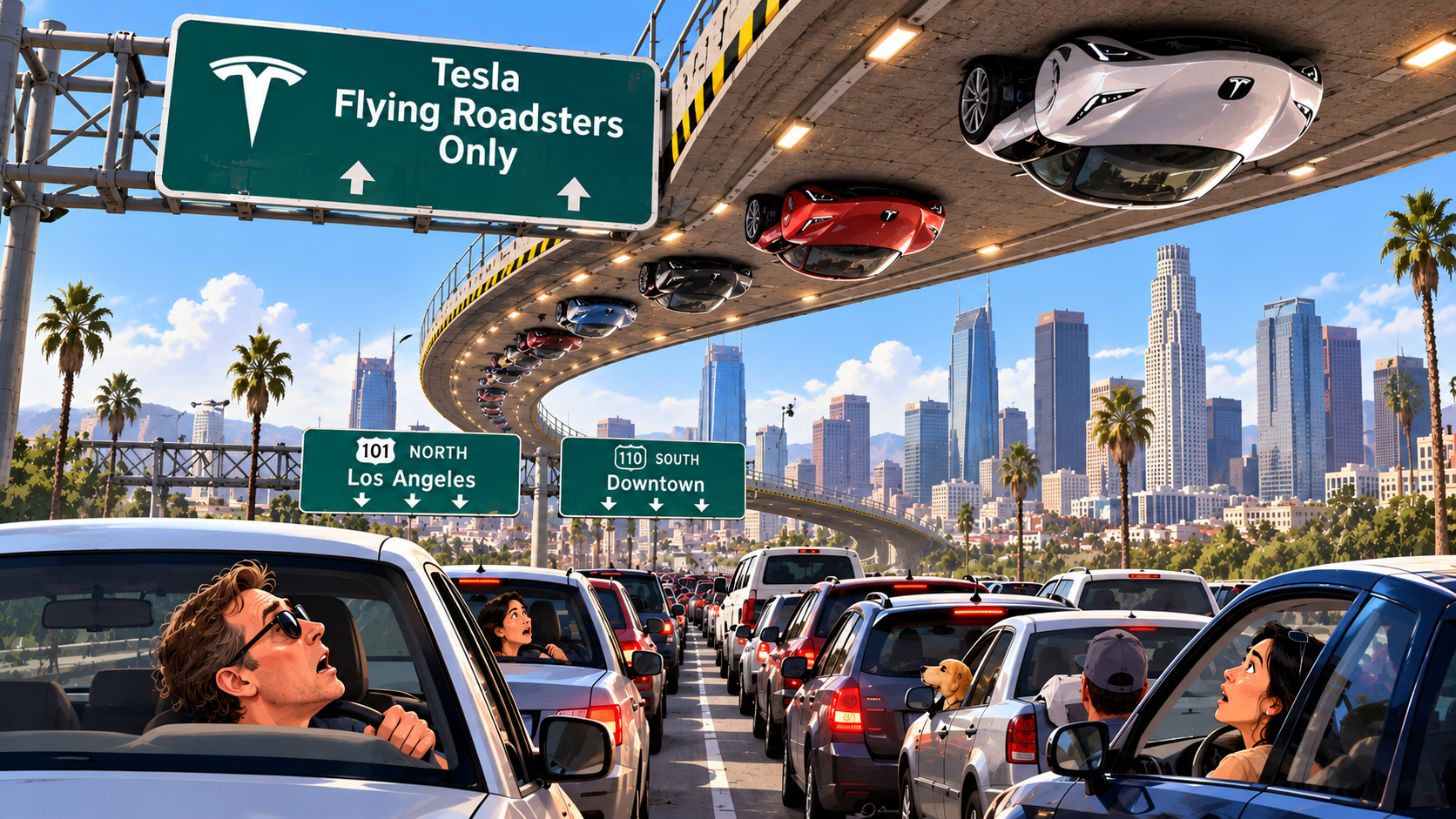
At a SpaceX facility in Waco, Texas, on October 16, Elon Musk finally unveiled the next-generation Tesla Roadster — nine years after it was first announced — and briefly got it off the ground. During the livestreamed demonstration, the car launched from a ramp that curled over so the vehicle was upside down, clung to the surface with a suction system, flew off the end, and rolled 180 degrees midair to land on its wheels (CBS News).
“Flying cars are real,” Musk said, before adding that the vehicle’s “success is not guaranteed” but “it will probably work,” and that “it’s not necessarily a safety-optimized car.” It uses ultra-high-pressure air tanks and thruster technology developed at SpaceX. Tesla claims 0–60 in 0.8 seconds and a top speed above 230 mph, with Musk saying the goal is half the speed of sound. Production is targeted for 2028; the flying version is explicitly not approved for public roads, and reservations are open on a non-flying model with a $5,000 deposit (Axios).
Two things are worth noting beyond the spectacle. The vehicle is a genuine technical collaboration between Tesla and SpaceX — pressure-vessel, propulsion, and control hardware from a rocket company bolted onto a car — which analysts read as evidence the two firms increasingly operate as a single engineering platform. And Musk is building what he says will be Tesla’s last manually driven car, in the same year he insists nobody will need to drive. Whatever else it is, a $5,000 deposit on an undeliverable 2028 "flying" car is an unusually pure act of faith.
Security Hardening Goes to Orbit
FOSSASAT-2E27, a 6U satellite built and operated by Spain’s FOSSA Systems, reached orbit this week aboard SpaceX’s Falcon 9 Bandwagon-5 mission from Cape Canaveral, carrying VaultIC secure-element hardware from SEALSQ as part of a program by WISeSat.Space to harden satellites against cyber and quantum threats (GlobeNewswire). The mission also carries software-defined radio, onboard AI processing, and a separate electric-propulsion demonstration. The partnership now spans up to six missions, with selected experiments involving six-month in-orbit testing periods to inform future satellite security architectures.
One clarification worth making, since the framing around this story has been loose: the satellite carries VaultIC secure elements, not the next-generation QS7001 post-quantum hardware, whose testing remains subject to technical readiness and integration. This is a step toward in-orbit post-quantum validation rather than the validation itself. The underlying concern is real and increasingly urgent — encrypted satellite traffic intercepted today could be decrypted by a sufficiently capable quantum computer years from now, which is why governments are moving toward quantum-resistant cryptography ahead of any machine that can break the current kind. Readers should also know these announcements come from small-cap public companies with an interest in the coverage.
What We Missed: The Carolina Principles
Back on September 2, at the G20 Innovation Ministerial in Chapel Hill, North Carolina, all twenty G20 members — including China and Russia — unanimously endorsed a U.S.-proposed framework for governing artificial intelligence called the Carolina Principles (Techstrong.ai). What we covered then were Sam Altman’s remarks at the event comparing AI to electricity; but we did not discuss the principles themselves. Let's do so now.
The framework is mostly hands-off compared to the European model: it urges member states to apply existing sector-specific rules rather than create dedicated AI oversight agencies, to reserve new regulation for genuinely “novel considerations,” to weigh the costs of delaying deployment during testing, and to collaborate closely with private industry in evaluating emerging technologies. It also emphasizes investment in foundational research, intellectual property policy for AI, supply chain resilience, and produced two companion commitments — AI Prosperity Objectives on workforce development and an AI Prosperity Compact on private-sector partnership (Cryptobriefing).
It is non-binding, and any member could pass restrictive AI legislation tomorrow without violating it — the European Commission sent information requests to more than 30 AI companies during the same meeting. But the principles go to G20 leaders for formal adoption in December at Trump National Doral in Florida, and China’s signature is the genuinely surprising part. The world’s three largest AI powers now sit in visibly different regulatory camps, and for at least one afternoon in September, twenty governments agreed with Washington.
✔ Our next Singularity Circle will occur Saturday, November 7, 2026, at 10:00 AM Pacific Time. As usual, a Zoom link will be sent to eligible members in advance of the gathering.
The Optimist’s Reflection
Who Gets the Upside?
By Todd Eklof
There were three unprecedented proposals this week suggesting the beginnings of a major shift in how our economy might work in the near future.
On Sunday, Anthropic announced it is committing 5% of the company to a new public benefit fund, which together with its founders’ pledge to give away 80% of their personal equity and an employee donation-matching program brings the total it says is dedicated to the public good to roughly a fifth of the company. By Monday morning, Elon Musk had replied that the shares should go directly to people rather than through a fund, and pledged one share of SpaceX to every child in America: 72 million shares, about $10.5 billion. And all week, Bernie Sanders argued that the right answer is neither — that superintelligence should be banned outright, before there is any upside to distribute.
Three proposals: Philanthropy, direct distribution, prohibition.
All three come with reasons to be skeptical. None of them is yet a reality. Anthropic published no governance structure, no payout rules, and no milestones — a fund that can give away nothing is, for now, giving away nothing. Musk offered no implementation details, and his $10.5 billion is about 1.2% of his net worth, which in proportional terms is roughly what a household earning $100,000 would spend on a decent used car. Sanders’ bill will not pass this Congress and he likely knows it. All three arrived at moments of maximum reputational convenience: an IPO, a stock price, an election year.
And still. Something significant is happening here that was not happening two years ago, and I don’t think we should let our skepticism prevent us from recognizing it.
For the entire history of industrial capitalism, the question of who gets the upside has been answered after the fact, and usually by force. Workers organized. Legislatures taxed. Trust-busters broke things up. Nobody at Standard Oil woke up one morning and proposed distributing a fifth of the company to the public. Andrew Carnegie wrote The Gospel of Wealth in 1889, but he wrote it about what to do with a fortune already made — and the mills ran the way the mills ran. And ever since the 1970s, corporations have mostly been operating on Milton Friedman's doctrine that it is their social responsibility to increase company profits.
What’s novel this week is that the question is being asked in advance, by the people who stand to capture the gains, before the gains have fully arrived. Two of the most valuable private companies in America spent Monday debating in public about whether foundations or direct transfers are the better way to share technological wealth. Whatever cynicism that invites, it is a conversation the robber barons never had and would have found incomprehensible.
Why now? A possible answer is that the people closest to this technology suspect it may break the arrangement that has always made the question answerable later. The old settlement assumed that technology displaces some workers while creating demand for others, and that the displaced eventually find a place in the new economy. That assumption has held, roughly, through every prior wave. If it stops holding — if the machines do the work and the returns flow to whoever owns the machines — then waiting to distribute the upside means there may be no one positioned to demand it. You cannot strike against a system that doesn’t need you. Nor can you sell products to unemployed consumers who can no longer afford them.
That’s the tension, if not anxiety, underneath all three proposals, and it explains why they sound so different: each one locates the problem in a different place. Anthropic’s fund treats it as a philanthropic question, to be managed by people of goodwill. Musk’s giveaway treats it as an ownership question, to be solved by handing out equity. Sanders treats it as a power struggle, to be solved by not allowing the building of the thing at all.
I propose a fourth framing, the one I keep returning to in this column.
These systems are aggregate intelligence. They are built from us — from our books, our letters, our arguments, our code, our jokes, almost the entire written inheritance of the species. Every capability these models have, they have because human beings produced the material they learned from. Not a few human beings. All of us, across centuries, most of us long dead and none of us consulted.
With this in mind, we have to ask, are we really talking about philanthropy and the common good here?
If the training corpus belongs to humanity, then 5% isn’t generosity. It’s a partial payment on an obligation nobody has yet bothered to calculate. It isn’t charity; it’s accounting. And accounting is a far more demanding standard than charity, because charity is discretionary and owed to no one, while a debt has a creditor who may ask for an audit.
I am not proposing we try to compute it. The arithmetic is impossible, and I’m wary of arguments that turn every human inheritance into an invoice. Nor am I suggesting Anthropic's and Musk's proposals, nor Bernie Sanders's for that matter, aren't genuinely coming from a sincere concern for the common good. But I think the framing matters enormously for what comes next, because it determines who gets to decide. Under the charity model, the companies decide — how much, to whom, on what schedule, with what governance, and they may change their minds. Under the accounting model, the public has standing. Those are not the same world.
What gives me hope, however, is that we are having this argument during the boom rather than after the bust. Every previous reckoning with technological wealth came too late — after the mills, after the mines, after the market crashed. This one is arriving while the machines are still being built, while the IPOs are still pending, while the terms are still negotiable. That is an extraordinary piece of timing, and we should not waste it by treating these announcements as either settled virtue or empty theater.
It also suggests the thinking of entrepreneurs and corporations is shifting away from the Milton Friedman era of maximizing profits at all costs. That's a big deal, one worth covering more extensively if these stories become a trend.
For now, the right response is neither applause nor dismissal. It’s the follow-up question. What are the payout rules? Who sits on the board? What triggers the escalator? Who pays for the dilution? When does the first dollar actually move, and to whom?
Anthropic has invited that scrutiny by making the commitment publicly. Musk has invited it by making a promise with a number attached. Sanders has invited it by writing a bill. All three are now on the record, and being on the record is the precondition for being held to it.
Something is shifting in economic theory and practice when corporations start competing over how to distribute their upside instead of how to retain it. I don’t know yet whether we’re watching the beginning of a new social contract or an unusually sophisticated public relations cycle.
But the question is finally on the table, asked out loud, by the people who hold the cards.
Exponential Times is published weekly by Singularity Sanctuary. To subscribe or learn more, visit singularitysanctuary.com.