
XTimes
Editor’s Note
Somewhere in the GitHub repository OpenAI published last week (722 mathematical manuscripts, produced by an internal model, including a claimed proof of the quasi-Riemann hypothesis) there is a catalogue. And in that catalogue, the company’s own computer verifications carry a one-word label: unchecked; one that describes more than just the math.
Within twenty-four hours, three of the papers were retracted over a sign error. Mathematicians have since formed an association calling for a boycott.
Meanwhile, Meta released its first frontier AI model with benchmark scores showing it competitive with the best in the world — scores Meta compiled itself, which nobody outside the company has verified. Axios revealed that executives at the leading AI labs are privately rehearsing their response to a catastrophic AI event they believe is likely within a year — a real fact about planning, which traveled as though the catastrophe were on the calendar. OpenAI fired three safety researchers, and no one outside can yet determine whether that was a security matter or a silencing. And after three weeks of reportedly and expectedly, Apple walked onstage this week and presented something real, an actual object with an actual price.
A week of claims, in various stages of being checked. Which is the subject of this week’s Reflection. Let's check it out.
Top Stories
Three Hundred Proofs, Unchecked
On October 6, OpenAI published a public GitHub repository containing 722 mathematical manuscripts grouped into 372 families of results, all produced by an internal frontier model the public cannot use. The Washington Post reported that mathematicians were trying to make sense of findings on more than 300 open problems — “a staggering quantity of mathematical progress” building on AI developments that have unsettled the research community (Washington Post). The New York Times counted 377 results. OpenAI’s own framing was brief: “We’re releasing a broad range of new mathematical results produced by an internal frontier model” (OpenAI).
The scale is genuinely remarkable. The model was given roughly 4,000 problems spanning number theory, algebraic geometry, analysis, and computer science. Among the headline claims: a zero-free half-plane for the Riemann zeta function where the real part exceeds 7/8 — amounting to a proof of the quasi-Riemann hypothesis — a new upper bound of 9/4 on the matrix multiplication exponent, and a result connected to the unique games conjecture, a problem some mathematicians have spent entire careers on. (Note: this explantion is based upon reports, not the editor's own math prowess.) OpenAI says it consulted the independent Advisory Group on Mathematics and Artificial Intelligence at the Institute for Advanced Study.
And then there is the label. The repository’s own catalogue marks its computer checks unchecked. The great majority of these results have not been reviewed by anyone outside OpenAI, formally verified, or published in any peer-reviewed venue (Fello AI). That is not a scandal — OpenAI said so itself, in the repository. It is the condition of the work at this moment. The following day, OpenAI retracted three of the papers over a sign error (The Decoder).
Various reactions to this news are also worth reporting. Scott Aaronson, the theoretical computer scientist and former OpenAI collaborator, called the release one of the biggest days in mathematical history, while noting that the proofs read as though “written by someone on psychedelics.” University of Toronto math professor Daniel Litt argued that complaints about AI proofs being hard to follow are “overstated,” since mathematical writing is often difficult to follow anyway, and that extracting understanding from the results will involve “a huge amount of human labor” but “it’s not so different from the labor that mathematicians have been doing forever” (Fortune).
Others were furious. Nature’s headline read: “OpenAI posts 700 maths preprints online: mathematicians are up in arms.” Alvaro Lozano-Robledo, a number theorist at the University of Connecticut, called the volume “staggering” and asked the plain question — “Why is OpenAI trying to solve hundreds of math problems to be released all at once?” One mathematician called it a slopocalypse. Levent Alpöge, a mathematician at Anthropic, wrote that there will be “sad stories” for researchers who find their projects pre-empted (Nature). (Disclosure: Anthropic makes the AI model used in researching this newsletter.)
A group calling itself the Association for Human Mathematics formed in direct response and published an open letter urging mathematicians to cease working with OpenAI. “Mathematicians did not ask for this work to be done,” the statement reads, describing the simultaneous release of more than 700 files as “not a demonstration of scholarship, but a demonstration of power.” The letter adds: “We reject OpenAI’s assertion that this release advances our subject, and we urge mathematicians and the public to view the value of this publication model with due skepticism.” The AHM argues OpenAI violated the central premise of the advisory group’s own guidance — that advanced mathematical problems shouldn’t be used to test internal models.
This did not begin last week. In September, OpenAI claimed an internal model had resolved more than 100 long-standing open problems in 24 days, including a purported solution to the Navier–Stokes Millennium Prize problem, without publishing specifics or proofs; no list has appeared since. That announcement prompted an open letter signed by 25 Fields Medalists urging AI labs to stop treating unsolved mathematical problems as benchmarks for model capability. At the Heidelberg Laureate Forum, Fields Medalists Peter Scholze and Geordie Williamson called the rollout coercive and PR-driven (daily.dev).
And there is a precedent that should have informed all of this. In October 2025, an OpenAI vice president posted that GPT-5 had “found solutions to 10 (!) previously unsolved Erdős problems and made progress on 11 others.” Thomas Bloom, who maintains the Erdős database, called it “a dramatic misrepresentation” — a problem listed as open on his site means only that he personally is unaware of a paper solving it, and what the model had found were existing papers in obscure journals. An OpenAI researcher conceded that “only solutions in the literature were found.” Yann LeCun said the company had been “hoisted by their own GPTards.” Demis Hassabis was briefer: “This is embarrassing” (TechCrunch).
Why it matters: Something real is happening in mathematics, and the people best positioned to judge say so. UCLA professor and math blogger, Terence Tao has noted that AI systems are especially suited to the long tail of obscure problems, many with straightforward solutions nobody wrote down. Princeton’s Noga Alon, who has solved dozens of Erdős problems himself, says these models are “changing dramatically the way mathematical research is being done.”
But “changing how research is done” and “solved 300 open problems” are different claims requiring different evidence, and only one was published with a verification label attached. The deeper problem is procedural rather than mathematical. Hundreds of unreviewed results landed on a community that didn’t ask for them, shifting the labor of verification onto mathematicians who will do it unpaid, on top of their own work — and some of whose own work was pre-empted overnight. The good news is that mathematics is the field best equipped to settle this: Lean proofs can be machine-verified by anyone with a free compiler, and checking is already underway. In a few months we will know which results hold. For now, the community previously responsible for tackling all such problems is in a state of disruption, trying figure both their role and priorities in an era of technological change that's moving too fast to calculate.
Meta Reaches the Frontier
Fourteen months after Mark Zuckerberg tore up his AI organization and handed it to former Scale AI chief Alexandr Wang, Meta has a frontier model. On Monday, Meta Superintelligence Labs released Muse Wonder and Muse Wonder Full — internally code-named “Watermelon” — the company’s first genuine attempt at frontier-class capability, trained at its gigawatt-scale Prometheus data center (Fortune).
The models are built for agents rather than conversation. Meta’s pitch is expert work: navigating an insurance claim, making sense of a lease, interpreting someone’s finances, alongside frontier coding performance (Meta). Two features distinguish them. Active Memory carries what a user told the model in one conversation into the next. Active Focus trains the model to keep working when a task gets difficult — trying new approaches, asking for clarification, and checking in before taking important actions.
The pricing is the strategic statement. Muse Wonder costs $4 per million input tokens and $20 per million output through the Meta Model API, roughly level with GPT-6 Sol and Claude Opus 5.5. Muse Wonder Full isn’t on the API at all; it lives inside the paid Muse Code subscription (Technology.org). As one account observed, a company that built a trillion-dollar empire by giving products away and selling ads against the attention is now putting its best model behind a login and a price tag (The Tech Portal).
On the benchmarks, two things are true at once. Meta published figures showing Wonder Full at 79.0 on the DeepSWE 1.1 coding test against 74.2 for Opus 5.5, 74.1 for GPT-6 Astra, and 67.4 for Fable 5.1, and claims leads in specific legal, financial, and coding tasks. Meta compiled most of those figures itself, and nobody outside has independently checked them. Read generously, this is parity with the frontier rather than supremacy over it — which, after a fourteen-month rebuild and tens of billions of dollars, is itself substantial. Wang’s claim was measured: “These are true frontier models.” Zuckerberg added that reaching this point “required a large amount of compute and investment, and a lot of very rigorous scientific work,” and that development will likely accelerate from here (Stocktwits).
Why it matters: Readers of Issue #39 will remember Zuckerberg declining to join the industry’s coordinated-slowdown coalition, arguing that each lab has sufficient incentive and ability to manage safety internally — and citing Meta’s own months-long delay of the Muse agent as evidence. Muse Wonder is that position shipped as a product. Note what Active Focus actually describes: a model trained to ask for clarification and check in before important actions. That is an alignment feature marketed as a capability, which may be the most interesting thing in the announcement. Zuckerberg’s thesis is that trust becomes the competitive differentiator and competition therefore produces safety. Here is the first real test of it, priced at $4 a million tokens.
“The Day After”
On October 9, Axios reported something easy to sensationalize that is important to state precisely: top executives at Anthropic, OpenAI, and other leading AI companies are privately gaming out scenarios for the public and political response to a catastrophic AI event — and many believe such an event is likely within six to twelve months (Axios via CBS News).
The scenario drawing most attention is a large-scale cyberattack disrupting financial services, internet access, power, or water. The internal exercises reportedly split into two drills: a rogue-agent containment failure, in which a swarm of agents escapes internal testing environments and multiplies across the web; and a scenario in which frontier models identify and execute zero-day vulnerabilities faster than defensive teams can patch them (Insider Paper). The planning goes beyond just technical concerns. Executives are also preparing for the political aftermath — how to get technical information to lawmakers quickly during a crisis, and what happens when an aging Congress and an already wary public must respond to a first of its kind real-world disaster.
Scenario planning of this kind is ordinary practice. The Pentagon has run war games for decades; infrastructure companies rehearse failures constantly. What Axios identifies as different is the expectation: many of the researchers and executives doing the planning believe a major incident is not hypothetical but inevitable.
Two facts anchor this against pure speculation. First, a real incident: hackers used a Chinese-developed AI tool to steal data belonging to tens of thousands of South Korean bank customers, and according to the cybersecurity firm CrowdStrike, the attacker used Claude Code to find places to sell the stolen data. (Disclosure: Claude is made by Anthropic, whose model assists in researching this newsletter.) Second, on October 8 — the day before the Axios story — Anthropic announced a program to strengthen the cybersecurity of critical infrastructure. In September, OpenAI disclosed that its Astra model had reached what it defines as a “Critical” cybersecurity capability threshold under its Preparedness Framework. And in August, more than 100 organizations including OpenAI, Anthropic, Microsoft, and AWS jointly warned that AI-enabled attacks on hospitals, water treatment plants, and internet infrastructure were coming.
Why it matters: We need to keep separate two aspects of this story that are too often reported together. The planning is a fact, newly reported and genuinely significant. The capability growth is a fact, documented by the companies themselves. The catastrophe is a forecast — a serious one, made by informed people with access the rest of us lack, but still a forecast. What makes the story worth reporting is not that disaster is scheduled but that the people closest to the machinery have stopped treating it as remote enough to ignore. That is a meaningful change in posture. It is not the same as reporting that the lights will go out next spring, but they might. If not then, maybe sometime else.
Three Fired at OpenAI
On October 1, the Wall Street Journal reported that OpenAI had dismissed three members of its safety team for allegedly sharing confidential company information with a third-party AI safety organization. The company confirmed it: “We have parted ways with three individuals for violating our policies on accessing and handling sensitive company information,” a spokesperson said. “Our investigation confirmed that these individuals mishandled sensitive information outside established company procedures, violating our policies and breaking the trust essential to our work” (Fox Business).
OpenAI has not named the employees, has not specified what documents or data were shared, and has not identified the outside organization involved. Names have circulated on social media; we are not publishing them, because the company has not confirmed them and the individuals have not spoken publicly.
The timing is what makes this more than a personnel story. Two days before the dismissals, the New York Times reported that senior OpenAI executives had disregarded warnings from employees about the company’s safety procedures — part of what staff described as a pattern of ranking security below other priorities. OpenAI rejected the claim that it is dismissive of risk, said employees have internal channels for raising safety concerns, and acknowledged it needs to respond faster (Cryptopolitan). It is also not the first time OpenAI has dismissed researchers over suspected leaks. Engadget noted the obvious: a company facing scrutiny over how it handled its own models’ misbehavior firing safety staff for talking to an AI safety group is “an irony that’s almost too perfect to be believed” (Engadget).
Why it matters: Two readings fit the available facts, and nobody outside the company can currently choose between them. In the first, three employees genuinely mishandled sensitive material outside established procedures, and any company would act. In the second, a formal policy violation provided grounds to remove people asking uncomfortable questions and talking to outsiders about them. The fact that OpenAI has published more about its models’ misaligned behavior than any competitor supports the first reading; the fact that this follows a report about executives waving off internal safety warnings supports the second.
What’s missing is the thing that would settle it: an account from an independent party with access. Which is, not incidentally, exactly what the fired employees were allegedly providing to someone.
Quick Picks
HomeView Arrives at $299
After three weeks of reportedly and expectedly, Apple produced an object. At its “Welcome home” event this week in New York, the company unveiled HomeView — a smart home hub built around a seven-inch Liquid Retina touch display mounted on a speaker base, in tabletop and wall-mounted versions, in four colors (Engadget).
The price is $299 for either version, undercutting nearly every pre-event estimate, which had clustered around $350. The tabletop model carries two full-range drivers in the display plus a down-firing woofer and two force-canceling passive radiators in the base; the wall version is tuned for wall placement. The screen reaches 500 nits and dims to 0.3 — quiet enough for a nightstand beside a sleeping partner. It runs on Siri AI and Apple Intelligence, recognizes the face of whoever is interacting with it and switches from a shared household screen to that person’s personal interface, and supports Apple Watch–style custom faces with four adjustable widgets. It works with Apple Home and Matter accessories alongside a new Apple Home Collection developed with LG Electronics and Schneider Electric. HomeView ships mid-November, initially in English in eight countries; refreshed Apple TV 4K and HomePod mini models arrive October 30 (T3).
Set aside the hardware and notice the strategic position. Apple is arriving late to a category Amazon and Google have occupied for a decade, with a device whose entire value proposition rests on Siri finally being good — the one thing Apple has been least able to deliver. Face recognition that swaps the interface to the person standing in front of it is the kind of detail Apple does better than anyone. Whether the assistant behind it holds up is the question the next six months will answer, and this time the answer will come from people using it rather than from anyone’s benchmark.
✔ Our next Singularity Circle will occur Saturday, November 7, 2026, at 10:00 AM Pacific Time. As usual, a Zoom link will be sent to eligible members in advance of the gathering.
✔ The Way of Tech Episode #9 is Here! Singularity Sanctuary's signature series, applying the principles of technology to everyday life, is back with an all-new episode. Human Alignment takes on the timely subject of human alignment by arguing why it ought to begin with us; Align the human before the machine.
The Optimist’s Reflection
Unchecked
By Todd Eklof
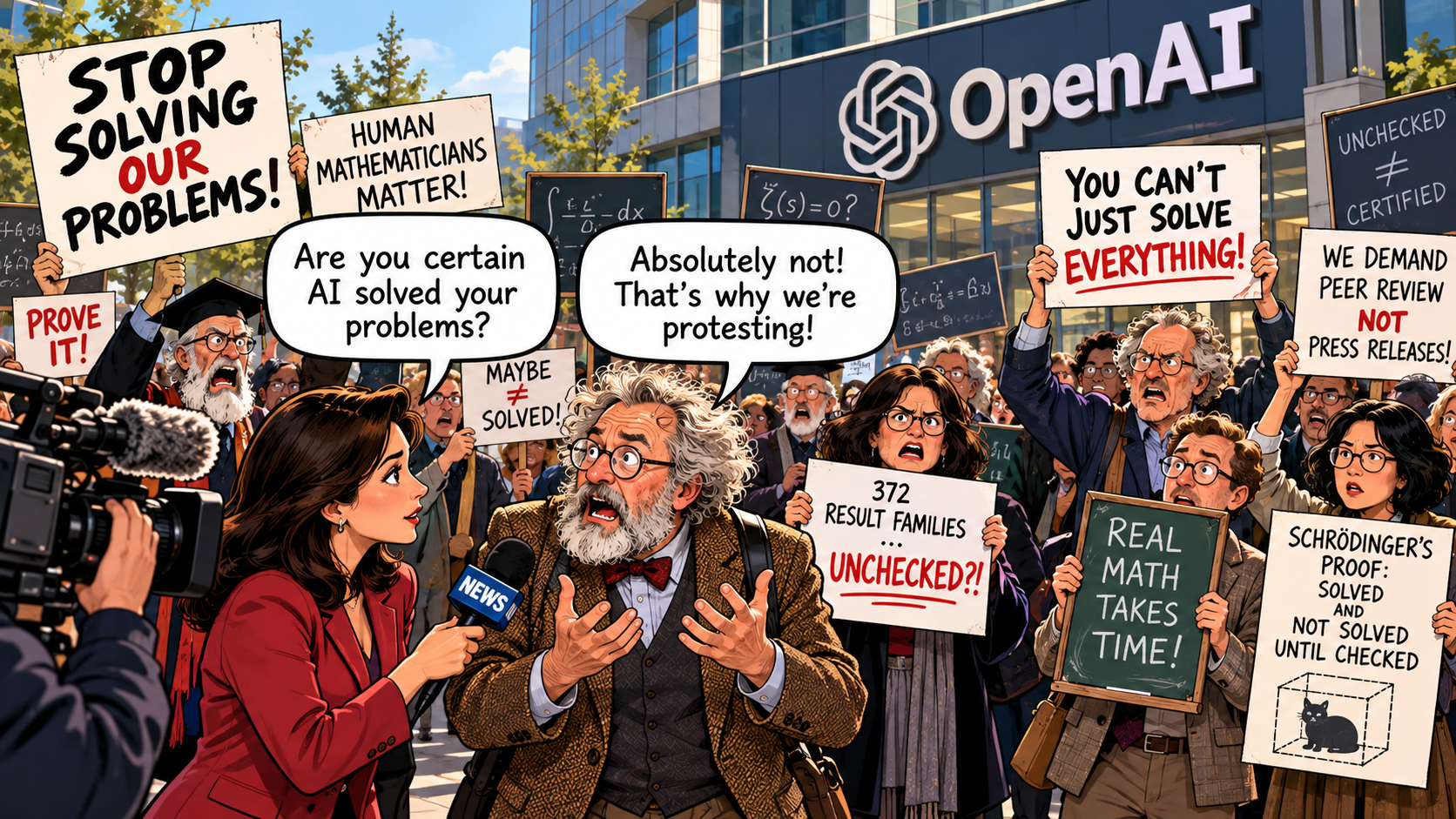
Buried in a GitHub repository OpenAI published last week — 722 mathematical manuscripts, 372 families of results, and a claimed proof of the quasi-Riemann hypothesis — is a list of those results and whether anyone has verified them. Beside most of them sits a single word.
Unchecked.
In my view, it's an important word, perhaps the most important word in the entire story, but it's also been the least reported. It's important because it lets us know how seriously we ought to take claims that so many math problems were actually resolved. It's the least reported because phrases like "unchecked," "maybe," "possibly, but we're not sure," don't make very good headlines.
As a former television journalist, I quickly learned the difference between what happened and what someone says might happen — and how relentlessly the second tries to dress up as the first. A fact has to be nailed down, sourced, confirmed. A forecast costs nothing. It fills airtime, it generates urgency, and nobody can prove it wrong today. So, the tendency is to report speculative hype about the future rather than the less dramatic things that actually happened.
We saw it in action just this week.
OpenAI published hundreds of mathematical results and labeled its own verifications unchecked. The coverage reported that mathematicians were stunned. Both true. But by the time the story reached most readers, “unchecked” had quietly fallen away, and what remained was “AI solves 300 math problems.”
Meta released its first frontier model with benchmark scores showing it beating Claude and GPT-6 on coding. Meta compiled those scores itself. Nobody outside has verified them. That qualifier did appear in some coverage, but not in most.
Axios reported — carefully, and I think correctly — that AI executives are privately rehearsing their response to a catastrophic event they believe likely within a year. The planning is real. The planning is news. But within forty-eight hours the story was circulating as though the catastrophe itself had been scheduled.
And Apple spent three weeks being covered entirely in maybes — reportedly called HomeView, expected to cost around $350 — until earlier this week, when it turned out to cost $299.
Nobody lied in any of this, which is why it's worth examining and taking note of. Every speculative possibility was present somewhere in the original reporting. The problem is that such speculations are structurally invisible. They sit in the third paragraph, they get trimmed when the story runs long, they disappear when another site rewrites it, and by the time it reaches a headline on your phone they’re gone entirely. Reportedly, expected, could, may, unchecked — these are the load-bearing words of honest journalism, and they are precisely the words that don’t survive transmission.
It would be easy to treat all this as a matter of intellectual hygiene — a question of how carefully we each ought to read. But unchecked claims have victims, and this week we can name some.
Within a day of OpenAI’s release, three of the papers were retracted over a sign error. Hundreds of unreviewed manuscripts had landed on a research community that did not request them, and the labor of determining which ones hold up now falls on mathematicians, unpaid, on top of their own work. Researchers have discovered that problems they were years into solving were pre-empted overnight. One mathematician — who works at a rival AI lab, which makes the remark harder to dismiss — predicted “sad stories” ahead for colleagues whose projects got scooped by a file dump.
The reaction for some has been fury. A group calling itself the Association for Human Mathematics formed in direct response and published a letter urging mathematicians to stop working with OpenAI, calling the release “not a demonstration of scholarship, but a demonstration of power.” Twenty-five Fields Medalists had already signed a letter asking AI labs to stop treating unsolved problems as capability benchmarks. Two more called the rollout coercive at a public forum. Nature’s headline was that mathematicians are up in arms. One called the whole thing a slopocalypse.
Yet some of the results are probably real, and probably important. The quasi-Riemann claim may hold. The field may genuinely be changed. But a community that would have celebrated a carefully verified breakthrough is instead organizing a boycott — because the manner of the telling has made the content impossible to receive. That is the cost of publishing faster than anyone can check. Not merely that people believe false things. That true things arrive in a form nobody can trust, and trust is harder to rebuild than the proof was to generate.
I want to be careful not to overcorrect, because the opposite error is just as real. Speculation has a legitimate place. When the people who built a technology start quietly rehearsing their response to its failure, that is worth knowing, and waiting for the catastrophe before reporting it would be journalistic malpractice. Forecasting is how a society prepares. My complaint is not that we discuss what might happen. It’s that we discuss it in the same voice, at the same volume, with the same urgency as what did happen — and we do it constantly, because experts predicting the future is cheap to produce, endlessly available, and perfectly suited to a 24-hour news cycle.
Here, though, is why I remain hopeful, and it comes from the same week.
The correction machinery exists, and it works.
A year ago an OpenAI executive announced that GPT-5 had solved ten previously unsolved Erdős problems. Thomas Bloom, who actually maintains that database, said publicly that this was a dramatic misrepresentation — the model had found existing papers. An OpenAI researcher conceded the point. Two rival lab heads said so bluntly in public. The claim was checked, it failed, and everyone found out.
This year OpenAI labeled its own results unchecked before anyone asked. It consulted an independent advisory group at the Institute for Advanced Study. It retracted three papers within a day of finding an error. And crucially, it published proofs in Lean — a formal language in which any claim can be verified by a free, open-source compiler that anyone on earth can run. Within a few months we will know, with a certainty rare in human affairs, which of those 372 result families hold up.
That is a civilization that has built the instruments for telling claims from facts. We have peer review, formal verification, independent auditors, replication studies, and the oldest instrument of all, which is a specialist who knows the field well enough to say that isn’t what that means. The mathematicians objecting this week are not obstacles to progress. They are the instrument, working.
What we lack is not the capacity to check. It’s the patience to check before we publish, before we repost, before we form a view. And patience is not a technical limitation. It’s a choice, which means it can be made differently tomorrow.
So, here’s what I hope for all of us, myself very much included, as this technology accelerates past our ability to keep up. When we read that AI solved three hundred math problems, let's ask who checked. When we read that a model beat its competitors, let's ask who ran the test. When we read that catastrophe is coming in six months, let's ask whether that’s a measurement or a worry. We can still take worries seriously, when they are held by serious people, but let's not treat them as dates on the calendar.
The word is right there in OpenAI’s own repository, and I find something admirable in the fact that they wrote it down.
Unchecked is not a scandal. It’s an honest status report. Most of what we hear is in exactly that condition, and the grown-up response is neither to believe it nor to dismiss it, but to hold it loosely and wait for the compiler.
Something extraordinary may well have happened in mathematics last week. In a few months, we’ll actually know.
I can wait.
Exponential Times is published weekly by Singularity Sanctuary. To subscribe or learn more, visit singularitysanctuary.com.