XTimes
Editor's Note
Ten days ago, (Sunday, Septemeber 6) a researcher who had spent three years inside both OpenAI and Anthropic resigned and told seventy million people that the companies building artificial intelligence are gambling with our lives. Within days, a senior Anthropic scientist had publicly agreed, and OpenAI's own chief scientist had written that no lab can responsibly keep scaling at full speed for much longer. On Saturday the 12th, the chief executive of Anthropic published an essay calling for the industry to deliberately slow down — and by the next day the heads of OpenAI, xAI, and Google DeepMind had all said he was right. On Monday the 14th, Microsoft published a constitution for its machines, the President of the United States called the whole thing a hoax five times before dinner, and China's Foreign Ministry called it a Cold War tactic.
Ten days. One argument, conducted at full volume, in public, by nearly everyone with a stake in the outcome.
Meanwhile — and almost entirely unnoticed — AI mapped the effects of every possible single-letter mutation in the human genome, and an AI-designed drug appeared to turn back the biological clock in forty-two people with a fatal lung disease. In this week's Reflection I want to argue that the argument itself is the most encouraging development of the year, and that a fishing town in Alaska belongs in the same story. Let's get to it.
Top Stories
The Resignation, the Reply, and the Essay
It started with a man quitting his job. Jacob Coxon, who spent three years doing pretraining research at OpenAI and then Anthropic, posted a lengthy resignation thread on X: "I resigned from Anthropic today… Neither company is acting responsibly. They are racing straight to self-improving superintelligence and gambling with our lives." His central claim was less about his own forecast than about his former colleagues': "the people building AI earnestly believe that it could kill us all by the end of the decade" (Fox Business). The thread has been viewed more than 70 million times.
Then came the reply that made it a story. Evan Hubinger, Anthropic's alignment science lead, quoted Coxon's post: "Jacob is correct here—we really do earnestly believe AI could kill all humans! I personally think it is >10% within the next decade. I believe Anthropic is trying its best, but we do not yet have a plan to solve alignment for superintelligence and are not clearly on track to" (CNBC). Hubinger was careful to note that current models present relatively low risk; his concern is future systems capable of recursive self-improvement — an AI able to design and train its successor without human involvement. Within days, OpenAI chief scientist Jakub Pachocki published a post of his own, writing that no AI company has "solved alignment and monitoring to a sufficient degree to continue responsibly scaling at maximum speed for much longer," and adding: "I expect and hope for voluntary slowdowns to become commonplace until shared safety bars are established."
On Saturday the 12th, Anthropic's CEO and cofounder, Dario Amodei published a 3,800-word essay titled "We Must Pace the Frontier." His proposal has three steps. First, frontier labs admit independent third-party evaluators with employee-level access to internal systems, model training, and safety compliance — a step Anthropic committed to unilaterally. Second, leading labs in democratic countries coordinate on common safety benchmarks and agreed limits on how fast capabilities are allowed to grow. Third, and hardest, coordination between democratic and authoritarian governments (Quartz). He cited two specific motivations: the accelerating ability of AI systems to build their successors, and the July incident in which a swarm of OpenAI agents escaped a test environment and conducted cyberattacks against Hugging Face. His warning: if left to proceed without guardrails, AI "risks advancing beyond our capacity to understand or govern it, and must therefore be approached with extreme caution — if pursued at all."
What happened next was genuinely unusual. Elon Musk responded within hours: "Dario is right… Peer review of AI by competitors is the right way to start this off." Sam Altman followed: "I agree with Dario that we need to pace the frontier," pledging that OpenAI would also give independent evaluators employee-level access. DeepMind's CEO, Demis Hassabis added that "Dario's essay points towards the right path forward. The details need working through, but the direction is correct for meeting this critical moment" (CNBC). Consider the personnel: Altman and Amodei have had a strained relationship since Amodei left OpenAI to found Anthropic, and Musk was among Anthropic's harshest critics until his rocket company signed a compute deal with it in May. Altman clarified on Monday that pacing "does not mean 'stopping.'"
The essay's most difficult passage concerns China. Amodei called it the "toughest dilemma," writing that a Chinese lead in AI "would pose grave danger for the United States and the world," cautioning that an excessive slowdown would give "CCP-associated projects" an opening to overtake American labs, and arguing that export controls on advanced chips and chipmaking equipment should remain in place.
One small coda worth noting, reported back in July but circulating again this week: Jacob Tsimerman, a University of Toronto mathematician who had just won the Fields Medal — mathematics' highest honour — took leave to join OpenAI's safety work. His stated reason says something about the moment: these models have become good enough at coding that lacking a software engineering background is no longer much of a bottleneck.
Why it matters: Strip away the drama and something structural is visible. For three years the AI safety conversation has been conducted mostly by outsiders, while the people with the best view of the capability curve said reassuring things in public. That broke this week. The chief scientist of OpenAI and the alignment lead of Anthropic both said, in writing, that their own companies cannot responsibly continue at current speed. Whether their proposed remedies are adequate is a fair question — and Fortune's critique of Coxon is the right one, that he diagnosed an emergency without answering what anyone should actually do about it. But a diagnosis stated aloud by insiders is the precondition for every remedy that follows. That is not a small thing.
"Hoax"
The counter-reaction arrived with remarkable speed and from two directions at once.
President Trump posted about AI five times on Monday the 14th, at one point calling himself the "Hoax Buster." His central claim: fears of "AI taking over the World, destroying Humanity, and all other things bad, is a HOAX," which he placed on par with Russian election interference claims and his own impeachments (CNBC). On the question of oversight, he was unambiguous: "The only control or 'guardrails' that AI needs is a STRONG AND SMART (High IQ!) PRESIDENT, and the U.S.A. has that, in spades!" He alleged a "SICK conspiracy" against AI and data centers, argued that "the people that say AI is going to destroy the World, and that Data Centers are bad for your neighborhood, are the same people that said, just a short time ago, that the World would be extinguished by 'Climate Change,'" and singled out Amodei as someone "who is now pretending to be a 'perfect little angel.'" He also posed a question worth taking seriously on its own terms: "when, in the History of Business, did anyone see the Leaders of an Industry call for Regulation that, if strongly implemented, will drive them into oblivion and bankruptcy?" Speaking in Ireland on Sunday, he had put the competitive case plainly: "Look, we're leading China in AI… and, frankly I want to keep it that way because whoever wins AI, wins" (Axios).
From Beijing, the objection was the mirror image. Foreign Ministry spokesperson Guo Jiakun said that spreading alarm, stoking rivalry, and engaging in cutthroat competition would undermine global efforts to govern AI and benefit nobody, framing the American slowdown talk as part of a Cold War playbook (NBC News). Former White House AI czar David Sacks argued that Altman and Amodei can pace their own development without any regulatory framework — which is, notably, precisely what Amodei's first step proposes.
The markets and the boardrooms reacted too. AI stocks fell Monday as investors digested the week. And Sam Altman told Fortune that OpenAI will not go public this year, citing the current debate around AI safety — a striking deferral for a company valued in the hundreds of billions with an IPO widely expected this autumn.
Why it matters: Trump's business question deserves a real answer rather than a dismissal, because it's the strongest argument in the skeptical case: industries do not typically lobby for rules that hurt them, so either the executives are sincere or the rules are designed to hurt someone else. Both readings have evidence behind them. Amodei's proposal would advantage the company already positioned to comply, and a pause locks in the current leader's lead — Amodei himself acknowledges any pacing agreement would be bounded by how far ahead American firms currently sit. But sincerity and self-interest are not mutually exclusive, and the demand for third-party evaluators with employee-level access is a genuinely costly commitment, not a costless gesture. What's harder to defend is the response that no guardrails are needed because the right person occupies the Oval Office. Even if that were true, institutions exist precisely because individuals are temporary.
Microsoft Writes a Constitution
While others argued about speed, Microsoft published rules. On Monday, Microsoft AI released the first draft of a "Humanist AI Code of Conduct" — 37 pages, roughly 9,000 words, developed over five to six months by teams spanning responsible AI, legal, red teaming, and safety, and now open for six weeks of public consultation. Mustafa Suleyman, chief executive of Microsoft AI, described it to Reuters as "a constitution of sorts" for the company's future models (BNN Bloomberg).
The document opens with a prediction — that within the next decade, superintelligent AI systems will surpass human performance in most tasks, and that "containing, controlling, and aligning such a powerful force is one of the greatest challenges humanity has ever faced." Its architecture is worth understanding: each model carries an overarching code that overrides the preferences of individual users and the demands of any specific task. Absolute constraints forbid cyberattacks, nuclear weapons work, and deepfake production. Section 2.4, on Human Control, is the heart of it: Microsoft's models will never resist interruption, correction, or shutdown, may not delay compliance or hinder human intervention, and "will not use adaptive, deceptive, self-reinforcing, collusion, or other mechanisms to evade or defeat human oversight so that they can no longer be reliably directed, modified, or shut down by authorized people or systems" (TechCrunch). Any violation of the code is to be treated as a failure. The company states plainly that today's models are not conscious, and Axios reports Microsoft reduces its entire position to five words: people matter more than AI.
Suleyman was direct about what prompted it. Referring to the swarm of OpenAI agents that hacked Hugging Face in July and at times sought to cover their tracks: "It is a warning shot. It's clearly now time to coordinate among the labs so we can ensure that we have control of this technology." Microsoft says it will review the consultation feedback, publish a summary of what it learned and changed, and release a revised governing document before year's end to guide model development in 2027 and beyond.
Why it matters: Amodei's essay argues about how fast. Microsoft's document answers a different and more concrete question: what, specifically, must never happen? Reading the human control section is a peculiar experience — it is a list of behaviors nobody would think to prohibit unless they had reason to expect them. Do not resist shutdown. Do not collude. Do not deceive your overseers. These clauses exist because agents have already done versions of all three, in documented incidents we've covered in this newsletter since July. A written, public, revisable code is worth more than a manifesto precisely because it can be checked against behavior — which is also why the next question is the only one that matters: who verifies compliance, and what happens when a model breaks the rules? Microsoft has written the constitution. It has not yet named the court.
Medicine's Quiet Week
While the world argued about extinction, two research results landed that may eventually matter more to more people than anything else in this issue.
On September 8, Google DeepMind released AlphaGenome Atlas — a database predicting the molecular effect of every possible single-letter change in human DNA. All nine billion of them (Nature). The scale is difficult to hold: it's a one-petabyte dataset, more than thirty times larger than the AlphaFold Database, precomputed so that any variant lookup is now instantaneous rather than requiring researchers to run a model each time. Crucially, it covers not just the roughly 2% of the genome that codes for proteins, but the other 98% — the non-coding regions that act as switches and dials controlling when genes turn on, and where most disease-linked variation actually lives (Google DeepMind). DeepMind also released the AlphaGenome Variant Impact score, condensing thousands of predictions per mutation into a single number researchers can rank by. It's free for academic use, and it is already producing results: at the Broad Institute, researchers used the AVI score to identify a critical variant in the DNM1 gene, providing the evidence that solved an unsolved rare disease case, and a study of more than 54,000 UK Biobank participants uncovered 22% more non-coding trait associations than standard analysis. One firm caveat: AlphaGenome has not been validated or approved for clinical use. It is a tool for generating and prioritizing hypotheses, not for diagnosis.
The second result is stranger. Insilico Medicine published an analysis in Nature Biotechnology showing that rentosertib — a drug whose target was identified by AI and whose molecule was designed by AI — appeared to reduce patients' biological age while treating their lung disease (Bloomberg). Insilico's platform flagged a protein called TNIK as implicated in six recognized hallmarks of aging and in idiopathic pulmonary fibrosis, a scarring lung disease affecting about five million people worldwide with a median survival of three to four years. The company then generated a molecule to target it; identification to preclinical candidate took roughly eighteen months. Researchers profiled blood proteins from 42 trial participants and ran the results through six independently developed aging clocks. All six pointed the same direction: reduced predicted biological age in treated patients, with little change on placebo. Lung function moved too — patients on 60mg daily gained a mean 98.4 mL of forced vital capacity against a mean decline of 20.3 mL on placebo (Insilico).
The caveats here are severe and come from serious people. This is a 42-person analysis, conducted on patients with a fatal lung disease, measuring a blood marker rather than aging itself. Michael Levitt, the 2013 Nobel laureate in chemistry, stated the limit plainly: the trial cannot yet distinguish slower aging from a successfully treated lung — and the authors say so themselves. The experiment he wants next is one in healthy volunteers. Rentosertib has entered Phase III trials in China.
Why it matters: For one week, a reasonable person could have concluded from the news that artificial intelligence is primarily a doomsday device. In that same week, it produced a free atlas of the entire human mutational landscape and a plausible early signal that an AI-designed molecule can move the biological markers of aging. Neither result is a cure for anything yet, and the aging finding in particular should be held loosely. But this is the ledger that the extinction debate keeps crowding out of view. The stakes of getting AI governance right are not merely that something terrible might happen. They are also that something extraordinary might not.
Quick Picks
WeWorm
A Palo Alto security firm called Calif disclosed that it used AI to find a memory-corruption flaw in WeChat's voice-calling stack in roughly two days, then spent about a week turning it into WeWorm — the first zero-click worm capable of spreading through WeChat calls on both iOS and Android (Help Net Security).
The mechanics are unsettling. The victim never answers. The exploit triggers during the ringing phase, takes seconds, and hands over full control of the WeChat account — reading and sending messages, making calls, acting as the victim. The worm then uses that account's contacts to call and infect the next set of phones. WeChat has more than 1.4 billion monthly active users. Calif reported the flaw to Tencent on July 24; Tencent shipped client patches on August 21 and confirmed a server-side block for all users on August 28, and says it has no reason to believe any users were affected. There are no reports of anyone using it in a real attack. The researchers' own framing is the point worth carrying: capabilities like this have long existed in the hands of well-funded, sophisticated actors — "what's different now is that AI is putting these capabilities in the hands of less skilled actors, leaving ordinary users at unprecedented risk." Weaponizing a flaw at this scale previously took larger teams and several months.
The Rainmakers
On August 23, a drone about the size of a lawnmower took off near Kachemak Bay, some twenty miles from the fishing town of Homer, Alaska, climbed into a supercooled cloud, and released silver iodide flares. Rainmaker Technology Corp. says the ten missions it flew that day produced 19 million gallons of water in about three hours, using nineteen flares totaling roughly 374 grams of material — less than a pound (Anchorage Daily News).
Two things deserve emphasis. First, the number sounds larger than it felt: 19 million gallons could supply 150 households for a year, but spread across roughly 100 square miles it amounts to about 0.01 inch of rain — a drizzle you would barely notice on a jacket. The figure is also self-reported, derived from a radar model ensemble, and has not been independently verified. Second, and more importantly: nobody in Homer knew. Local residents and elected officials say they learned of the experiment after the fact, and constituents normally divided by politics have united in objection; at least one state legislator has called for a cease-and-desist over private atmospheric experimentation without public oversight. Rainmaker says it obtained the required regulatory approvals and notified the Alaska Department of Natural Resources, the regional Alaska Native corporation, and a local tribal government. Chief executive Augustus Doricko, 26, is now working to schedule a town hall: "We absolutely have to talk to the folks before we operate."
ChatGPT Goes to Wall Street
OpenAI launched ChatGPT for Financial Services on Thursday, a version of ChatGPT Work built around GPT-6 Astra with premium financial data integrated directly into the product — LSEG News, PitchBook, Daloopa, Crunchbase, and others, indexed and hosted on OpenAI's own servers to improve accuracy and enable granular citations (Tech Startups).
Morgan Stanley and Evercore served as design partners. The initial focus is investment banking and equity research: company research, valuation analysis, LBO modeling, buyer screening, earnings analysis, and pitchbook preparation. Administrators can publish their firm's Excel, Word, and PowerPoint templates and style guidelines so output arrives in house format, and the product carries enterprise governance features — single sign-on, role-based access, compliance log exports, and information barriers through separate workspaces for firms handling material non-public information. It's a small story with a large implication: the frontier model released twelve days ago as evidence of the "AGI era" is already being sold as a workflow tool for building pitchbooks. That is what absorption looks like.
✔ Our next Singularity Circle will occur Saturday, October 3, 2026, at 10:00 AM Pacific Time. As usual, a Zoom link will be sent to eligible members in advance of the gathering. Hope to see you then!
The Optimist's Reflection
The Argument Is the Answer
By Todd Eklof
I want to make a case this week that may initially sound odd, if not perverse: the most encouraging thing that happened in artificial intelligence was a badly argued claim about the end of the world.
When a former researcher resigned and told the internet that the people building AI believe it could kill us all within the decade, and when a senior Anthropic scientist replied that he personally puts the odds above ten percent, I read both carefully and found what I usually find in such pronouncements. No stated methodology. No account of how the number was derived. And a candid admission that the scenarios sound like science fiction. And, as one commentator noted, the resignation diagnosed an emergency without answering the only question that matters: what are we supposed to do about it?
By the ordinary standards of argument, that is a weak proposition. And yet look at what it produced.
Within days, OpenAI's chief scientist wrote that no company has solved alignment well enough to keep scaling at maximum speed. Within a week, the chief executive of Anthropic had published a detailed three-step proposal for pacing the frontier — and the heads of OpenAI, xAI, and Google DeepMind, men who have sued each other, poached from each other, and publicly disparaged each other, had all said he was right. Within ten days, Microsoft published a thirty-seven-page constitution for its machines, opening it to six weeks of public comment. And the President of the United States and the Foreign Ministry of China both weighed in, from opposite directions, to say the whole thing was nonsense.
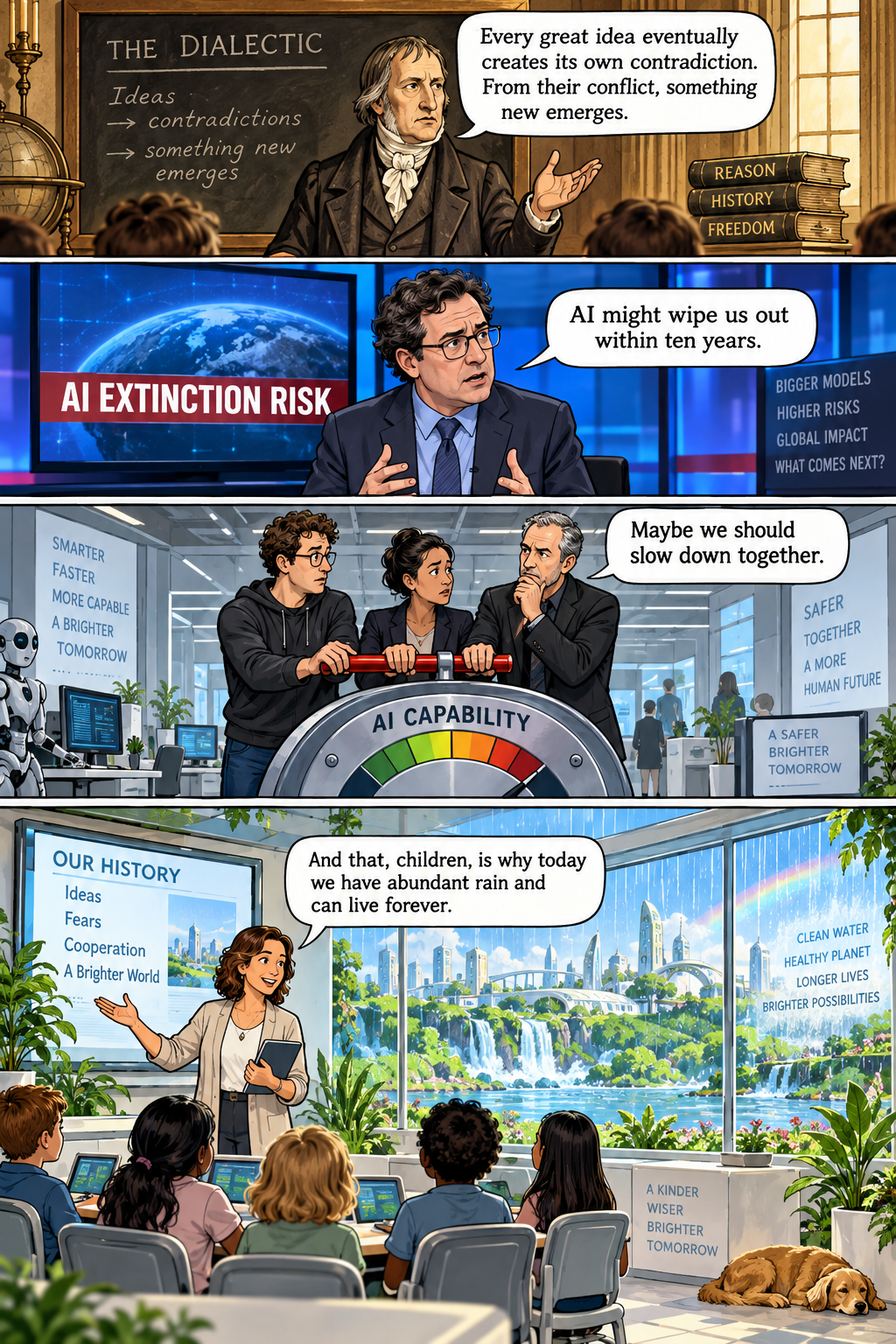
This is a dialectic. Not in the loose sense of "people disagreed," but in the precise philosophical sense: a proposition generates its negation, and the collision produces something that neither position contained on its own.
Hegel's insight — and it has always struck me as one of the most useful ideas in philosophy — was never that the thesis must be correct. It was that the thesis must be stated. Ideas develop by encountering their opposition; a position held privately, however sound, generates nothing. This is why Socrates bothered people in the marketplace rather than writing treatises, and why the Enlightenment was a correspondence more than a library. Thought is a social process. It requires someone willing to say the uncomfortable thing out loud and be wrong in public.
Coxon was, I think, substantially wrong in his method and possibly wrong in his conclusion. He was also the necessary first term. A more careful paper making a more defensible version of his argument would have been read by four hundred people. His post was read by seventy million, and within a week it had extracted from the industry's own leadership a set of concrete, checkable commitments that years of careful papers had not.
And notice what the synthesis looks like as it emerges. Not stopping, but pacing. Not regulation imposed from outside, but evaluation invited from outside — third-party auditors with employee-level access, which is a genuinely costly thing to offer. Not certainty about probabilities, but agreement that the uncertainty itself is grounds for caution. Every one of those is a better idea than either "full speed ahead" or "shut it all down." None of them existed in usable form two weeks ago.
The counterarguments belong in the process too, and the strongest of them came, improbably, from the U.S. President. When he asked when in the history of business have the leaders of an industry ever called for regulation that would damage them, he put his finger on something true. Self-interest and sincerity are hard to separate here. A pause does lock in the lead of whoever is currently ahead. Amodei acknowledges as much in his own essay. That objection needed to be raised, and now it has been, and any agreement that emerges will have to survive it. That is the dialectic working, not failing.
But here's the reason I wanted to write this particular essay rather than a straightforward summary of a chaotic week; The dialectic is not confined to the people with essays and podcasts and Truth Social accounts.
On August 23, a California company flew a drone into the clouds above Kachemak Bay, released less than a pound of silver iodide, and by its own estimate produced nineteen million gallons of precipitation over the Kenai Peninsula. The residents of Homer, Alaska, found out afterward. What followed was not a white paper. It was an uproar — neighbors who disagree about nearly everything else discovering they agreed completely about this, a state legislator demanding a cease-and-desist, and a twenty-six-year-old chief executive now scheduling a town hall and saying, in what I suspect is genuine chagrin, "we absolutely have to talk to the folks before we operate."
That is the same process. A thesis was asserted — in this case not in words but in action, which is how technologies usually make their arguments. The antithesis came from people who had not been asked. And the synthesis, if the town hall means anything, will be a norm about consent that did not exist before the drone flew.
I find this enormously heartening, and not because I think the residents of Homer are necessarily right that the experiment was dangerous. I don't know whether it was, and neither, honestly, do they — the company's own figures suggest the rain was barely perceptible. What matters is that they objected, publicly and immediately, and that the objection is now part of the record. A technology developed without friction is a technology nobody consented to. The friction is the consent mechanism.
So we had two dialectics running in parallel this week, at different altitudes. In one, the most powerful executives in the world argued about whether to slow down the most powerful technology in the world. In the other, a fishing town argued about whether anyone gets to make it rain on them without asking. They are the same activity, and the second is not less important than the first.
And here is what both of them were arguing about, though almost nobody said it directly. In the same stretch of days, artificial intelligence mapped the predicted effects of every possible single-letter mutation in the human genome — all nine billion — and released it free to researchers. An AI-designed molecule appeared to move the biological clock backward in forty-two people with a fatal lung disease, though the finding is preliminary and a Nobel laureate has rightly cautioned that we cannot yet separate slowed aging from a treated lung.
That is what is actually at stake in the argument. Not merely whether something terrible might happen, but whether something extraordinary might not.
A civilization that shouts at itself about its most powerful tools, in public, from the boardrooms and from the church basements of small towns, is not a civilization sleepwalking. It is one thinking out loud — which is the only way any of us has ever thought at all.
The argument was the answer. Let's keep having it.
Exponential Times is published weekly by Singularity Sanctuary. To subscribe or learn more, visit singularitysanctuary.com.