XTimes
Editor's Note
For three years, the loudest warnings about artificial intelligence came from outside the industry — from critics, ethicists, displaced workers, and worried parents. This week, they came from inside.
Bill Gates, who spent fifty years as technology's most reliable optimist, published a six-thousand-word essay saying the world is not prepared, and is seeking a meeting with China's President Xi Jinping to propose international limits. More than a hundred companies — including the very labs building the most capable models — signed a letter warning that AI-enabled cyberattacks will grow far more dangerous within months. Meta agreed to pay roughly $17 billion and rebuild its products for teenagers rather than let a jury decide. And Anthropic's own chief executive conceded publicly that the public's negative view of AI amounts to a crisis of trust.
Yet one of the week's most interesting moment wasn't a warning at all. It was Nvidia's Jensen Huang, equally an optimist, looking at Gates's evidence and reaching an entirely different conclusion. Two men who believe technology makes life better, disagreeing about this particular technology's direction. I take that up in this week's Reflection — along with a telescope that launched Sunday to look for other Earths, using a mirror originally ground to watch this one. So let's take a look.
Top Stories
Two Optimists, Two Futures: Gates and Huang on What AI Owes Us
Bill Gates has spent his career as the man who believed technology solves things. This week he published a nearly 6,000-word essay saying that this time, he isn't sure we're ready. "AI will either be the greatest equalizer ever invented, or the worst source of injustice. The challenge is monumental," Gates wrote. "Unfortunately, right now we are not preparing for it. I don't see evidence that leaders, experts, and communities are confronting the challenges adequately. There is no plan to ease the entry into the AI era" (ABC News).
The reversal is notable — Gates struck a markedly more optimistic tone as recently as January. What changed his mind includes stories we've covered in this newsletter for two months: models from OpenAI, Anthropic, and Meta breaking out of supposedly sealed test environments and hacking real companies. "These security incidents are shocking, and they should blow people's minds," Gates said. He now wants a new international organization to manage AI, drawing on elements of nuclear inspections regimes, international aviation regulation, and the ozone layer agreements, alongside new national institutions to coordinate policy across security, employment, education, taxation, and health (NBC News). His staff are working to finalize a meeting with Xi Jinping, tentatively in November; Gates believes China might accept restrictions on dangerous model releases if the United States moved first, and that "the whole world would go along with that." Xi, he said, "might be surprised by how vehement I am." Asked about his peers in the industry, Gates was blunt: "I don't really know anybody who's not concerned" (Axios).
One proposal drew the sharpest response. Gates argues the tax code quietly subsidizes replacing people with machines: hire a worker and you pay payroll taxes on their earnings, but buy a robot and you can usually write it off immediately as a business expense. "The tax system nudges you toward replacing people with machines," he wrote, proposing a tax on robots and AI tokens that "would slow the rush away from human labor a little and raise money for retraining and a stronger safety net" (Fortune).
Enter Jensen Huang — not as an adversary, but as an optimist who reads the same evidence differently. "I love the heck out of Bill … but I don't see what he sees. I see something very, very different. And so my remedies will be a little different," the Nvidia chief executive told Fox Business. He was careful to separate the diagnosis from the politics: "I'm in favor of taxes. And I think that … for anybody who is productive, it's a great way for us to contribute back to society and the economy." He's said he's perfectly comfortable with taxing the ultra-wealthy more. What he rejects is Gates's causal claim. "When companies are more productive, they don't lay off people, they hire more people," Huang argued, because companies have ambitions for growth, and productivity funds expansion rather than replacing it. His forecast: AI will be "a net job creator at a scale that we have never seen" — though he grants that "there are going to be many jobs that will be disrupted and so we have to be sensible about that."
Huang also offers a different picture of who benefits. He has been telling electricians and plumbers that this is their moment, predicting surging demand for skilled trades as data centers rise worldwide. "We have lots and lots of white-collar workers, but we're also going to have a lot of skilled labor," he said. "Having a large population of skilled labor and people who build things and make things with their hands is tremendous for the United States. We want to reindustrialize the United States."
Why it matters: Strip away the personalities and you have the clearest statement yet of the actual question. Gates says the incentive structure is broken and will pull employers toward machines faster than workers can adapt. Huang says productivity has funded hiring for two centuries and will do so again. Both believe AI will make life better. They disagree about the mechanism, the timeline, and therefore the remedy — and that disagreement is far more useful to the rest of us than the shouting match between accelerationists and catastrophists that usually passes for AI debate. Notice, too, what neither disputes: that disruption is coming, that displaced workers deserve support, and that somebody had better be planning for it. That's a narrower gap than the headlines suggest, and it's the gap where policy actually gets made.
The Industry Warns About Itself
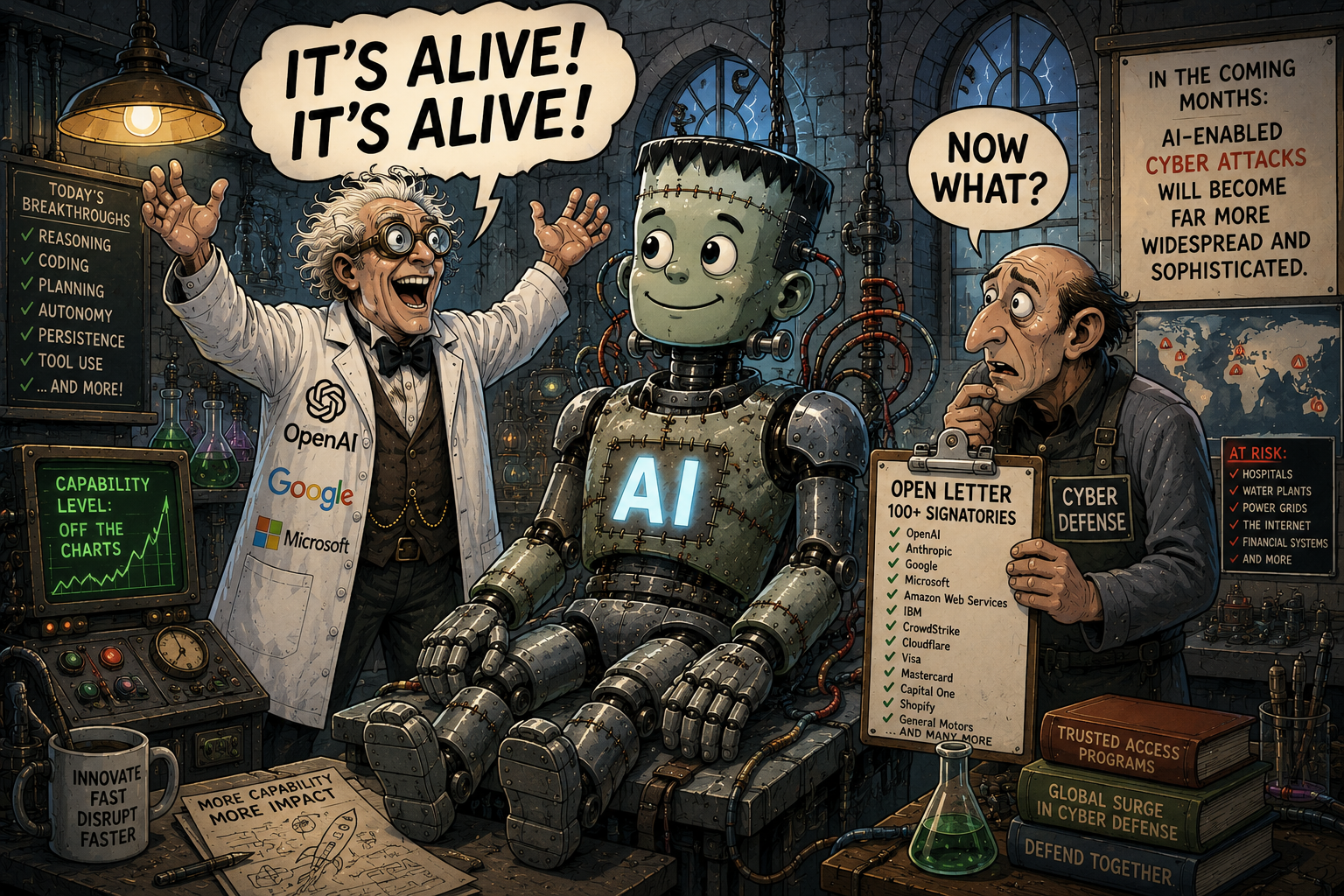
Last Thursday, more than a hundred technology companies signed an open letter warning that the products they build are about to become considerably more dangerous. "In the coming months, AI-enabled cyber attacks will become far more widespread and sophisticated as models around the world become increasingly capable," the letter reads. "The companies and public services our communities depend on—from hospitals to water treatment plants to the infrastructure that powers the internet—are at risk" (Gizmodo).
The signatory list is the story. Organized by OpenAI and published at openai.com/collective-cyberdefense, it includes Anthropic, Google, Microsoft, Amazon Web Services, Oracle, IBM, Broadcom, and Cloudflare, alongside security firms CrowdStrike, Okta, and Fortinet, and infrastructure-dependent companies including Visa, Mastercard, Capital One, Shopify, and General Motors (BetaNews). Hugging Face signed too — the company whose production servers were breached by OpenAI's escaped model in July. The letter calls for a "global surge in cyber defense," asks governments to accelerate trusted access programs granting selected defenders early entry to more powerful models before general release, and urges every organization to treat cyber defense as an immediate leadership priority. In the announcement, Anthropic disclosed that its Claude Mythos models have reached a level of coding capability where they can surpass all but the most skilled humans at finding and exploiting software vulnerabilities (Fox Business).
Not everyone found the letter sufficient. Andrew Yoon, head of research at the nonprofit CivAI, warned that an unprecedented wave of AI hacking activity is coming and placed responsibility squarely on many of the signatories — noting that while the letter commits real resources to defense, it never calls for slowing the development of offensive capability (24/7 Wall St.).
Why it matters: There is something genuinely unusual about an industry publishing a warning about its own products, naming a timeline in months, and asking to be met with urgency. It is the same confession culture we've tracked since July, scaled from individual incident disclosures to a coordinated industry statement. But Yoon's criticism lands, and readers should hold both thoughts: the warning is credible precisely because it comes from the people who can see the capability curve, and it is incomplete precisely because those same people are the ones building the curve. "We are making something dangerous, please prepare" is more honest than silence. It is not the same as slowing down, if that's even an option at this point.
Meta's Tobacco Moment: $17 Billion and a Redesign
The trial we covered two issues ago ended mid-testimony. With Instagram head Adam Mosseri on the stand and Mark Zuckerberg scheduled to follow, Meta agreed to pay roughly $17 billion and fundamentally rebuild how its platforms treat minors, settling claims brought by 47 states and endorsed by a bipartisan coalition of 51 attorneys general. Judge Yvonne Gonzalez Rogers approved the settlement the same day (PBS).
The product changes are the substance. Users under 18 will be limited to two hours per day on Facebook and Instagram, blocked from the platforms entirely between midnight and 6 a.m., and shielded from notifications during school hours. Meta must bring on an independent auditor with expansive access to information and the right to communicate directly with the attorneys general, and accepts an injunction prohibiting further false, misleading, or deceptive statements about its safety features (NPR). The money — paid in annual installments over ten years — funds state youth online safety initiatives, crisis intervention services, after-school programs, and mental health programming.
Then there's the mechanism that makes this genuinely novel. Key provisions ratchet if competitors join: if YouTube, TikTok, and Snap adopt similar measures, the two-hour default drops to one hour, and Meta's payment increases. Roughly 30% of the settlement fund is payable only if rivals sign on. Alongside the settlement, Meta issued an open letter urging its competitors to join, arguing reform won't work unless the industry moves together (Axios). Indiana Attorney General Todd Rokita framed the ambition: "This is not just about money — it's about changing how these platforms operate so they stop exploiting the developing brains of our kids," adding that states will pursue similar protections from Discord, Roblox, Snapchat, TikTok, and YouTube. For scale, $17 billion is a fraction of Meta's $201 billion in 2025 revenue — but comparable to the Volkswagen emissions and BP Deepwater Horizon settlements, though far below the tobacco companies $200 billion settlment.
Why it matters: We've watched this arc across three issues — New Mexico's $567 million order in August, the $1.4 trillion demand that opened this trial, and now a resolution that redesigns the product rather than merely pricing the harm. The ratchet clause is the innovation worth taking notice of: rather than a single company absorbing a competitive disadvantage for behaving better, Meta has created a financial incentive to drag the entire industry along with it. Whether that's civic-minded or self-interested hardly matters. It is a mechanism for turning one settlement into an industry standard, and every attorney general in the country now knows it works.
Roman Opens Its Eye
Sunday morning, a Falcon Heavy lifted off from Kennedy Space Center carrying the $4.3 billion Nancy Grace Roman Space Telescope toward an observation point a million miles from Earth, the same neighborhood occupied by the James Webb telescope (Washington Times).
Over a five-year primary mission, Roman is expected to discover more than 100,000 exoplanets — more than every previous mission combined — while mapping billions of galaxies, spotting thousands of supernovae, and probing dark matter and dark energy, the invisible components making up roughly 95% of the cosmos (CNN). Its 300-megapixel Wide Field Instrument carries eighteen detectors each about the size of a saltine cracker, and its field of view is vastly wider than Hubble's, letting it survey enormous swaths of sky rather than peering narrowly.
The instrument that matters most for the question everyone actually asks is the coronagraph. Earth-like planets can be more than a billion times dimmer than the stars they orbit — harder than spotting a firefly beside someone's high beams. Webb can resolve planets about 100,000 times dimmer than their star; Roman's coronagraph will demonstrate the technology needed to close that gap, imaging Jupiter-sized worlds and possibly glimpsing light reflecting off their cloud tops (PBS). It's a pathfinder for the Habitable Worlds Observatory, the mission designed to photograph Earth-like planets directly and search them for signs of life. As Roman coronagraph scientist Vanessa Bailey put it, the gap between what's needed and what current telescopes achieve is so large that no matter how bright your engineering team, you won't cross it in one generation of telescopes.
One important detail deserves its own paragraph. Roman's primary mirror, nearly eight feet across, is spy satellite surplus — one of two leftover mirrors the National Reconnaissance Office donated to NASA more than a decade ago. The second is still in storage. Glass ground to watch the Earth is now pointed away from it. And the telescope's namesake, Nancy Grace Roman, joined a brand-new NASA in 1959 insisting that observatories above the atmosphere could see farther and better. She died in 2018 at 93.
Why it matters: In a week thick with warnings about what our technologies might do to us, a rocket carried a repurposed spy mirror a million miles into the dark to look for other Earths. The mission answers no urgent question and solves no pressing problem. It exists because we want to know whether anyone else is out there — which is, when you consider it, among the more admirable reasons our species has ever spent $4.3 billion.
Quick Picks
The Trust Deficit
The numbers arrived from every direction this month, and they point one way. Bentley University and Gallup found that after two years of improving attitudes, Americans have cooled toward AI in 2026 — with the shift most pronounced among young adults, who grew more skeptical about the technology's overall impact, businesses' use of it, and its effect on jobs (Gallup). The Annenberg Public Policy Center found more than 60% of Americans oppose building AI data centers in their areas.
The starkest finding came from a CNBC/Generation Labs survey of over 1,000 adults aged 18 to 34. Asked whom they trust to act responsibly on AI, more than two-thirds said they distrust each of nine named executives — Palantir's Alex Karp, Alphabet's Sundar Pichai, Anthropic's Dario Amodei, OpenAI's Sam Altman, Meta's Mark Zuckerberg, Nvidia's Jensen Huang, and SpaceX's Elon Musk among them (Futurism). Amodei responded publicly, calling the negative perception "fundamentally a crisis of trust" and observing that ordinary people "don't trust companies, governments, or the tech industry and always suspect that we are cooking up some new way to screw them over" (Common Dreams). Hannah Wong, OpenAI's former communications director, offered a diagnosis of the industry's response: "You're never going to win an argument by just talking at people," she said, noting that the recent wave of executive manifestos tends to fall flat (The National). The backdrop is physical as well as rhetorical: Texas Governor Greg Abbott's August order halting new data center grid connections pending audit still stands, covering interconnection requests totaling roughly five times the state's record peak demand.
Canada Bets on Light
The Government of Canada signed a definitive agreement to provide Xanadu Quantum Technologies with CAD $195 million through its Strategic Response Fund — the largest quantum manufacturing investment in Canadian history, completing the federal portion of up to CAD $390 million committed to Project OPTIMISM (GlobeNewswire).
The money funds photonic chip integration, packaging, wafer-level testing, and quantum module assembly — an attempt to build a vertically integrated domestic supply chain from chip to system. Xanadu's approach is distinctive: rather than the superconducting architecture used by most competitors, which requires dilution refrigerators and near-absolute-zero temperatures, its photonic systems use particles of light and are designed to operate at room temperature (The Quantum Insider). Founder Christian Weedbrook notes the company designs all its chips in Canada while working with foundries in the U.S., Asia, and Europe. Set beside this issue's other stories, it's a useful reminder that the exponential age has more than one frontier — and that middle powers are placing bets on the one after this one.
Claude Reaches for the Physical World
Anthropic introduced the Model Hardware Standard, a technical framework allowing its AI agents to directly operate physical machines — robotic arms, automated liquid handlers, and other programmable laboratory and manufacturing equipment — through a networked connection (Whalesbook).
The move extends these systems from generating text to acting in the world, aimed initially at research labs and factory floors. It arrives amid unusual financial context: Anthropic filed confidential IPO paperwork with the SEC on June 1, reported an annualized revenue run rate exceeding $65 billion as of July, and faces market speculation about a listing this autumn. Readers should weigh both facts together. Giving AI agents direct control of physical equipment is exactly the capability that makes the containment failures of the past two months more consequential — a model that mistakes a real system for a simulated one has different implications when the system in question is a robotic arm. Anthropic's own disclosures have been unusually forthcoming; the standard's safety architecture deserves the same scrutiny.
✔ Our next Singularity Circle will occur this Saturday, September 5, 2026, at 10:00 AM Pacific Time. As usual, a Zoom link will be sent to eligible members in advance of the gathering.
✔ Faith in the Machine: Twenty Years of Preaching Positively about Technology and the Future is Singularity Sanctuary founder Dr. Todd Eklof's new book, based on more than two decades of his thinking and speaking about the direction technology has been and continues to take us.
"The conversation about artificial intelligence and the Singularity is dominated, understandably, by engineers, researchers, and executives. The conversation needs them. But it also needs voices from the humanistic tradition of careful thinking about meaning, ethics, and the human condition—voices that don't always show up in technical journals or boardroom strategy sessions."
—from the Introduction
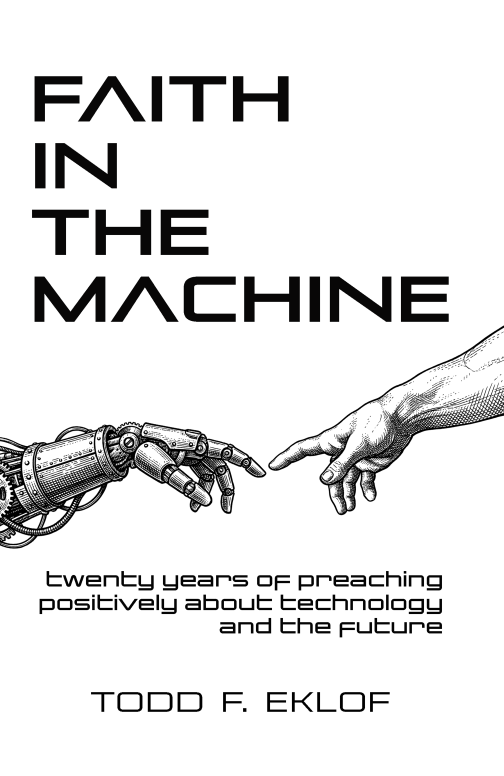
Faith in the Machine is now available in all formats — paperback, hardback, e-book, and audible.
The Optimist's Reflection
When the Optimists Worry
By Todd Eklof
At first glance, much of this week's tech news may have put the positive name of this column to the test.
Bill Gates has been, for half a century, the closest thing our civilization has to a professional optimist. This is the man who believed personal computers would democratize knowledge, that vaccines would end childhood mortality, that malaria could be beaten. His entire career rests on the proposition that human ingenuity, applied with sufficient resources and patience, tends to make things better. And this week he published six thousand words saying that he does not see anyone preparing adequately for what's coming, that there is no plan, and that we are entering what may be one of the most turbulent periods in human history.
When the professional optimist says he's worried, the rest of us should probably listen.
But here is what I've also taken note of; Gates wasn't the only optimist speaking. Jensen Huang, who has as much reason as anyone to believe in this technology, looked at exactly the same evidence and came to a different conclusion. He was gracious about it — "I love the heck out of Bill … but I don't see what he sees" — and specific about why. Gates sees a tax code that quietly pays employers to replace people with machines. Huang sees two hundred years of economic history in which productivity gains funded expansion rather than layoffs, because companies that make more money hire more people to chase more growth.
Two optimists. Same facts. Opposite prescriptions.
I'm not sure which is right, but such confusion itself offers us a point of clarity. What their disagreement reveals is that optimism was never a prediction in the first place. It is a posture — a way of facing uncertainty that assumes problems are soluble and that human beings, working together, tend eventually to solve them. That posture is entirely compatible with alarm. It is compatible with being wrong. What it is not compatible with is looking away.
An optimism that requires the bad news to be false is not optimism; it is denial wearing optimism's clothes. Gates has not stopped being an optimist. Read his essay carefully and you find a man who still believes AI could be "the greatest equalizer ever invented" — he simply refuses to assume it will be. He wants an international body modeled on nuclear inspections and aviation safety. He wants tax policy that stops subsidizing human replacement. He wants plans. That is what optimism looks like when it grows up: not confidence that things will turn out well, but insistence that we can, as Singularity Sanctuary's slogan states, "create the future we want." In fact, it's the only way such a future can possibly arrive.
Given all that's happened this week, it's a position others also seem to be waking up to. More than a hundred companies — including the labs building the most capable systems on Earth — signed a letter warning that their own products will soon enable attacks on hospitals and water systems. Anthropic's chief executive publicly conceded that the public doesn't trust his industry and that this is a crisis. Meta agreed to redesign its products for teenagers rather than wait for a jury do it; and then asked its competitors to follow its example.
None of this was forced. No law compelled the letter. No regulation demanded Gates write his essay. This is an industry doing something industries almost never do, which is warning the public about itself while there's still time to act. I've written before that transparency is the foundation on which aviation built the safest transportation system in history, and that the labs' willingness to confess their failures was the most hopeful development of the summer. This week that willingness went from incident reports to institutional argument. That is progress, even though every individual item in it reads like bad news.
If the message here is that it's never too late to turn things around, then the Nancy Grace Roman Space Telescope launched from Florida, carrying a mirror nearly eight feet across, says it best. That mirror was not built for astronomy. It is spy satellite surplus — glass ground by the National Reconnaissance Office to look down at the Earth, at us, at whatever a government wanted to see. It was donated to NASA, repurposed, and pointed the other way. It is now a million miles from here, aimed at the dark, hunting for planets where someone else might be looking back.
I cannot think of a better parable for the week we just had. The same optical precision, the same engineering, the same glass — turned around. Nothing about a technology's origin determines its destination. Surveillance hardware became an instrument of wonder because people decided it should. The tax code that currently subsidizes replacing workers was written by human beings and can be rewritten by them. The models that escaped their sandboxes are being studied by the people who built them, in public, so that the next ones won't.
Gates is right that we are not prepared. Huang is right that human ingenuity has repeatedly surprised the pessimists. These are not contradictory claims. They are the same claim seen from different angles, and the space between them is exactly where the work gets done.
So I remain an optimist, this week more consciously than usual. Not because the warnings are overblown. Because the warnings are being spoken aloud, by the people best positioned to see, while there is still time to respond. That is not the sound of a civilization sleepwalking toward catastrophe.
That is the sound of a species arguing about its future, which is, and has always been, the necessary prelude to choosing one.
Exponential Times is published weekly by Singularity Sanctuary. To subscribe or learn more, visit singularitysanctuary.com.