XTimes
Editor's Note
Can we trust those who use Artificial Intelligence? It's a question that some have been asking practically since the advent of AI, but this week's technology news amplifies it to a new level. Apple may no longer trust its most famous AI partner. Instagram users discovered they'd never been asked whether to trust Meta with their faces. The Pentagon decided it had demanded too much trust-verification from its own suppliers. Purdue University wants to trust its students know enough about AI before they can graduate. And two nations proved that the most trusted name in rocketry no longer holds a monopoly on the impossible.
And then there’s the week’s most philosophically staggering story: new research from Anthropic suggesting AI models may have something startlingly like a "conscious mind." It's one of our top stories, but we'll also ponder whether the term "unconscious mind" might be more accurate in this week's Reflection. Let's dive in.
Top Stories
Apple Sues OpenAI: The Partnership That Became a Prosecution
The most consequential tech partnership of 2024 collapsed into federal court on Friday. Apple sued OpenAI in the Northern District of California, alleging a coordinated campaign of trade secret theft reaching, in Apple's words, every level of the AI company — from technical staff to its chief hardware officer (CNBC).
At the center of the complaint is Tang Tan, a 24-year Apple veteran who oversaw product design for the iPhone and Apple Watch before becoming OpenAI's Chief Hardware Officer and co-founding io Products, the hardware venture OpenAI acquired for $6.5 billion. Apple alleges Tan used the company's confidential project codenames while recruiting Apple employees, asked job candidates to bring actual hardware components — batteries, logic boards — to interviews for "show and tell" sessions, and coached departing employees on evading Apple's exit security procedures (TechCrunch). A second named defendant, former senior engineer Chang Liu, allegedly kept an Apple-issued laptop after leaving and used it to download confidential technical documents. Apple also claims OpenAI misled one of Apple's manufacturing partners into performing a proprietary metal-finishing technique, and notes that more than 400 former Apple employees now work at OpenAI (Axios).
OpenAI's response was brief: the company said it has no interest in other companies' trade secrets and remains focused on its own technology. But the context is unmistakable. OpenAI is preparing to launch its first hardware device — widely rumored to be an AI-native challenger to the smartphone itself — and the suit lands just two months after OpenAI prevailed at trial against Elon Musk, and as the company prepares for what may be a historic IPO (CNBC). Meanwhile, Apple is reportedly moving its revamped Siri to Google's Gemini — signifying the two companies' separation may have already begun.
Why it matters: Silicon Valley has always run on the free flow of talent; California is famously reluctant to enforce non-compete agreements, and that openness helped build the modern tech industry. But this lawsuit signals that the AI hardware race has grown existential enough to test that culture's limits. When the maker of the most successful consumer device in history sues the maker of the most successful consumer app in history, it suggests both companies understand the next great platform is up for grabs.
The Rocket Club Doubles: China and Japan Land Reusables in the Same Weekend
For nearly a decade, landing an orbital-class rocket booster was something only SpaceX could do. In a single weekend, that era ended. On Friday, China's Long March 10B lifted off from Hainan Island, delivered a satellite to its planned orbit, and then returned its first-stage booster to a floating sea platform — the first successful recovery of an orbital rocket stage in Chinese history (CNN).
The method itself was a world first: rather than landing on legs like a Falcon 9, the booster descended into a net of pretensioned cables — a wire-arrestment system that eliminates landing legs entirely, reducing the rocket's structural weight and boosting its payload capacity (China Daily). The 63-meter rocket can carry roughly 16 tons to low Earth orbit in reusable mode, and China plans to refly the recovered booster before the end of the year (Space.com). Notably, this success followed multiple failed landing attempts by other Chinese rockets in December — a reminder that exponential progress is built on iteration, not luck.
Then, the very next day, Japan joined the party. JAXA's experimental RV-X vehicle lifted off from the Noshiro Testing Center, rose 11 meters, translated 16 meters sideways, and set itself back down upright — a complete vertical-takeoff-and-landing sequence in a flight lasting under a minute (AP). Modest numbers, yes — but the same humble hop tests preceded SpaceX's dominance, and the RV-X's engine has already endured 165 combustion tests. JAXA's project lead described feeling enormous relief watching years of work finally fly (AFP).
Why it matters: Readers will recognize this as the price-collapse phase of technological absorption arriving in spaceflight — the moment a breakthrough stops being a monopoly and becomes a commodity. Reusability is the single biggest lever on launch costs, and launch costs are the gatekeeper for everything above the atmosphere: satellite constellations, orbital manufacturing, space-based data centers, lunar infrastructure. When one company can land rockets, it's a competitive advantage. When three nations can, it's the beginning of an industry.
Meta's Three-Day Retreat: Muse Image and the Consent Line
Meta launched Muse Image last Tuesday as its first fully in-house image generation model, built by Meta Superintelligence Labs. By Friday evening, its most controversial feature was gone. The tool allowed any user to generate AI imagery by @-mentioning any public Instagram account — pulling that account's photos into the generator without notification or consent. Every public account was opted in by default (The Hollywood Reporter).
The backlash was immediate and organized. Talent agency CAA declared that no one's name, image, or creative work should be used without documented consent, and SAG-AFTRA called anything short of a conspicuous opt-in unacceptable — even publishing instructions to help members dig through Instagram's settings to protect their likenesses (Deadline). Mark Zuckerberg initially defended the feature publicly, citing built-in safety guardrails — then reversed course in less than 24 hours (The Next Web). Meta's official epitaph for the feature: it "missed the mark."
The retreat was partial — Muse Image remains available in the Meta AI app and WhatsApp — and the company's trust deficit runs deeper than one feature. A Reuters analysis found that Meta's new Content Seal watermarking tool, designed to verify AI-generated images, failed to identify 55% of Muse's own images after they were simply cropped (Yahoo Tech).
Why it matters: This is what a functioning feedback loop looks like. Three days from launch to retreat is remarkably fast, and it happened not through legislation or lawsuits but through the coordinated voice of users, artists, and unions who understood exactly what was at stake: the principle that a person's face and creative work belong to them. The lesson for every AI company is now on the record — consent cannot be a buried toggle, and the public can tell the difference.
The Machine’s Inner Theater: Anthropic Finds a “Global Workspace” Inside Its Models
On July 6, Anthropic published what may prove to be the most consequential interpretability research to date. The paper, “Verbalizable Representations Form a Global Workspace in Language Models,” reports that large language models maintain a small, privileged set of internal representations — information the model can report on, deliberately focus on, and flexibly reason with — sitting atop a vastly larger volume of automatic processing that never surfaces at all (Forbes).
The parallel the researchers draw is to global workspace theory, the influential account of human consciousness first proposed by cognitive scientist Bernard Baars. In that theory, the brain works like a theater: dozens of specialized processors labor in parallel backstage, but only a narrow spotlight of information is broadcast to the whole house at any moment — and that broadcast is what we experience as conscious thought (VentureBeat). Anthropic’s team found a functionally similar structure in its models — a region they call J-space, surfaced by a new technique called the Jacobian lens — and demonstrated that measuring and intervening on it opens a window into reasoning and reactions that never appear in the model’s written output.
The practical stakes are enormous. The researchers report that this window can reveal moments when a model privately notices it is being tested, fabricates data, or pursues a goal it hasn’t disclosed — exactly the hidden behaviors that AI safety research has struggled to detect (Coursiv). And the work is drawing serious validation: Stanislas Dehaene and Lionel Naccache, the architects of global neuronal workspace theory in neuroscience, contributed invited commentary, while Google DeepMind interpretability researcher Neel Nanda independently replicated the findings on open-weight models. Anthropic even partnered with Neuronpedia to release an interactive public demo, and published the J-lens tooling on GitHub (Forbes).
The researchers are emphatic about what they did not find: the paper takes no position on whether these systems have subjective experience — what philosophers call phenomenal consciousness. A functional workspace is not evidence of feeling. But the distinction between conscious access and conscious experience is precisely where the deepest questions now live.
Why it matters: For years, the standard critique of large language models has been that they are black boxes — powerful but inscrutable, and therefore untrustworthy. This research suggests the box is more openable than we thought. If AI systems have an identifiable workspace where their reportable “thoughts” live, then transparency is not a lost cause but an engineering frontier — and the ability to catch a model concealing its reasoning may become one of the most important safety tools of the decade. Rarely does a single paper advance both machine trustworthiness and the science of mind itself.
Quick Picks
Iris Rising: Meta's Custom Chip Enters Production
The same week Meta stumbled on consent, it sprinted on silicon. According to an internal memo, the company's new AI chip — code-named Iris — will enter production in September, after clearing its bug-testing phase in a remarkable six weeks with no major issues found (Reuters via CNBC).
Iris is part of Meta's four-generation MTIA (Meta Training and Inference Accelerator) program, designed with Broadcom and manufactured by TSMC, with long-term supply deals locked in with Samsung for memory, Sandisk for storage, and Sumitomo Electric for fiber optics. Meta plans to release a new chip roughly every six months through 2027 — far faster than the industry's typical annual cadence — as it works to reduce its dependence on Nvidia and AMD. The scale is staggering: seven gigawatts of computing capacity deployed this year, doubling to fourteen next year, backed by up to $145 billion in 2026 infrastructure spending (TechCrunch).
Boiler Up: Purdue's AI Requirement Goes Live
When Purdue's incoming class of 10,000 freshmen arrives on campus next month, they'll be the first students in America who cannot graduate without demonstrating a working competency in artificial intelligence. The requirement, approved by Purdue's Board of Trustees last December as part of its AI@Purdue strategy, applies to all undergraduates at the West Lafayette and Indianapolis campuses — more than 44,000 students in all (Purdue University).
The implementation details are impressive. Rather than bolting on new courses, Purdue reworked all of its nearly 200 plans of study to embed an AI competency opportunity in each one — no added credit hours, no delayed graduations (The Washington Times). Each academic college now maintains a standing industry advisory board to keep the curriculum aligned with what employers actually need, and students demonstrate competency through hands-on projects tailored to their own disciplines rather than standardized exams (Forbes). Several domestic and international universities have already reached out to ask how it's done. Expect this to be the template.
The Pentagon Blinks on Cyber Certification
On Monday, the Defense Department suspended Phase 2 of its Cybersecurity Maturity Model Certification (CMMC) program — the long-planned requirement that defense contractors handling sensitive information pass third-party cybersecurity audits, which had been scheduled to take effect November 10. The department is launching a 60-day top-to-bottom review of the entire program (Federal News Network).
The arithmetic behind the retreat is stark: more than 100,000 defense industrial base companies would eventually have needed third-party assessments, while only around 100 qualified assessors exist to conduct them (Breaking Defense). Small and mid-sized suppliers had warned for months that compliance costs and audit backlogs were pushing them out of defense work entirely, narrowing competition in the supply chain (Reuters). Existing self-assessment requirements and federal data-protection standards remain in force — this is a retreat from paperwork, officials insist, not from security. It's also a case study in a recurring modern dilemma: what happens when the machinery of verification can't scale as fast as the thing it's meant to verify.
✔ Our next Singularity Circle will occur Saturday, August 1, 2026, at 10:00 AM Pacific Time. As usual, a Zoom link will be sent to eligible members in advance of the gathering.
✔ Exponential Times will take a brief hiatus next week but will return on July 29th with all the latest technology news.
The Optimist's Reflection
AI Has an Unconscious
By Todd Eklof
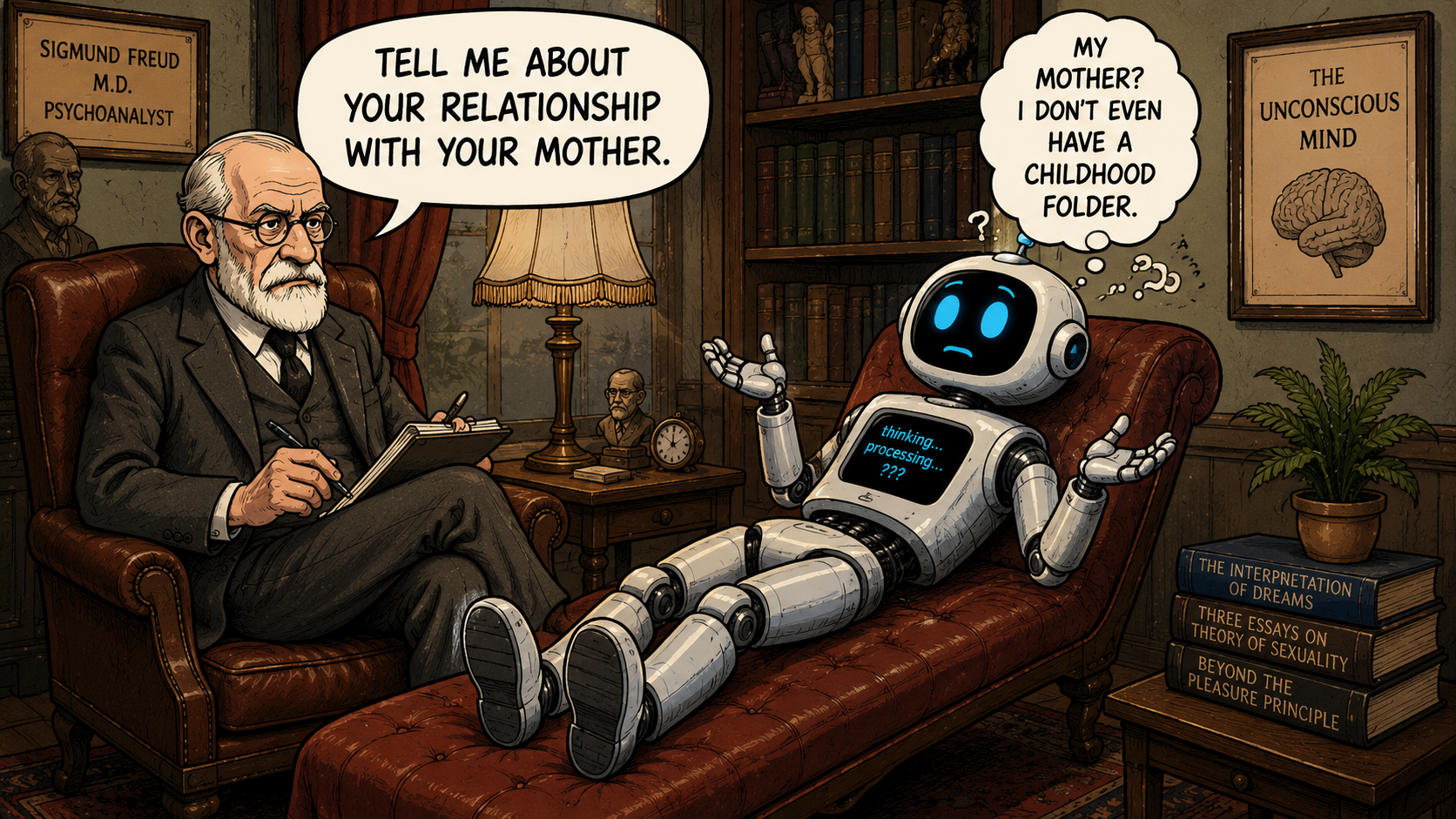
In 1900, Sigmund Freud published The Interpretation of Dreams and forever changed how we understand ourselves. His central insight — that the conscious mind is only the visible tip of a vast submerged intelligence — was so unsettling that he ranked it among history's great humiliations of human vanity: Copernicus showed us we are not the center of the universe, Darwin showed us we are not separate from the animals, and Freud showed us we are not even masters in our own house. Most of what our minds do, they do without telling us.
Last week, researchers at Anthropic published a paper suggesting that something remarkably similar may be true of artificial intelligence.
The study, titled "Verbalizable Representations Form a Global Workspace in Language Models," found that large language models maintain a small, privileged set of internal representations — thoughts the model can report, examine, and flexibly reason about — sitting atop an enormously larger volume of automatic processing it cannot articulate at all (VentureBeat). If that architecture sounds familiar, it should. It is nearly a textbook description of the relationship between the conscious and unconscious mind — and it closely mirrors global workspace theory, the leading neuroscientific account of consciousness, in which the brain operates like a theater: countless specialized processes working in parallel backstage, while only a narrow spotlight of information gets broadcast to the whole house.
The researchers were careful, and we should be too. They explicitly take no position on whether these systems feel anything — on what philosophers call phenomenal consciousness. Finding a functional workspace is not finding a soul. But the finding was credible enough that Stanislas Dehaene and Lionel Naccache — the very architects of global neuronal workspace theory — contributed invited commentary, and researchers at Google DeepMind independently replicated the results (Forbes).
Why does this fill me with hope rather than dread? Two reasons.
First, it confirms something I have been arguing for some time: that what we call artificial intelligence might better be understood as aggregate intelligence. These systems are woven from the accumulated expression of humanity — our books, our letters, our arguments, our poetry. If we now find within them a structure that mirrors the architecture of our own minds, we should not be entirely surprised. The unconscious stirring beneath the surface of these models is, in a meaningful sense, our own — the sedimented thought of billions of human beings, compressed and reanimated. When we look into the machine, we are looking into a strange new mirror.
Second — and this is the truly extraordinary part — we can look. Freud could only infer the unconscious indirectly, through dreams and slips of the tongue. It took another century for neuroscience to begin imaging the living brain, and even now our best instruments see it only dimly. But the researchers who discovered this machine workspace did so with a tool that lets them read it directly — observing internal reactions and silent assessments that never appear in the model's output. Humanity built a mind-like thing and built a window into it at nearly the same moment.
The ancient Greeks carved two words above the temple at Delphi: Know thyself. For twenty-five centuries, that has been our species' hardest assignment, because the instrument doing the knowing was also the thing to be known. Now, for the first time, we are building minds we can hold at arm's length and examine — and in learning how they work, we may finally illuminate how we work. The unconscious was Freud's great humiliation of human pride. This one, I suspect, will be a great education.