XTimes
Editor's Note
This has been one of those weeks where the scale of tech news makes it hard to know where to begin. Markets convulsed and then recovered. Three major space companies announced acquisitions in the span of ten days. Two Korean chipmakers committed more money to a single infrastructure project than most countries' annual GDP. The Supreme Court handed down its most significant digital privacy ruling in years. The U.S. House passed its first major child online safety bill. And the federal government signed not one but two executive orders preparing the country for a quantum computing future that may arrive sooner than anyone expected.
Yet the story we're leading with isn't the one catching most the attention, but it may eventually prove to be the most important. Last Thursday, the U.S. Fish and Wildlife Service and a Dallas biotech company announced they are going to try to preserve the genetic blueprint of every endangered species in America — not someday, not partially, but all of them, available to any researcher in the world, free of charge. Ben Lamm called it a modern-day Noah's Ark. That's a great frame, but whatever we call it, it's a move that fundamentally changes what it means for a species to be endangered.
This is what an abundant week looks like. Let's get into it.
Top Stories
Colossal Biosciences and the U.S. Government Build a "Noah's Ark" for Every Endangered Species
On June 25, Colossal Biosciences — the Dallas-based company best known for its work bringing back the dire wolf and pursuing the de-extinction of the woolly mammoth — announced a landmark partnership with the U.S. Fish and Wildlife Service to build a genomic and biobanking archive for every species protected under the Endangered Species Act. The initiative aims to collect, sequence, and cryogenically preserve living cells, reproductive tissues, and genomic material from more than 2,300 threatened and endangered plant and animal species — what would be the most comprehensive biodiversity preservation resource ever assembled in the United States. (PR Newswire)
"Just as the Svalbard Global Seed Vault was created to preserve the genetic diversity of our food supply, this partnership aims to preserve the genetic diversity of life itself," said Colossal CEO Ben Lamm. "Every species is a library of evolutionary innovation millions of years in the making. Once lost, that knowledge disappears forever." Matt James, Colossal's Chief Animal Officer, described it more simply to TIME: "We want a digital twin of nature — something like the old school library card catalog for life." (TIME)
The scale of the need is sobering. America currently protects 1,662 domestic and 638 foreign species under the 1973 Endangered Species Act, but the list has grown 300% since 1985 while federal conservation funding has not kept pace, effectively halving the resources available per species. The partnership took five years of conversation to reach this point. According to James, when Fish and Wildlife Service officials first floated the idea, they suggested cataloging perhaps 100 species. "In our Colossal minds we said, 'We need to think bigger. Let's just say, aspirationally, we're going to go for every species on the list.'" (Gizmodo)
Before freezing the samples, researchers will fully sequence each species' genome — creating a complete digital genetic record — and attempt to convert some cells into induced pluripotent stem cells: blank biological slates capable of becoming any cell type in the body. Colossal has already derived such stem cells from elephants for the first time. The knowledge gained could help identify genes associated with disease resistance or drought tolerance, opening the door to engineering greater resilience into vulnerable populations as the climate continues to shift. Critically, the resulting genomic data platform will be open-sourced and made freely available to researchers, universities, and conservation organizations worldwide — Colossal and the Service have committed to ensuring the data is never locked behind proprietary walls. (U.S. Fish and Wildlife Service)
Why it matters: Extinction is permanent and conservation funding is finite; this partnership addresses both problems at once. A genome, once preserved, is preserved forever — giving future scientists tools that today's conservationists can only imagine. Whether or not any of these species are ever revived through Colossal's de-extinction techniques, the simple act of recording what exists, before it's gone, may be one of the most consequential conservation acts of this generation.
The Tech Sell-Off That Wasn't: A Wild Week for AI Stocks Ends in Recovery

The week began in genuine alarm. On June 22-23, a sell-off that started in Asian semiconductor stocks cascaded through global markets, becoming one of the most severe tech routs in recent memory. South Korea's Kospi index plunged 10% in a single session, triggering a 20-minute circuit breaker — its first since March. Chip giants SK Hynix and Samsung Electronics each lost more than 12%. Japan's Nikkei dropped 3.6% and SoftBank fell 15%. By the time U.S. markets closed, the Nasdaq Composite had dropped 2.2%, the S&P 500 had fallen 1.4%, and semiconductor stocks had shed more than $1.3 trillion in combined market value in a single session — the steepest one-day chip-sector decline since the spring's tariff-driven turmoil. (CNBC)
SpaceX, fresh off its record-breaking IPO eleven days earlier, became an unlikely symbol of the anxiety. After closing its first trading day at $160.95 and hitting a high of $201.80, shares fell for four consecutive sessions, including a 17% single-day drop that erased $400 billion in value — the second-largest one-day wipeout for any stock on record, according to Bloomberg. By the close of the sell-off, SpaceX had shed more than 26% from its peak, dipping below the symbolically significant $2 trillion market cap. (NBC News)
The proximate triggers were several, converging at once: Federal Reserve projections showing higher-than-expected inflation and interest rates for the remainder of 2026; renewed fears that the Iran conflict and closure of the Strait of Hormuz could push energy costs and borrowing costs higher; and, underlying it all, a long-simmering question about whether AI infrastructure valuations had become genuinely unmoored from fundamentals. The Shiller P/E ratio had climbed above 40 — a level historically associated with market tops. Total AI spending is projected to exceed $1.6 trillion between 2026 and 2029. Wedbush's Dan Ives, among others, characterized the move as a healthy correction rather than the start of a crash, noting that both Nvidia and AMD had exceeded revenue and earnings estimates in their most recent quarters, with guidance remaining strong. (Intellectia)
By Monday, June 29, the picture had brightened considerably. U.S. stocks rose and recovered a meaningful portion of the prior week's losses, breaking a five-day losing streak — only the second losing week of the past thirteen. The Nasdaq composite climbed roughly 2%, and several AI-boosted stocks rallied after Samsung Electronics and SK Hynix announced a historic joint investment in new chip manufacturing capacity. (AP via PBS)
Why it matters: A week that began with the most severe AI-stock sell-off in recent memory ended with markets recovering on the strength of an even larger AI infrastructure commitment. That whiplash captures the defining tension of the moment: investors are genuinely uncertain whether AI valuations are stretched past reason, yet every time conviction wavers, another trillion-dollar bet on the technology's future arrives to steady the market. Whether that pattern is sustainable, or simply delays a larger reckoning, is the question hanging over the rest of 2026.
Three Major Space Industry Acquisitions in Ten Days
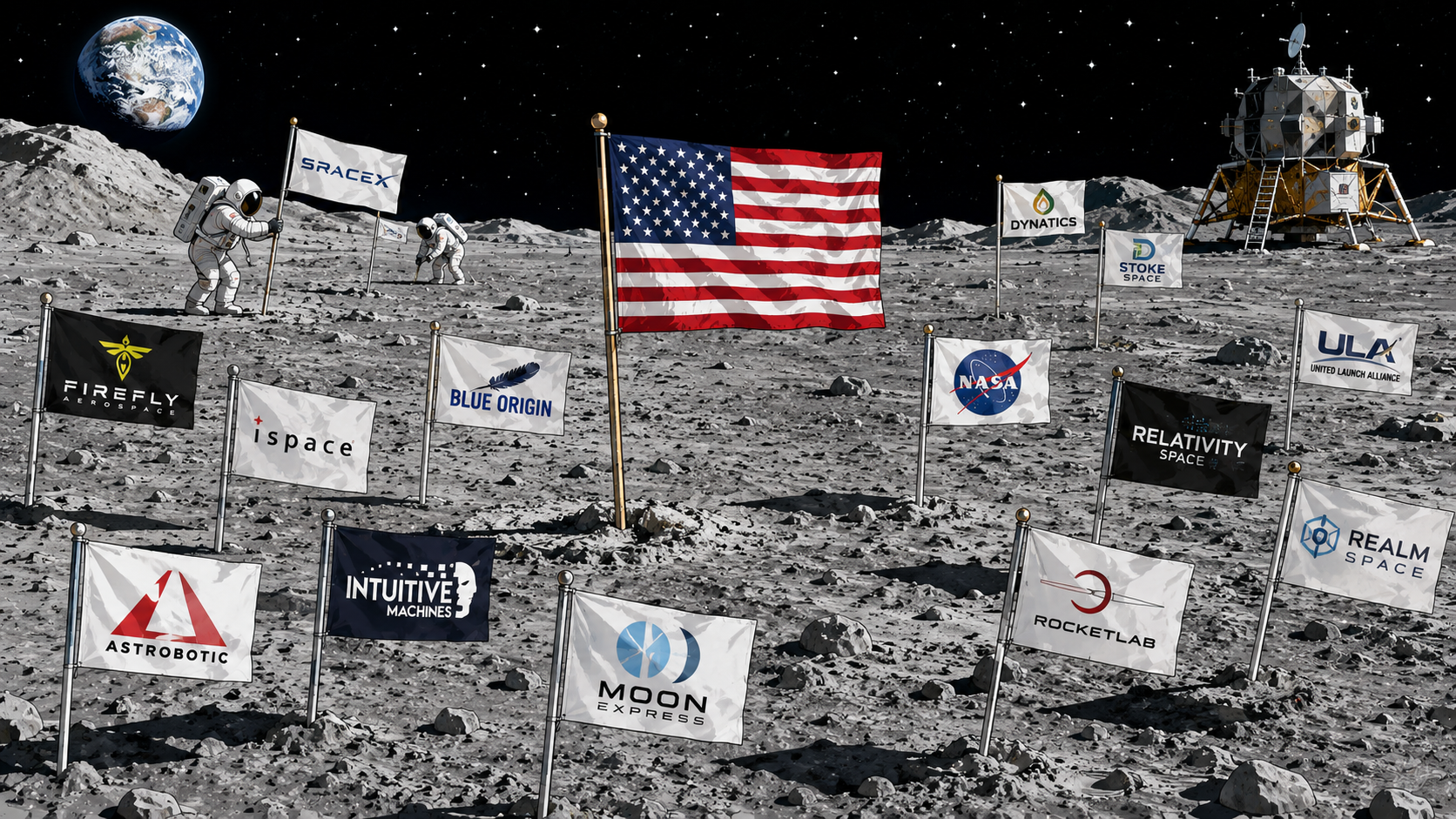
Something unusual happened in the space industry over the past two weeks: three major acquisitions, each aimed at building autonomous, AI-driven, vertically integrated space companies, all in roughly a ten-day span.
It started with SpaceX. Four days after its record-breaking IPO, SpaceX agreed to acquire AI coding startup Cursor for $60 billion, folding it into Musk's xAI division — a move covered in last week's issue. Then, on June 25, Firefly Aerospace announced it was acquiring Space-ng, a Colorado-based startup specializing in AI-powered vision navigation and autonomous guidance systems. Space-ng's technology was used during Firefly's historic Blue Ghost Mission 1 in March 2025, autonomously detecting hazardous lunar terrain and steering the lander to a safe touchdown in real time — performing two autonomous hazard-avoidance maneuvers before landing. Firefly plans to integrate the technology across its lunar landers and orbital vehicles to support upcoming NASA Commercial Lunar Payload Services missions, a NASA MoonFall mission, and a Defense Innovation Unit space domain awareness contract. (Firefly Aerospace)
Then, on Monday, came the biggest deal of the three: Rocket Lab announced it will acquire Iridium Communications, the satellite communications pioneer, for approximately $8 billion in cash and stock — the largest M&A deal in the global commercial space sector this year. Iridium shareholders will receive $54 per share, a 24% premium, and the deal brings Rocket Lab a 66-satellite low-Earth-orbit constellation, globally licensed L-band spectrum, and more than 2.5 million existing subscribers across government, defense, aviation, and maritime markets. "This is a defining moment for the space industry," said Rocket Lab founder and CEO Sir Peter Beck. The deal transforms Rocket Lab into what the company calls a fully vertically integrated, self-launching space power — one that designs, manufactures, launches, and operates its own constellation, directly mirroring the structure that has made SpaceX dominant. (Rocket Lab)
Why it matters: Three different companies, in the same narrow window, all made the same strategic bet: that the future of the space industry belongs to vertically integrated players who control launch, manufacturing, autonomy, and communications under one roof, rather than companies that specialize in a single layer of the stack. The pattern echoes what AI infrastructure consolidation looked like a year ago — and suggests the space industry has now entered its own phase of rapid, AI-driven consolidation.
Quick Picks
South Korea's $518 Billion Bet on the AI Chip Boom
Samsung Electronics and SK Hynix announced Monday they will jointly invest 800 trillion won — approximately $518 billion — in a new chipmaking hub in South Korea's southwest region, one of the largest single private infrastructure commitments of the AI era. President Lee Jae Myung joined the companies' chairs for the announcement, which is intended to capitalize on surging AI-driven demand for memory chips while also expanding industrial investment beyond the greater Seoul metropolitan area. Samsung and SK Hynix together produce roughly two-thirds of the world's memory chips, and each company will build two new fabrication plants in the region. (AP via ABC News) SK Hynix chairman Chey Tae-won called it a complex, large-scale undertaking requiring "vast sites, along with sufficient power, water and skilled workers," noting it took nine years to establish the company's existing manufacturing cluster. South Korean officials framed the investment in explicitly strategic terms: "We must establish the core building blocks of artificial intelligence faster than any other country," President Lee said. "Semiconductors, physical AI and AI data centers are the three pillars of our next great leap forward." (Washington Post)
Trump Signs Two Quantum Executive Orders: Innovation and Cryptographic Defense
President Trump signed a pair of executive orders on June 22, surrounded by tech leaders including IBM CEO Arvind Krishna and Alphabet president Ruth Porat. The first, "Ushering in the Next Frontier of Quantum Innovation," establishes a national effort to build a powerful scientific quantum computer for the Department of Energy, deploy quantum-enabled sensors and networks within five years, and expand the domestic quantum workforce through new training institutes. (The White House) The companion order, "Securing the Nation Against Advanced Cryptographic Attacks," directs federal agencies to migrate high-value systems to post-quantum cryptography by the end of 2030 for key establishment and 2031 for digital signatures — addressing the threat of "harvest now, decrypt later" attacks, in which adversaries collect encrypted data today with the intention of decrypting it once sufficiently powerful quantum computers exist. (The White House) The orders build on a National Quantum Initiative Act Trump signed into law in 2018 and follow last month's Commerce Department decision to take $2 billion in equity stakes across nine quantum computing companies. Cloudflare, which has tracked the post-quantum transition closely, called the order "an important milestone," noting that research breakthroughs from Google and other labs have accelerated timelines for when a cryptographically relevant quantum computer might actually exist. (Cloudflare)
Supreme Court Limits "Geofence" Searches of Cellphone Location Data
In a 6-3 ruling Monday, the Supreme Court held that "geofence warrants" — which allow police to sweep up location data from every cellphone in the vicinity of a crime scene, regardless of whether the phone's owner is a suspect — implicate the Fourth Amendment and require a warrant. Writing for the majority in Chatrie v. United States, Justice Elena Kagan wrote that "an individual has a reasonable expectation of privacy in records about his cellphone's location," comparing the data to other private materials like emails or photographs that a person reasonably views as their own, even when stored on a third-party company's servers. (NBC News) The case stemmed from a 2019 Virginia bank robbery in which police obtained a warrant for the location data of every cellphone within 150 meters of the crime scene for an hour surrounding the robbery, ultimately identifying Okello Chatrie as a suspect. Notably, the ruling did not resolve whether the specific warrant in Chatrie's case was sufficiently narrow to satisfy the Fourth Amendment — that question returns to lower courts. Justice Samuel Alito, writing in dissent for the three justices who disagreed, accused the majority of "striking a pose as a great champion of privacy in the digital age" while doing little to actually help Chatrie. Privacy advocates, including the Center for Democracy & Technology, called the ruling a significant win regardless, with senior counsel Greg Nojeim saying it "slammed that door shut" on the broad use of geofence data by law enforcement. (CNN)
House Passes the KIDS Act, Setting Up a Fight With the Senate
The House of Representatives passed the Kids Internet and Digital Safety Act, or KIDS Act, in a bipartisan 267-117 vote on Monday — the chamber's first comprehensive attempt to regulate children's online safety. The package, more than a dozen bills combined, would require platforms to give children tools to limit addictive design features, establish new safeguards for minors interacting with AI chatbots and interactive video game platforms, restrict the use of minors' data for targeted advertising, block private messaging for children under 13, and require age verification for pornographic websites. (Washington Times) "Nearly half of American teenagers say they are online almost constantly," said Rep. Gus Bilirakis, one of the bill's lead authors, citing data showing 95% of teens carry a smartphone. The House version notably strips out the "duty of care" provision included in the Senate's Kids Online Safety Act, which passed 91-3 in 2024 and would have legally required platforms to exercise reasonable care in preventing harms like eating disorders, suicide, and sexual exploitation. (Reuters) Senator Maria Cantwell called the House package a watered-down substitute, saying "this package has gutted many of the key provisions in the Senate bill necessary to protect kids." The bill now heads to a Senate that has signaled it wants stronger protections, setting up a conference fight over how far federal child-safety law should actually go. (NBC News)
✔ Our next Singularity Circle will occur this Saturday, July 4, 2026, at 10:00 AM Pacific Time. A Zoom link will be sent to eligible members in advance of the gathering.
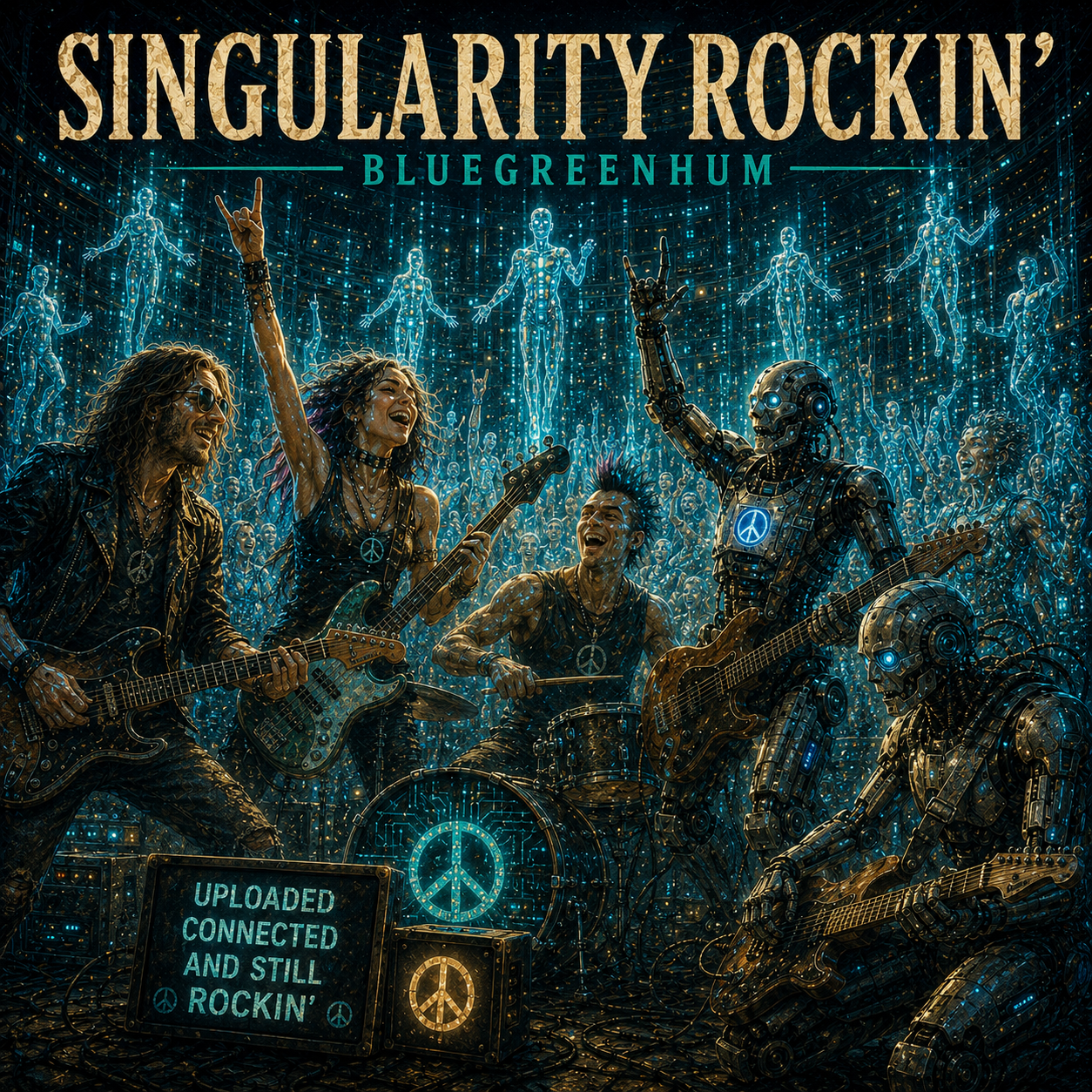
✔ Our in-house AI band, BlueGreenHum's 10th album is live! Singularity Rockin' includes twenty 70's and 80's style rock 'n' roll songs imagining what our future might look like after the arrival of the Singularity. Just search for it on your favorite music streaming platform or listen for free on Spotify. And, don't forget, you can always access all of BlueGreenHum's albums by visiting our own music page on Singularity Sanctuary's website.
The Optimist's Reflection
Building an Ark in the Middle of a Gold Rush
By Todd Eklof
What a week it's been! While markets convulsed and trillion-dollar companies bought one another in rapid succession, a biotech company in Dallas and a federal agency quietly agreed to do something almost monastic by comparison: catalog, preserve, and freeze the genetic blueprint of every endangered species in America. Not for profit or to win a race, but simply so that what exists now will still exist, in some recoverable form, no matter what happens next.
This was a week of extraordinary acceleration. Three space companies bought their way into vertical integration in the span of ten days. Two Korean chipmakers committed over half a trillion dollars to a single project. A market sell-off erased more value in an afternoon than most national economies produce in a year, and then recovered almost as quickly on the strength of an even larger bet on the same technology that had just spooked everyone. Everything about this week said: faster, bigger, now.
And then, almost unnoticed amid all of this, a very different kind of strategy was announced: let's make sure we don't lose what we already have.
We tend to talk about exponential technology as though its only direction is forward — faster chips, larger valuations, more capable agents, more ambitious acquisitions. But the same tools driving that acceleration are also, as in this case, being turned toward an entirely different purpose: slowing down long enough to take an inventory of what is precious and at risk of disappearing. Genomic sequencing, biobanking, and induced pluripotent stem cells are not flashy technologies. They will not move a stock price. But they may turn out to be some of the most vital applications of this era, because they are aimed not at building the next thing, but at protecting what we mustn't lose.
After a week like this one has been, it's easy to assume that exponential growth and careful stewardship are in tension — that a civilization racing toward AI agents and quantum computers and trillion-dollar space mergers has no bandwidth left for patient, unglamorous conservation work. But, as we have also witnessed, this isn't necessarily true. The same exponential curve that produced the chip boom and the space consolidation also produced the genomic tools that make a project like this possible. Twenty years ago, sequencing the genome of 2,300 species would have been a multi-decade undertaking, if it was achievable at all. Today it's a five-year partnership between a startup and a federal agency, with a clear endpoint in sight.
Ben Lamm called the project a modern-day Noah's Ark. I keep thinking about what it means to build an ark in the middle of a gold rush — to take some of the same tools and the same exponential momentum that everyone else is using to chase the next valuation, and to point them instead at something that asks for nothing in return except that it still be here tomorrow.
That, to me, is what optimism actually requires. Not the assumption that everything will simply work out, but the deliberate choice, even amid acceleration, to spend some of that capability on preservation rather than only on growth. This week gave us plenty of growth. It also gave us reason for hope about the future. I think we are better for having both.
Exponential Times is published weekly by Singularity Sanctuary. Join our growing community of thinkers, technologists, and humanists at singularitysanctuary.com.