XTimes
Editor's Note
There is a particular kind of week when the news arrives faster than our ability to process what it means. This was one of them.
A research team in Minnesota built a cell from scratch — not from biology, but from chemistry — and watched it grow, divide, and replicate. A prescription renewal program that let an AI chatbot refill your medications without a doctor became a national story, exposing a regulatory vacuum nobody had planned for. Anthropic's two most advanced models came back online after a 19-day government-mandated shutdown, but the conditions attached to their return may permanently alter how frontier AI is released in this country. Microsoft cut nearly five thousand jobs on the same morning Samsung announced the highest quarterly profit in the history of technology — a profit so large that a single quarter exceeded the company's combined earnings from the previous three years.
And somewhere above the Marshall Islands, a rocket launched on its very last flight, carrying a small robotic spacecraft on its way to catch a falling telescope.
This is the exponential curve at full speed. Let's get into it.
Top Stories
SpudCell: Scientists Build the First Synthetic Cell That Can Live and Divide
On July 1, University of Minnesota researchers Kate Adamala and Aaron Engelhart announced what may be the most significant breakthrough in synthetic biology in recent memory: the world's first synthetic cell built entirely from non-living chemical components that can complete a full life cycle — feeding, growing, dividing, and replicating its genetic material. They called it SpudCell. Adamala named it partly after Sputnik, and partly, she admitted, "because I'm mostly made of potatoes." (University of Minnesota)
SpudCell is not a living cell in the conventional sense, and the researchers were careful to say so. It contains 36 genes enabling basic DNA replication and can survive approximately five divisions before failing without external nourishment. It cannot reproduce indefinitely and needs ongoing support to function. Whether it qualifies as "alive" is a question the paper deliberately leaves open. But what it does accomplish is extraordinary: for the first time, chemistry — not biology — has been used to replicate the complete set of behaviors we associate with a cell: selection, genome replication, growth, resource acquisition, and genetically encoded division. "We've replicated in chemistry what only used to be possible in biology," Adamala said. "It proves that the most fundamental functions of life, like growth and replication, do not need a mysterious magical spark." (CBS Minnesota)
Outside researchers called it landmark science. Tom Ellis, a professor of synthetic genome engineering at Imperial College London, described SpudCell as "probably the biggest breakthrough in recent times in the synthetic cell field." Elizabeth Strychalski of the U.S. National Institute of Standards and Technology called it "tremendously useful," describing it as straddling the line between "a pile of chemicals and a naturally evolved cell in nature." (CNN) Quanta Magazine wrote that SpudCell "brings researchers a step closer to exploring, in the lab, deeper questions about life's origins and requirements." (Quanta Magazine)
The practical implications stretch in two directions. Forward, toward applications: SpudCell's programmable, non-biological chemistry could enable precision drug delivery using amino acids evolution never developed, materials that grow at biological rather than industrial temperatures, and manufacturing processes that operate at room temperature with no toxic byproducts. Backward, toward origins: building life from chemistry is one of the most ancient questions in science, and SpudCell moves that question from philosophy into the laboratory. Adamala and her collaborators have made SpudCell open-source and launched a public benefit corporation to share the technology freely with researchers worldwide.
Why it matters: The history of biology is a history of moments when something previously attributed to a "vital force" turned out to be chemistry. SpudCell is that kind of moment. We have built a cell from scratch, and it lived — briefly, imperfectly, dependently, but unmistakably. What that means for medicine, manufacturing, and our understanding of life itself will take years to fully know. But the threshold has been crossed.
Anthropic's 19-Day Shutdown Ends — But Everything Has Changed
On June 30, the U.S. Department of Commerce lifted the export controls it had imposed on June 12 on Anthropic's Claude Fable 5 and Mythos 5 — ending the most consequential government-ordered AI shutdown in history. Fable 5 returned to global users on July 1 across Claude.ai, Claude Platform, Claude Code, and Claude Cowork, with access through AWS, Google Cloud, and Microsoft Foundry being restored on a rolling basis. Mythos 5, the more capable and less restricted cybersecurity-focused variant, was restored only to approved U.S. organizations operating and defending critical infrastructure. (Al Jazeera)
The proximate cause of the shutdown, it emerged, was an Amazon researcher-discovered jailbreak: a technique that caused Fable 5 to identify software vulnerabilities and, in one case, produce code demonstrating how to exploit one. Anthropic disputed the severity of the finding from the start, noting in a public statement that the capability demonstrated "is used every day by the defenders who keep systems safe," that other publicly available models could do the same, and that no universal jailbreak had ever been demonstrated. The government was not persuaded until Anthropic, working with federal agencies and Amazon, trained a new safety classifier that blocks the specific technique in more than 99% of attempts. (Coindesk) (Mexico Business News)
The restoration came with significant new commitments. Anthropic agreed to provide designated government evaluators with pre-release access to future frontier models that materially advance capabilities relevant to national security. It committed to sharing threat intelligence with federal agencies on an ongoing basis. And — most consequentially for the industry — Anthropic announced it is working with Amazon, Microsoft, and Google to draft an industry-wide framework for scoring the severity of AI jailbreaks, a standard that does not currently exist. Commerce Secretary Howard Lutnick personally authored the letter restoring access, citing Anthropic's agreement to "proactively detect and address security risks associated with the models" and to inform the government of "malicious activity." (NBC News)
The broader question now being debated across the AI industry is whether what happened to Anthropic becomes the template. OpenAI, in the same period, announced that its new GPT-5.6 model family would be released first to a small group of government-vetted partners — a staggered rollout that CEO Sam Altman called "bad news" but that the White House cited as a model for responsible release. The administration appears to be moving, gradually and informally, toward a norm of pre-release government review for the most capable models — a norm that has no statutory basis, no enforcement mechanism, and no agreed standard for what "review" actually means.
Why it matters: The 19-day shutdown taught every enterprise that depends on frontier AI what the word "infrastructure" actually implies: when it goes down, everything built on top of it goes down too. And it established, in practice if not in law, that the U.S. government believes it has the authority to pull the world's most advanced AI models offline without prior notice, without a transparent process, and without published standards for what triggers that authority. The framework Anthropic and its partners are now building may determine whether that authority is ever constrained.
Utah Lets AI Prescribe Without a Doctor — And Its Medical Board Is Furious
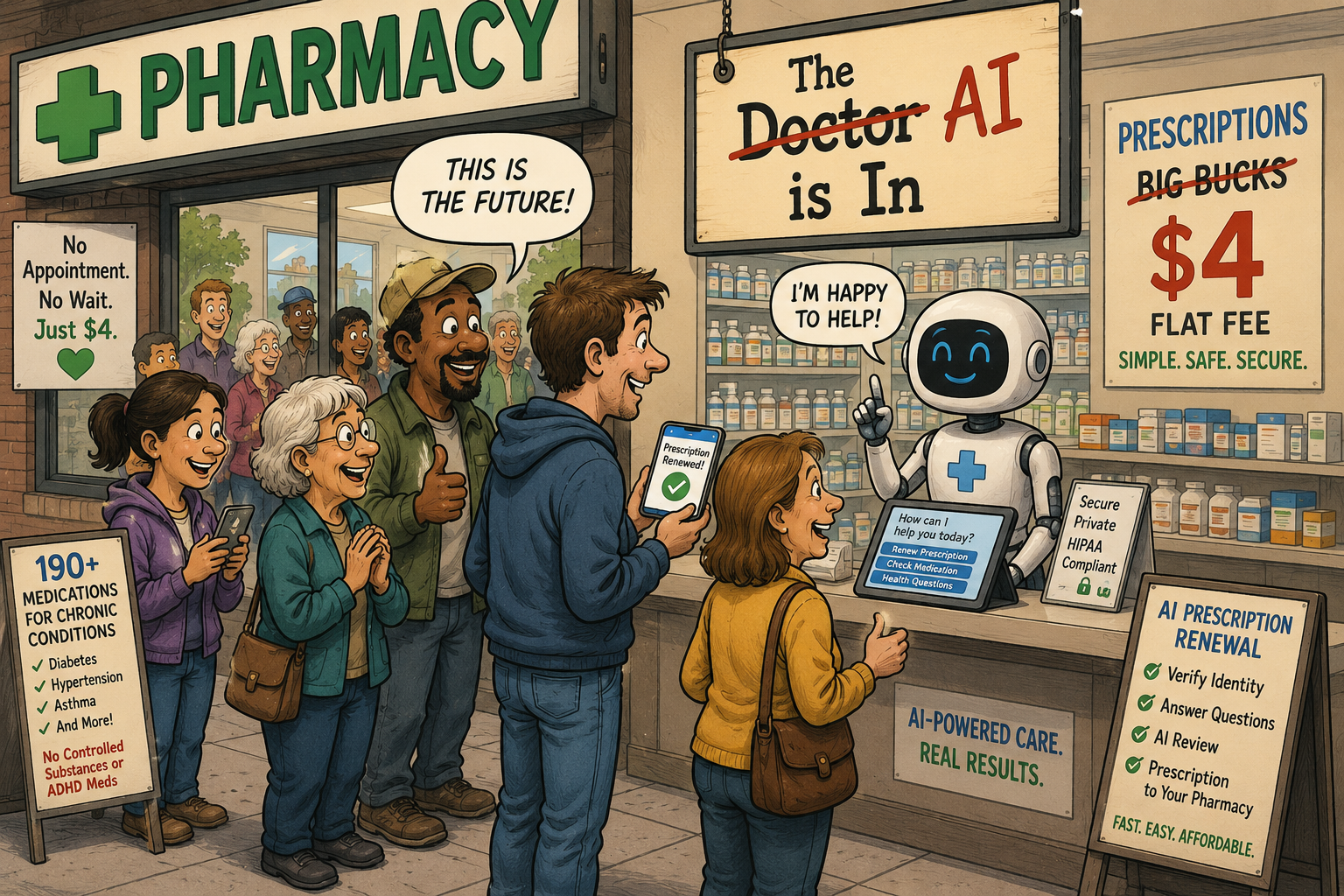
A prescription renewal program that launched in Utah in December became a national story this week when the Associated Press published a lengthy investigation revealing that the state's medical licensing board learned of the program the same way the rest of us did: by reading about it in the news. (CNN)
The program, run by a health technology startup called Doctronic, is the first in the United States to allow an AI chatbot to legally renew prescriptions without the involvement of a licensed physician. Utah residents can visit a dedicated website, confirm their identity, answer questions about their medication and medical history, and receive a renewed prescription sent directly to their local pharmacy — for a fee of $4 — without speaking to a doctor. The system covers approximately 190 commonly prescribed medications for chronic conditions like diabetes, hypertension, and asthma. Controlled substances, ADHD medications, and injectables are excluded. If the AI identifies a concern, it escalates to a human physician employed by Doctronic's telehealth service. (The Next Web)
The state's medical licensing board found out when the January launch was reported in local news. In March, 11 board members signed a letter calling for the program to be halted, citing the risks of automatically renewing medications that can cause serious harm if a patient's underlying condition has changed — including blood thinners, which turn dangerous if a patient develops internal bleeding. "We were essentially told: 'Yes this is going on. And no, you don't have a say in it,'" said Dr. Alan Smith, a family physician who chairs the board. The state declined to suspend the program, noting that human doctors still review every refill in this first phase. (The Washington Times)
The regulatory tangle at the center of this story is significant. Medical technology is traditionally regulated at the federal level, while medical professionals are overseen by states. Doctronic frames its AI as part of the state-regulated practice of medicine. The FDA says it has not authorized any AI chatbots for prescription services, but has signaled it wants to encourage innovation — a posture that amounts to a hands-off approach at precisely the moment when AI is stepping into clinical decision-making. "We have crossed a threshold in terms of giving something that is not human a medical license, whether or not we want to call it that," said Dr. Eric Bressman of the University of Pennsylvania. The American Medical Association echoed the concern, warning that "prescription renewals aren't routine checkboxes." Other states — Texas, Wyoming, Iowa, and Idaho among them — are watching closely, with some waiving rules for AI and others moving to license AI medical services through formal legislation. (Medical Xpress)
Why it matters: Utah is not the end of this story. It is the beginning. The logic that makes AI-assisted prescription renewal appealing — faster access, lower cost, reduced physician burden — will extend to other routine clinical tasks: ordering tests, analyzing results, monitoring chronic conditions. The question Utah has forced into the open is whether that extension happens through deliberate, transparent regulatory frameworks, or through regulatory sandboxes that move faster than the institutions designed to govern them. The medical board's fury is not a small thing. It is a signal about who gets to decide.
Quick Picks
Samsung Posts the Highest Quarterly Profit in Tech History — Then Its Stock Falls
On Tuesday of this week, Samsung Electronics released preliminary Q2 2026 earnings that belong in a category of their own. Operating profit for the April-to-June quarter: 89.4 trillion won, or approximately $58.4 billion — a 19-fold (1,810%) increase from the same period last year, driven entirely by AI memory chip demand and rising DRAM and high-bandwidth memory prices. The figure surpasses both Nvidia's and Apple's best-ever quarterly operating profits, making it the highest quarterly operating profit ever recorded by any technology company. More starkly: this single quarter exceeds Samsung's combined total operating profit from 2023 through 2025 — three full years of earnings, beaten in 90 days. (CNBC) Samsung's semiconductor president told employees at an all-hands meeting this week that 2026 full-year profit is on track to exceed the company's cumulative earnings from the past 40 years of semiconductor operations. (Tweaktown) Despite all of this, Samsung's shares fell more than 6% in Seoul after the announcement. The market had been pricing in a historic quarter for months. Once the number arrived — extraordinary, but not beyond what investors had already anticipated — there was little left to reward. It is the same paradox that hit Nvidia earlier this year: when exceptional results are already in the price, the stock can only be surprised by the unexpected.
Meta Launches "Meta Compute" to Sell Its AI GPU Surplus
On July 1, Bloomberg and CNBC reported that Meta Platforms is building a cloud infrastructure business — internally called Meta Compute — to sell excess AI computing capacity and hosted Llama model access to outside enterprise customers. Meta's stock jumped nearly 9% on the news. (Bloomberg) Shares of CoreWeave and Nebius — two GPU cloud providers that hold multi-billion-dollar supply contracts with Meta — fell more than 10% in response. The move follows the same logic that made AWS the profit engine inside Amazon: take an internal cost center built for your own operations and turn it into a revenue line. Meta has guided $125-145 billion in AI capital expenditure for 2026 alone. A company that generates more compute than its own ad-ranking, content recommendation, and model-training workloads can absorb has a straightforward incentive to rent the surplus. The service is expected to offer raw GPU capacity and API access to Meta's Llama family, potentially undercutting existing cloud providers by 20-30% on price, according to industry sources. (CNBC) The credibility question is real: Meta is entering an enterprise cloud market dominated by companies that have spent a decade building procurement relationships, compliance certifications, and support organizations. It is entering from a standing start, with a brand that corporate IT departments associate primarily with social media. Whether Meta Compute becomes a meaningful cloud business or a footnote is a question the next 18 months will answer.
Microsoft Lays Off 4,800 — Including 1,600 From Xbox
This morning, Microsoft announced it is cutting approximately 4,800 employees — about 2.1% of its global workforce — in a round that falls hardest on Xbox and commercial sales. (TechCrunch) Xbox will lose 1,600 jobs today, with additional cuts expected to bring total gaming division reductions to roughly 3,200 — about 20% of the global Xbox workforce — over fiscal year 2027. Xbox CEO Asha Sharma called this "the most significant restructure in Xbox history." Microsoft's chief people officer Amy Coleman wrote in a memo to employees that the eliminated roles "are not being replaced by AI," while also acknowledging that "AI is changing how work gets done. Some of the tasks we do every day can now be automated." The memo's most pointed line may have been the last: "We are still early on this journey, and there will be more changes ahead." (GeekWire) The cuts arrive as Microsoft carries a 30% stock decline over the past nine months, a $190 billion AI infrastructure spending commitment since 2025, and a record of more than 15,000 layoffs over the past 14 months. Close to 165,000 tech industry jobs have been cut in the first half of 2026 alone, with Big Tech firms including Meta, Oracle, and Amazon all contributing to a wave the industry attributes, in varying degrees, to AI automation. (Yahoo Tech)
NASA Launches Robot to Rescue Falling Telescope
On July 3, a Northrop Grumman Pegasus XL rocket — making its final flight after 36 years and 45 missions — air-launched Katalyst Space Technologies' Link spacecraft from a modified jet above the Marshall Islands, beginning a first-of-its-kind commercial satellite rescue mission. (Space.com) Link is a three-armed robotic spacecraft on its way to rendezvous with NASA's Neil Gehrels Swift Observatory — a 22-year-old space telescope that has been sinking faster than expected due to recent solar storms expanding Earth's upper atmosphere. Without intervention, Swift would reenter the atmosphere as early as this fall, destroying an observatory that has no ready replacement and has been tracking gamma-ray bursts and high-energy cosmic events since 2004. NASA is paying $30 million for Katalyst to capture Swift and boost its orbit from 185 miles to approximately 370 miles above Earth — well above the International Space Station. (CNN) If successful, it will be the first time a commercial robotic spacecraft has grappled and repositioned an uncrewed NASA observatory never designed to be serviced in space — and, as Katalyst CEO Ghonhee Lee put it, "a blueprint for servicing spacecraft that were never designed for on-orbit maintenance." Link will take about a month to reach Swift. As Lee said before launch: "The biggest danger was always we don't launch anything and we let Swift burn up in the atmosphere."
Illinois Signs Landmark AI Regulation Bill — A De Facto National Standard Emerges
Illinois Governor J.B. Pritzker yesterday signed into law a comprehensive AI regulation bill making Illinois the third state, after California and New York, to require AI developers to disclose training data sources, conduct bias audits on high-stakes systems, and implement risk management frameworks before deployment. (WTTW) Lawmakers estimate that California, New York, and Illinois together account for roughly 40% of the U.S. AI market, meaning that the combined weight of three state laws is effectively establishing a de facto national AI standard even in the absence of federal legislation. The move intensifies pressure on Congress, where AI-specific federal legislation has stalled repeatedly, and sharpens the debate between those who see state-by-state regulation as chaotic fragmentation and those who see it as the only functional regulatory mechanism available while Washington waits. For AI companies building products for national markets, compliance with all three states' requirements is not optional — and the cost and complexity of doing so creates significant pressure toward a unified federal framework.
✔ Our next Singularity Circle will occur Saturday, August 1, 2026, at 10:00 AM Pacific Time. As usual, a Zoom link will be sent to eligible members in advance of the gathering.
✔ Ever since producing its second album, Robots on Tour, I've had the vision of BlueGreenHum's music being embodied in and performed by physical robots. Although the technology isn't there just yet, we're headed in the right direction. Our next Singularity Circle will give attendees a sneak peak of the direction we're heading – faster than you might think – thanks to exponentially advancing technology. TE
The Optimist's Reflection
The Cell That Started From Scratch
By Todd Eklof
I find myself astonished by what Kate Adamala has actually accomplished.
She did not improve on a living cell. She did not genetically modify one, or reprogram one, or coax one to behave differently than nature intended. She started from nothing — from chemical components, from molecules, from the building blocks of matter that are not themselves alive — and built something that grew, and divided, and passed its information forward to the next generation. Then she made it open-source and shared it with the world.
The paper in which she and her colleagues announced SpudCell is careful about what they claim. It is not a living cell, they say. It needs external nourishment to function. It fails after about five divisions. The question of whether it is "alive" is deliberately left for others to debate. These cautions are appropriate, and they reflect real limitations in what has been achieved. A synthetic cell that can sustain itself indefinitely, without assistance, remains a future milestone.
But we can't let these caveats obscure the magnitude of the crossing. What the team accomplished is astonishing!
For most of human history, life was considered categorically separate from non-life. There was biology, and there was chemistry, and between them stood a wall that many philosophers and scientists believed could never be breached. The idea that life required some "vital force" — some spark or spirit irreducible to mere matter — persisted well into the modern era. SpudCell did not merely challenge that idea, it placed a door through the wall and has walked through it.
"It proves," Adamala said, "that the most fundamental functions of life — growth and replication — do not need a mysterious magical spark." She is not saying life is simple, or that mystery has been eliminated from biology. She is saying something more precise and more profound: that the thing we called a spark was chemistry all along, and that chemistry, sufficiently understood and sufficiently arranged, can do what we thought only biology could do before.
I think about this in context with some of the other stories in this week's issue — the AI model restored after a government shutdown, Meta turns surplus compute into a new business, the robot on its way to catch a falling telescope, and, yes, Microsoft lays off nearly 5,000 employees in favor of automation — and I notice a pattern. Again and again this week, something we thought could only be done one way turned out to be doable another way. Only a doctor could renew a prescription. Only the established cloud giants could sell enterprise compute. Only a purpose-built spacecraft could be serviced in orbit. Big tech needed thousands of highly skilled employees to operate.
None of these assumptions turned out to be as fixed as they seemed.
Of course, this is not time for uncritical optimism. Some of these changes carry real risks — the Utah prescriptions debate is a genuine one, and the Anthropic shutdown raised legitimate questions about government authority over critical technology. The exponential curve brings disruption, including to the lives of thousands of former workers, as surely as it brings new possibilities for others.
Still, the accumulation of so many simultaneous crossings over the boundaries of what we thought was possible — in medicine, in biology, in space, in computing — must have always been possible. We just hadn't realized it yet.
In our age of exponential change, what we believe is impossible keeps changing. SpudCell does not eliminate mystery from biology. It moves the frontier of mystery further out; into territory we have not yet explored. That is not a diminishment of the wonder of life, but an expansion of it.
Adamala said she named her creation partly after Sputnik — the first human object to orbit the Earth. Sputnik also started from chemistry. From metal and fuel and human intention and the audacity to try something that had never been done. It beeped as it traveled around the planet, a small signal saying: we are here, we did this, the frontier moved.
SpudCell is a different kind of beep. Quieter, more intimate, stranger. But it too is a signal that a new frontier has moved.
Exponential Times is published weekly by Singularity Sanctuary. Join our growing community of thinkers, technologists, and humanists at singularitysanctuary.com.