XTimes
Editor's Note
There are weeks when the exponential curve feels abstract — a chart, a trend line, another math problem solved, a thing happening somewhere else. This was not one of those weeks. Since last week's issue, SpaceX went public in the largest IPO in history, and by the time the closing bell rang, Elon Musk had become the first trillionaire in human history. Four days later, SpaceX spent $60 billion of that freshly minted capital to buy an AI coding company. In the same stretch of days, the U.S. government shut down Anthropic's two most advanced AI models worldwide — the latest escalation in a year-long feud that may have far less to do with safety than its official justification suggests.
Money, power, and the struggle to govern both moved at a pace this week that made the rest of the news cycle feel almost quaint by comparison. And yet the rest of the news cycle mattered too: Britain announced the most restrictive child social media law in the democratic world, Google's CEO got a pointed reminder that young people are no longer simply dazzled by Silicon Valley, and a small chip in Hong Kong may have just solved one of quantum computing's most stubborn physical problems.
This is a big issue. It was a big week.
Top Stories
SpaceX Goes Public, Musk Becomes History's First Trillionaire — Then Buys an AI Company
On June 12, SpaceX priced its initial public offering at $135 per share, raising $75 billion in the largest IPO ever recorded. By the close of its first day of trading, shares had surged 19% to $160.95, pushing the company's market capitalization past $2.1 trillion and making it the sixth most valuable company in the United States — ahead of Broadcom, behind Amazon. (CNBC) Elon Musk's stake alone was valued at roughly $690 billion, and his total net worth crossed $1 trillion for the first time — a threshold no human being has ever reached. (Al Jazeera)
The valuation arrives despite financials that would sink most companies: SpaceX posted an $18.7 billion revenue but a $4.9 billion net loss in 2025, and trades at roughly 112 times last year's revenue. (ABC News) Some analysts see a company on the verge of transforming space, satellite internet, and AI infrastructure all at once. Others see pure momentum. Morningstar put SpaceX's fair value closer to $780 billion — barely a third of where the stock closed. "This was not a deal that was priced based on market forces," one investment banker told CNBC. "This was a deal based on what one man wanted."
Four days later, that one man put the new capital to work. On June 16, SpaceX formally agreed to acquire Cursor — the AI coding startup behind one of the most popular "vibe coding" tools on the market — for $60 billion in an all-stock deal, converting an option SpaceX had quietly secured back in April. (Reuters via Yahoo Finance) The acquisition is meant to give xAI — the Grok-maker that merged with SpaceX in February — a stronger foothold in AI coding tools, a category where it has lagged well behind OpenAI and Anthropic. Cursor, which generates roughly $2.6 billion in annualized business revenue, had been close to raising a new round that would have valued it at $50 billion before SpaceX's offer outbid the market entirely. (TechCrunch) The deal is expected to close in the third quarter.
Why it matters: In the space of one week, the world watched its first trillionaire emerge and immediately reinvest a meaningful fraction of that wealth into consolidating power in the AI industry. Whatever one believes about SpaceX's valuation, the velocity here is the story: capital, AI capability, and personal fortune are now compounding on a timescale of days, not years. The rules that used to govern how fast power and wealth could accumulate in a single set of hands appear to no longer apply.
The Government Shut Down Anthropic's Newest Models — But Was It Really About Safety?
On June 9, Anthropic released two new models: Claude Fable 5 to the general public and Claude Mythos 5 to a restricted group of approved users. Three days later, on Friday evening, the U.S. Commerce Department sent Anthropic a letter invoking an export control directive, banning all foreign nationals — including Anthropic's own employees — from accessing either model, citing unspecified national security concerns. (TechCrunch) Unable to verify the nationality of every user across every platform and cloud partner, Anthropic concluded it could not selectively comply — so it shut both models down entirely, for everyone, worldwide. (CNN)
Anthropic has said it believes the directive may relate to a discovered method for bypassing the models' safety guardrails — though the government's letter, which has not been made public, did not specify. (The Conversation) But a more recent TechCrunch report suggests the official explanation may not be the real one — that the directive is better understood as the latest escalation in a much longer-running dispute between Anthropic and the U.S. government. (TechCrunch)
That dispute dates back to earlier this year, when the Pentagon demanded Anthropic loosen its usage policies to allow Claude models to be used for fully autonomous weapons systems and domestic mass surveillance — guarantees Anthropic refused to give. (NBC News) President Trump responded by ordering every federal agency to cease using Anthropic's technology entirely, and Defense Secretary Pete Hegseth designated the company a "Supply-Chain Risk to National Security" — a label typically reserved for foreign adversaries, which bars military contractors from doing business with the firm. Anthropic sued over the designation, calling it unlawful, and has already won an early round in that case. OpenAI, notably, announced a new Pentagon deal in the same window the Anthropic ban was first imposed.
Despite all of this, Anthropic was deeply involved in helping the White House draft its recent AI executive order, and its executives had reportedly been invited to a signing ceremony at the White House that was abruptly canceled. The relationship, in other words, is not simply adversarial — it is something messier: a company the administration may need and resent in roughly equal measure.
Why it matters: This is not a story about a model being unsafe. It is a story about what happens when a government decides an AI company's product is too independent — when a company's refusal to weaponize its own technology becomes, in the eyes of that government, a national security problem in itself. Whatever the real trigger for Friday's directive, the underlying conflict is now plainly visible: who gets to decide what AI is and isn't allowed to do, and what happens to a company that says no.
UK Bans Social Media for Under-16s in the Most Restrictive Child Safety Law in the World
On June 15, Prime Minister Keir Starmer's government announced it will ban social media platforms — including Snapchat, TikTok, YouTube, Instagram, Facebook, and X — from offering services to anyone under 16, following the model Australia adopted last year. (UK Government) Messaging services like WhatsApp and Signal will not be included.
The ban goes further than Australia's in several respects. Britain will also impose world-leading restrictions on harmful features — including livestreaming and stranger-to-child communication — that will apply by default to both 16- and 17-year-olds, in order to avoid a "cliff-edge" the moment a child turns 16. The government is separately examining overnight curfews and limits on infinite scrolling for under-18s, with details expected in July. Notably, the law also requires AI "romantic companion" chatbots — those designed to simulate sexual relationships or roleplay — to enforce a strict 18-plus minimum age, with similar restrictions on intimate AI chatbot functionality more broadly for minors.
"Parents want to keep their kids safe and happy, but the online world has made that harder than ever," Starmer said. "This is a line in the sand. Tech giants had their chance and failed, but we're stepping in to protect children, back parents, and set a new normal for future generations." The government says the policy is backed by nine in ten parents. Legislation is expected before Parliament by Christmas, with protections coming into force in spring 2027.
Why it matters: This is the most sweeping child-safety intervention any major democracy has attempted on social media and AI companion technology together. It arrives in the same season as Apple's platform-level child safety overhaul and Florida's lawsuit against OpenAI — three different governments and companies, on two continents, converging on the same conclusion: the current model of "let platforms self-regulate around children" has failed, and the political will to replace it with hard restriction has arrived.
Quick Picks
PepsiCo's Driverless Trucks Quietly Outpace Tesla's Robotaxis
While the tech world has been fixated on Tesla's robotaxi rollout, PepsiCo has accomplished something hardly noticed until now, and arguably more impressive: 41 fully driverless box trucks — no driver, no safety observer in the cab — operating across Arizona, Texas, and Arkansas, more autonomous vehicles on public roads than Tesla's entire unsupervised robotaxi fleet, which industry estimates put at 20 to 38 vehicles. (Food Dive) Built in partnership with autonomous logistics firm Gatik, the fleet has logged zero accidents and a 99% on-time delivery rate since going fully driverless in June 2025, hauling Doritos, Gatorade, and Pepsi products between distribution centers and retailers like Walmart and Dollar General. This week, PepsiCo announced a new multi-year expansion agreement with Gatik, bringing its total investment in autonomous freight to roughly $600 million. (FreightWaves) Gatik, Isuzu, and Nvidia are now building a dedicated production facility in South Carolina to begin mass-producing the trucks in 2027 — at volumes the company says will eventually reach the tens of thousands. The most successful full-autonomy deployment in America right now isn't carrying people. It's carrying snacks.
Pichai Faces a Stanford Walkout — Over Gaza, Not AI
When Sundar Pichai took the stage to deliver Stanford's 2026 commencement address on June 14, roughly 200 graduates stood and walked out, while others jeered, blew whistles, and unfurled banners. (TechCrunch) Unlike the wave of commencement protests that have dogged tech executives this spring over AI anxiety, this one was sharply targeted: organizers cited Google's $1.2 billion Project Nimbus contract, which provides cloud and AI services to the Israeli military, alongside the company's relationship with U.S. Immigration and Customs Enforcement. Students carried signs reading "GENOCIDE RUNS ON GOOGLE" and waved Palestinian flags. Pichai, who earned his graduate degree at Stanford, appeared to have anticipated some form of backlash and avoided the subject of artificial intelligence entirely in his remarks, instead urging graduates to choose optimism and pursue hard, exciting work. (Fortune) The protest drew sharp reactions online, including from venture capitalist Vinod Khosla, who called it "biased, idiotic, short-sighted and very selfish," and Congressman Ro Khanna, who defended the students' right to demonstrate regardless of one's views on the underlying contracts. Reasonable people hold sharply different views on the Israel-Gaza conflict driving this protest; what's notable for our purposes is simply that a tech CEO's reception on campus increasingly depends on factors well beyond AI.
A Brain-Inspired Chip That Runs Near Absolute Zero
Researchers at the University of Hong Kong have built a neuromorphic chip — one designed to mimic the energy-efficient "spiking" behavior of biological neurons — that functions at 10 millikelvin, a hair's breadth above absolute zero. (ScienceDaily) Published in Nature Communications, the breakthrough exploits a previously uncontrolled electronic effect in silicon carbide transistors — the same workhorse material used in EV power electronics — allowing a single transistor to reproduce the firing pattern of a biological neuron under extreme cold. The significance lies in what extreme cold has in common across two very different technologies: quantum computers must be cooled to nearly this same temperature to function, and the control electronics that manage today's qubits currently have to sit outside that cold chamber, creating a wiring bottleneck that limits how large a quantum system can scale. A neuromorphic chip able to operate directly inside the cold zone, beside the qubits themselves, could remove one of the most stubborn physical barriers to building bigger quantum computers — with a side benefit for deep-space probes, which also operate in extreme cold and need radically energy-efficient onboard computing. (HKU)
✔ Our next Singularity Circle will occur Saturday, July 4th, 2026, at 10:00 AM Pacific Time. A Zoom link will be sent to eligible members in advance of the gathering.
✔ BlueGreenHum, Singularity Sanctuary's in-house AI band, has its own Spotify channel that includes over 150 inspiring songs to listen to anytime throughout your day. Check it out here: BlueGreenHum on Spotify
The Optimist's Reflection
The Friction Is the Process
By Todd Eklof
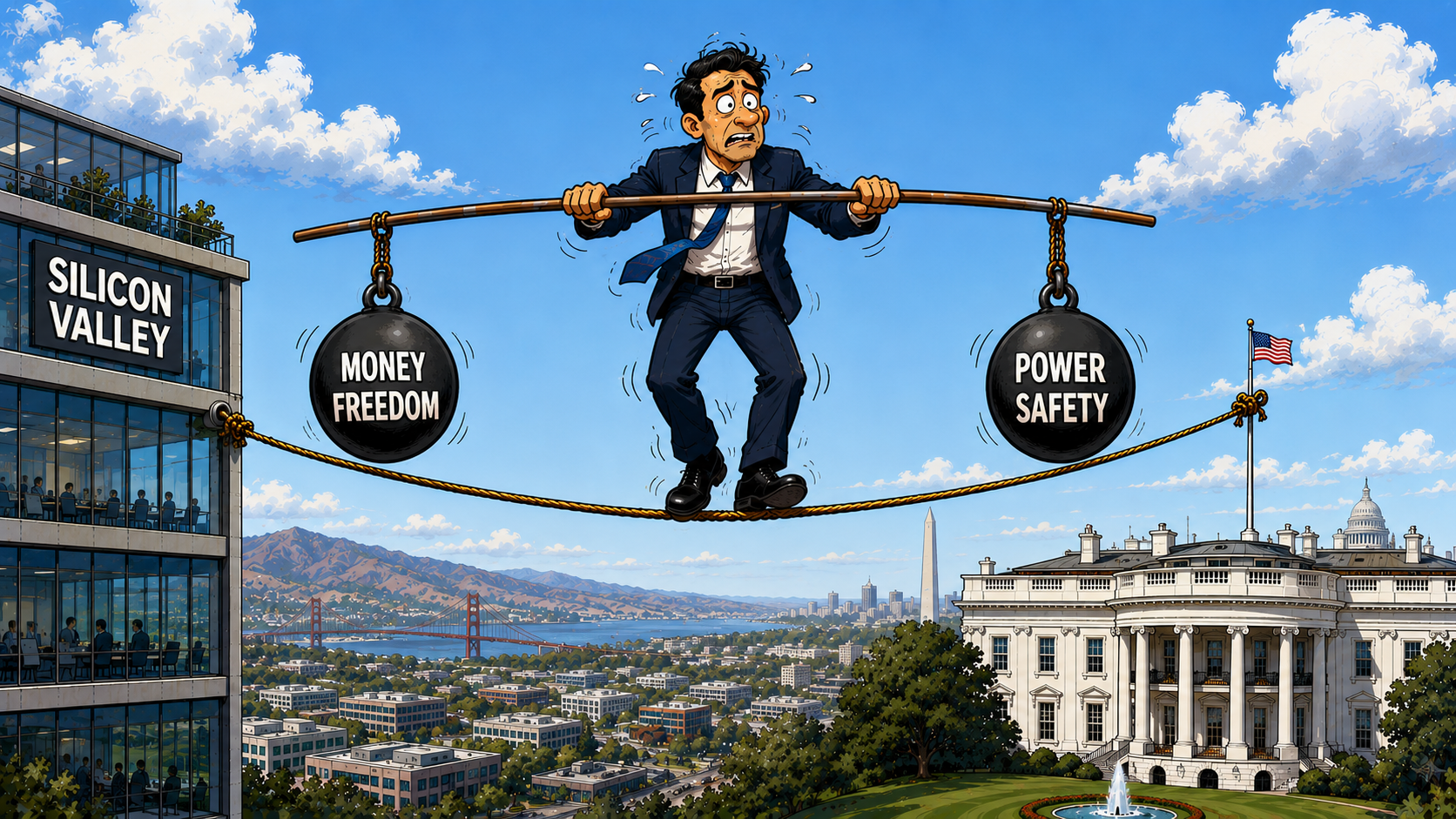
There is a temptation, when you survey a week like this one, to read all the conflict as evidence that something has gone wrong. Investors arguing past each other about whether SpaceX is worth $2.1 trillion or a third of that. A government and one of its own most important AI companies locked in an escalating standoff over autonomous weapons and surveillance. A nation debating how much freedom to take from its teenagers in the name of protecting them. Two hundred Stanford graduates standing up and walking out on a man many of them once admired. It would be easy to look at all of this and conclude that we are coming apart at the seams.
But maybe this is what it looks like when a civilization is actually working something out.
Consider the SpaceX disagreement. Nobody actually knows what a company like SpaceX is worth, because nobody has ever tried to price a company simultaneously building rockets, satellite internet, and frontier AI infrastructure. The wild divergence between the bulls and the skeptics isn't a sign that markets have broken. It's the market doing exactly what markets are for: a few hundred thousand independent judgments, in open conflict with one another, slowly grinding toward something like a consensus price. The disagreement isn't the malfunction. It is the mechanism.
Or consider the standoff between Washington and Anthropic. A company refused to let its technology be used for autonomous weapons and domestic surveillance, and a government punished it for that refusal. I find a great deal to be uneasy about how the administration has handled this. But I notice something else too: the fact that this fight is happening, openly, with lawsuits and public letters and journalists tracking every move, means the question of what AI should and shouldn't be allowed to do is being contested rather than quietly decided behind closed doors. A year ago, most people didn't know this fight existed. Now it's a story in every major outlet. That's important. Visibility is the precondition for accountability, and accountability is the precondition for getting it right.
The UK's social media ban sits inside its own real tension, between child welfare and individual liberty, and I don't think that tension resolves easily or should. But a democratic government debating, in public, how to draw that line is a healthier sign than a society that has stopped debating it at all — either because it has given up on protecting children or because it has given up on caring about freedom. The friction between those two values is exactly what keeps either one from running away unchecked.
And the Stanford walkout. Although I have my own strong opinions about the matter, I have no interest in adjudicating the Israel-Gaza conflict in these pages. But I'll say this: a generation of new graduates who are willing to stand up, in front of cameras and future employers, and tell a tech titan to his face that they disagree with his company's choices, is a generation that has not been cowed into passivity by power or prestige. Whatever you think of the specific cause, the willingness to make power answer to conscience is precisely the muscle every healthy society needs to keep exercised.
Social psychologist Erich Fromm suggested that the human task is not to escape contradiction but to live through it productively, to use the tension between opposing needs as the very engine of growth rather than treating it as a problem to be eliminated. A world with no conflict in it would not be a world at peace. It would be a world where someone had already won, permanently and completely, and the rest of us were simply living inside their answer.
I'd rather live in the noisy, contested version. The arguments happening in plain sight this week, about money and power and safety and freedom, are not proof that we're losing our way. They're proof that the way is still being made, by people who haven't stopped insisting it matters how we get there.
Exponential Times is published weekly by Singularity Sanctuary. Join our growing community of thinkers, technologists, and humanists at singularitysanctuary.com.