XTimes
Editor's Note
There is a particular kind of cognitive dissonance that defines our moment, and this week illustrated it with unusual clarity. On Thursday, Anthropic — one of the fastest-moving companies in the history of artificial intelligence — published a paper warning that AI systems may be on the verge of beginning to improve themselves, and called on the entire industry, including itself, to prepare for a coordinated slowdown if that threshold is crossed. On Monday of the same week, Anthropic filed a confidential draft S-1 with the Securities and Exchange Commission, initiating the process of going public at a valuation approaching a trillion dollars.
These are not contradictory acts. They are the same act, seen from two different angles. The people who understand this technology most deeply are the ones most urgently warning about it — and also the ones most urgently building it. That is not hypocrisy. It is the defining condition of our time.
This week also brought us a presidential executive order on AI that asks nicely rather than requires; the first microreactor to achieve criticality on American soil in decades; record public support for nuclear energy; Apple's most significant child safety overhaul in the company's history; and evidence that Google's stranglehold on the world's information is dissolving — one unanswered question at a time.
Top Stories
Anthropic Sounds the Alarm — Then Files for Its IPO
On June 5, Anthropic published a paper warning that artificial intelligence may be approaching what researchers call recursive self-improvement — the point at which AI systems begin designing and building their own successors with little human input. The company called on all frontier AI labs, including itself, to be ready to implement a coordinated and verifiable slowdown if that threshold is crossed. (Scientific American)
The warning is not abstract; Anthropic noted that its own systems are already being used to accelerate the pretraining research that makes future Claude models possible — AI improving the process that makes AI. The company acknowledged that the computing infrastructure required to train frontier models is so vast and distributed that monitoring, let alone enforcing, any meaningful pause would be extraordinarily difficult. What Anthropic is proposing is less a brake than a fire alarm: a commitment, shared across the industry, to recognize the moment and act on it. (Al Jazeera)
Four days earlier, on June 1, Anthropic had confidentially submitted a draft S-1 registration statement to the Securities and Exchange Commission — the formal first step toward an initial public offering. (Anthropic Newsroom) The filing follows a Series H funding round that valued the company at $965 billion post-money and a revenue trajectory that has the company projecting its first quarterly operating profit. If the IPO proceeds at that valuation, it would be the largest debut of an AI company in history.
The juxtaposition is not lost on observers. Anthropic is simultaneously the company most publicly committed to AI safety, the company warning most urgently about the risks of the technology it builds, and the company racing most visibly toward a trillion-dollar market capitalization. Its co-founder stood beside the Pope at the Vatican last month while the encyclical called for AI to be disarmed. Its CEO wrote an essay imagining AI systems with the intellectual capabilities of Nobel Prize winners arriving by late 2026. Its researchers are now warning that those systems may begin improving themselves before anyone has agreed on what to do about it.
There is no clean resolution to this tension, but it still needs to be considered. The companies that understand the risk most clearly are also the ones most structurally committed to advancing it. That is the world we are living in.
Why it matters: Recursive self-improvement — AI accelerating its own development — has long been the theoretical threshold beyond which human oversight becomes exponentially harder to maintain. Anthropic's paper does not claim that threshold has been crossed. It claims it may be close. If the company that built the technology is calling for a coordinated pause plan, the rest of us should probably be paying attention.
Trump's AI Executive Order: A Framework Built on Asking Nicely
After last month's aborted signing ceremony — when lobbying calls from Elon Musk, Mark Zuckerberg, and David Sacks killed a draft the White House was ready to sign — President Trump signed his AI executive order on June 2, alongside Senate Commerce Committee Chairman Ted Cruz and Commerce Secretary Howard Lutnick. (NBC News)
The order, titled "Promoting Advanced Artificial Intelligence Innovation and Security," directs federal agencies to develop benchmarks for assessing the cybersecurity capabilities of frontier AI models and establishes a mechanism for the government to test those models before public release. The key word is voluntary: AI companies are asked, not required, to submit their most powerful models to the government for up to 30 days of testing before release. The order explicitly bars any mandatory licensing or pre-clearance regime. (NPR) The earlier draft had required 90 days; that was cut to 30 and made optional after industry pushback.
The order also directs agencies to establish an "AI cybersecurity clearinghouse" to review and share information on model vulnerabilities, and calls for broader hardening of critical infrastructure against AI-enabled attacks. On the same day, Anthropic expanded Project Glasswing — its initiative to deploy Claude Mythos Preview with a select group of trusted cybersecurity organizations. The White House cited Glasswing as a model for the kind of voluntary collaboration the order is designed to encourage. (CNBC)
The administration has been pulled in two directions throughout: national security officials who want oversight of the most capable models, and the tech industry's allies who want no regulation at any cost. The result is a document that gestures toward oversight while ensuring that oversight has no enforcement mechanism.
Why it matters: The United States now has its first AI executive order with actual safety architecture — voluntary though it is. Whether AI companies choose to participate, and whether 30 days of government testing before release means anything in practice, are the questions that will determine whether this order matters at all. The administration chose innovation over precaution. Anthropic, in the same week, was arguing that precaution may soon be the only thing that matters.
Google's Quiet Reckoning: The Search Era Is Ending
It did not happen with a single announcement or a dramatic market event. It is happening the way most profound shifts happen — gradually, then all at once. The search monopoly that Google has held for two decades is dissolving, and this week's data makes the trajectory unmistakable.
The numbers from Chartbeat, covering thousands of publisher sites, are stark: Google referral traffic to publishers fell 33% globally in the year to November 2025, with U.S. publishers hit harder at 38% down year-over-year. (AdExchanger) Sixty percent of all Google searches now end without a single click to any website. For queries where Google's AI Overviews appear, that zero-click rate reaches 80 to 83%. ChatGPT now handles an estimated 12% of Google's daily search volume — and unlike Google, it sends almost no traffic anywhere. (ALM Corp)
Google is not a passive victim of this shift. At I/O in May, the company announced what it called the biggest upgrade to Search in 25 years — a full AI Mode powered by Gemini that has already surpassed one billion monthly users, with queries doubling every quarter since launch. "Information Agents" arriving this summer will monitor the web around the clock on a user's behalf, delivering synthesized updates rather than lists of links to click. The zero-click rate inside AI Mode reaches 93%. Google is not losing the search era so much as it is voluntarily ending it — and betting that it can own whatever comes next. (CNN) (Google Blog)
At its WWDC (Worldwide Developers Conference) this week, Apple announced the most significant upgrade to Siri in the assistant's fifteen-year history — a deeply agentic system capable of performing complex multi-step tasks across apps, understanding context from what's on screen, and acting autonomously on the user's behalf. Apple did not announce a search engine. It didn't need to. A Siri that can answer questions, book appointments, edit photos, summarize emails, and manage your calendar is a Siri that competes directly with Google for the user's first question of the day. (Tom's Guide)
The implications for the broader internet economy are significant. Publishers, small businesses, and content creators have built their revenue models around Google's traffic. That traffic is not being redirected — it is being absorbed. AI platforms answer the question and keep the user. The web does not see them.
Why it matters: Google is not dying. But the model that made it the most valuable advertising platform in history — send users to websites, earn revenue from ads on the way — is structurally compromised. The companies that understand this are already rebuilding for a world where being cited by an AI is more valuable than ranking first on a search results page. Those that don't are watching their traffic disappear and wondering why.
Quick Picks
Microsoft's Majorana 2: A Quantum Leap — or a Quantum Claim?
At Build on June 2, Microsoft unveiled Majorana 2, its next-generation topological quantum chip, claiming a 1,000-fold improvement in qubit stability — extending average qubit lifetimes from microseconds to approximately 20 seconds, with some qubits holding stable for a full minute. The company says it is now on track to build a commercially viable, scalable quantum computer by 2029, cutting its previous timeline in half. Microsoft developed the chip with assistance from its own AI research platform, using autonomous agents to analyze decades of accumulated research. (SiliconAngle) The catch: independent physicists remain deeply skeptical. Scientific American reported that outside experts say the underlying topological qubit approach "doesn't even work and never has." (Scientific American) Nature noted that the controversy around Majorana 1 — including a retracted paper — has never been fully resolved. Microsoft is asking the world to trust a roadmap that the broader physics community does not yet believe is physically achievable. Whether 2029 proves them right or wrong will be one of the most consequential bets in the history of computing.
Meta Backs Down: Employees Push Back on Keystroke Surveillance
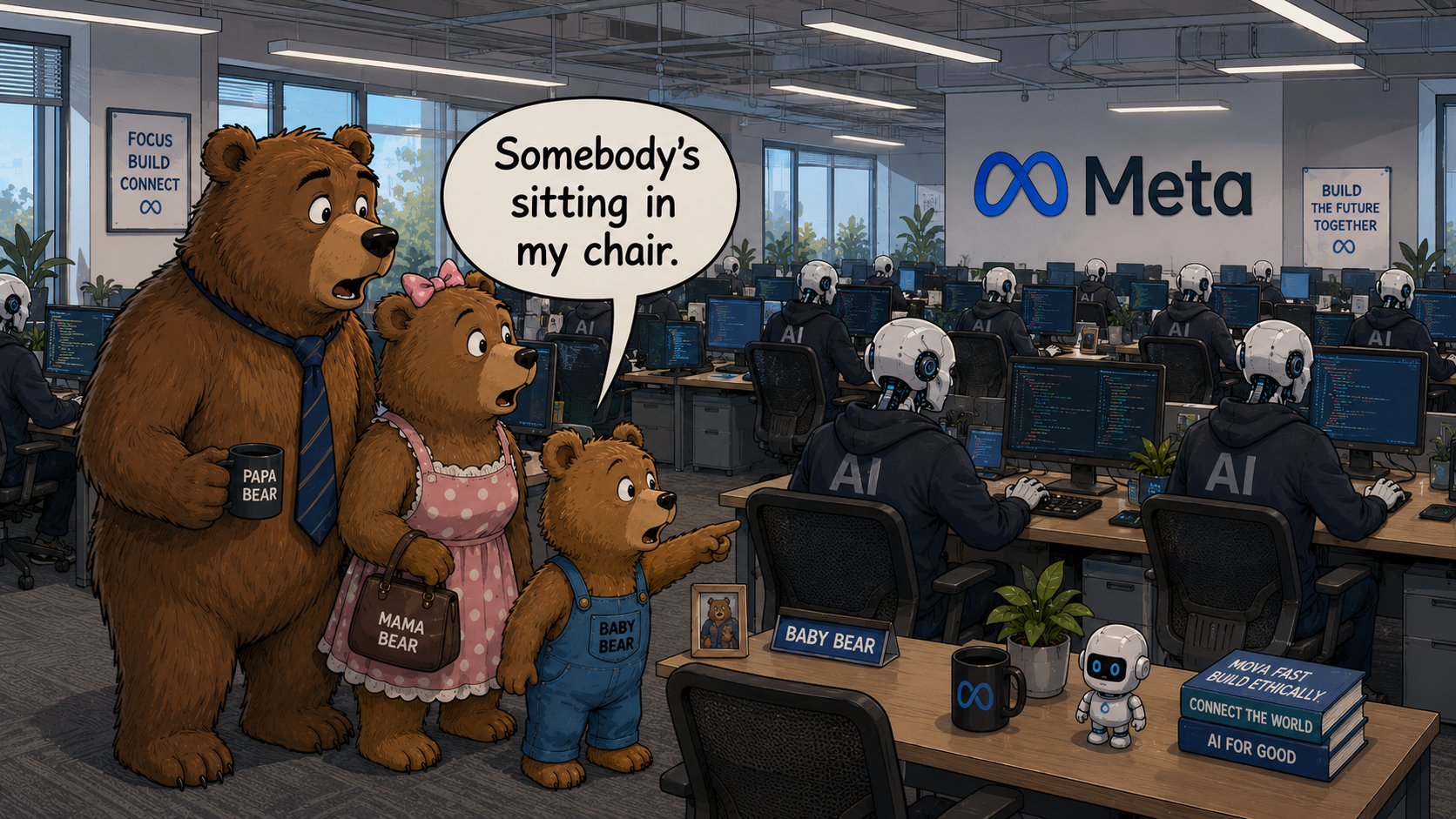
Earlier this year, Meta installed software on the computers of roughly 8,000 U.S.-based employees to capture mouse movements, keystrokes, clicks, and other workplace interactions as training data for AI agents — a program called the Model Capability Initiative. The goal was straightforward: to train autonomous agents on real workplace behavior rather than simulated tasks. The response from employees was immediate and angry, with workers describing the company as an "Employee Data Extraction Factory" and raising concerns about privacy, battery drain, and the capture of personal communications. (Reuters via Yahoo Finance) After weeks of internal pressure, Meta scaled back on June 2. Employees can now pause data collection in 30-minute intervals; a narrower group — remote workers, those handling sensitive information — can request full exemptions. The incident is a preview of one of the defining labor disputes of the agentic AI era: whose behavior gets harvested to train the machines that may eventually replace the people being harvested? (American Bazaar)
Apple at WWDC: Child Safety Becomes a Platform Feature
During this week's WWDC, Apple announced it is overhauling child safety at the operating system level with iOS 27, iPadOS 27, and macOS 27. The centerpiece is a new Child Account system that automatically applies age-appropriate restrictions across the entire device — not just individual apps — including limited adult content, age-gated media, and controlled App Store access. (Business Standard) New features include Ask to Browse, which requires parental approval before children can access new websites in Safari; a redesigned Screen Time dashboard with Time Allowances that let parents set daily limits by app category rather than individual app; communication controls requiring parental approval before children can add new contacts in Messages, FaceTime, or Phone; and automatic blurring of explicit or violent content in shared media for users under 18. Apple is also opening the underlying developer APIs so third-party apps can plug into the same system — making the argument that child safety works better as platform infrastructure than as a feature each app builds independently. (Deccan Herald) The timing, one week after Florida sued OpenAI over child safety failures, is not subtle.
Nuclear Energy Hits Record Support — and the First Microreactor Just Went Critical
Two nuclear stories arrived this week that belong in the same sentence. The latest Gallup survey, conducted in March 2026, found that 61% of Americans now favor nuclear energy as a source of electricity — the highest sustained level of support in more than a decade, up from a low of 44% in 2016. Support is rising across party lines, with Republicans at 74% and independents at 64%. (Gallup) And on June 4, Antares Nuclear completed the first fueled criticality test for its Mark-0 microreactor at Idaho National Laboratory — the first company to do so under the Department of Energy's Reactor Pilot Program, which was directed by executive order to achieve at least three advanced reactor criticality tests by July 4, 2026. (U.S. Army) The DOME test bed at INL — the world's first microreactor testing facility, opened in April — is also preparing to host Radiant's Kaleidos unit for a year-long test program later this year. The public wants nuclear. The labs are proving it can be built. The question now is how fast.
✔ Our next Singularity Circle will occur Saturday, July 4th, 2026, at 10:00 AM Pacific Time. A Zoom link will be sent to eligible members in advance of the gathering.
✔ Production on courses and series have slowed as we begin focusing on membership and promotional activities. But, rest assured, new episodes of The Way of Tech are on the way, along with other special productions. And, as you can see, we're keeping up with our weekly publication of Exponential Times — keeping you appraised of all the latest and most pertinent stories happening in the realm of tech.
The Optimist's Reflection
The Company That Warned Itself
By Todd Eklof
There is something almost unprecedented about what Anthropic did this week. A company at the leading edge of one of the most consequential technologies in human history published a paper warning that the same technology may be approaching the point at which it begins improving itself — and called for a coordinated global slowdown if that happens. Then it filed for an IPO.
At the outset, these two facts seem contradictory, if not hypocritical. But I don't think either framing is accurate.
The people who understand this technology most deeply are also the people most structurally embedded in advancing it. They did not get to the frontier of AI development by being timid. They got there by being brilliant, driven, well-funded, and committed to building something they genuinely believe could be the most transformative technology in history. And now, from that position — closer to the edge than anyone — they are looking over and saying: we should probably agree on what to do if we go too far.
That is not a contradiction. It's conscience operating inside a system that does not easily accommodate it, at least from an economic standpoint. But it is also a system made up of human beings, and it makes perfect sense from a humanistic standpoint. Moving forward cautiously and consciously with the welfare of others in mind is human, and it's refreshing to see it happening in action in what may currently be the most valuable company in history.
The 20th century social psychologist and humanist Erich Fromm distinguished between having and being — between the impulse to accumulate and the impulse to grow. Most technological development is organized around having: market share, compute, capability, valuation. What Anthropic is attempting, imperfectly and under enormous commercial pressure, is to introduce being into that equation — to ask not just what we can build, but what kind of world are we building toward, and do we have the wisdom to slow down if the answer starts to look wrong.
I am not naive about the limitations of voluntary commitments from trillion-dollar companies. But I am also not willing to dismiss the gesture. The alarm has been raised by the people who built the alarm system. That matters, even if the response is uncertain. Perhaps especially then.
Exponential Times is published weekly by Singularity Sanctuary. Join our growing community of thinkers, technologists, and humanists at singularitysanctuary.com.