XTimes
Editor's Note
On Monday, in the Synod Hall of the Vatican, Pope Leo XIV stood before an audience that included the co-founder of one of the world's leading AI companies and called for artificial intelligence to be "disarmed." On the same day, that company — Anthropic — was quietly closing a funding round that would value it at $900 billion, making it the most valuable private AI startup on earth.
These two events are not contradictory. They are, in a strange way, the same event — a recognition that something of enormous consequence is happening, and that the decisions made in the next few years will shape the human future in ways we are only beginning to understand.
This week also brought us the largest IPO filing in American history, a Starship rocket that launched successfully despite losing an engine mid-flight, a government that quietly took a $2 billion equity stake in the quantum computing industry, and the first chicks ever hatched from a fully artificial egg — a step, improbably enough, toward bringing the dodo back from extinction.
The exponential curve does not slow down to let us catch our breath. But it does, occasionally, give us a week like this one — a week in which the full scope of what we are building becomes, for a moment, impossible to ignore.
Top Stories
"Disarm It": The Pope Addresses the Machine
On May 25 — exactly 135 years to the day after Pope Leo XIII signed Rerum Novarum, the foundational Catholic teaching on workers' rights during the Industrial Revolution — Pope Leo XIV released his first encyclical. Titled Magnifica Humanitas ("Magnificent Humanity"), the more than 200-page document frames AI as the Industrial Revolution of our time and calls for it to be, in a word the Pope acknowledged was deliberately provocative: disarmed. (NPR)
Artificial intelligence needs to be disarmed. The word is strong, I know, but deliberately chosen. Like nuclear energy, it must be at the service of all and of the common good. In a similar sense, artificial intelligence now demands to be disarmed, freed from logics that turn it into an instrument of domination, exclusion, and death.
Pope Leo's encyclical goes on to warn against "a race for ever more powerful algorithms and larger datasets, driven by the desire to secure geopolitical or commercial dominance," and takes direct aim at the concentration of tech power, the use of AI in autonomous weapons systems, and algorithms that block access to "healthcare, employment and security" based on "data tainted by prejudice and injustice." The future of humanity, Leo wrote, cannot be left in the hands of a few wealthy tech leaders. (CBS News)
The document's presentation was itself a signal. Standing beside the Pope at the Vatican's Synod Hall was Chris Olah, co-founder of Anthropic — not Google, not OpenAI, not Microsoft. Olah told the audience that AI developers work "inside a set of incentives and constraints that can sometimes conflict with doing the right thing," and welcomed outside voices, including the Church, to "push events in a better direction."
"The questions raised by AI," he said, "are bigger than the AI research community."
TechCrunch noted pointedly that while AI is the encyclical's entry point, the problems Leo focuses on are older and more pervasive: inequality, war, the erosion of democracy, and the concentration of power in the hands of those who don't necessarily care whether humanity writ large remains magnificent. (TechCrunch)
Why it matters: The Vatican speaks to 1.4 billion Catholics and to a much broader global audience for whom moral authority still means something. Magnifica Humanitas is the most authoritative religious document yet to engage the AI era directly, and it frames the central question with clarity: is this technology being built for all of humanity, or for the few who control it? That question belongs at the center of every serious conversation about where we are headed.
Anthropic Is Now Worth More Than OpenAI — And Hired the Field's Most Beloved Researcher
In a week that confirmed Anthropic's emergence as the gravitational center of the AI world, two stories emerged almost simultaneously. First: Bloomberg reported that Anthropic is closing a new funding round of at least $30 billion at a pre-money valuation above $900 billion — surpassing OpenAI's $852 billion valuation and making it the most valuable private AI startup on earth. The round is co-led by Dragoneer, Greenoaks, Sequoia Capital, and Altimeter Capital, and is expected to close as soon as this week. The company projects $10.9 billion in revenue for Q2 2026 — up 130% from Q1 — and its first-ever quarterly operating profit. (Bloomberg via Yahoo Finance)
Second: On May 19, Andrej Karpathy — OpenAI co-founder, former director of AI at Tesla, and the researcher who taught millions of people how large language models actually work — announced he had joined Anthropic's pretraining team. "I think the next few years at the frontier of LLMs will be especially formative," Karpathy wrote on X. He will report to pretraining lead Nick Joseph and build a team focused on using Claude to accelerate Claude's own pretraining research — AI improving the process that makes AI. The AI research community's reaction was swift: one widely shared post called it "KD joining the Warriors for people who know linear algebra." (TechCrunch)
The two stories together tell a single narrative. Anthropic is simultaneously becoming the best-capitalized AI company in the world and attracting the field's most respected talent — and it is doing so while suing the Pentagon over its refusal to allow its technology to be used for autonomous weapons or mass surveillance of American citizens. That combination — financial scale, research credibility, and a public ethical stance — is unusual in the current landscape. (CNBC)
Why it matters: The AI race is often framed as a contest between OpenAI and everyone else. This week suggests a more complicated picture. Anthropic, founded by former OpenAI researchers who left specifically over safety concerns, is now larger by valuation, growing faster by revenue, and attracting talent at a rate that suggests the field's best minds have made a judgment about where the most important work is happening.
SpaceX: Two Historic Milestones in One Week
On Tuesday, May 20, SpaceX filed its long-anticipated IPO prospectus with the SEC, planning to list on Nasdaq under the ticker SPCX. The filing revealed a company that is, by almost any measure, extraordinary: valued at $1.25 trillion following its merger with xAI, targeting a raise that could exceed $80 billion, and positioned to become the first U.S. company to go public at a valuation above $1 trillion. Elon Musk will retain 85.1% of combined voting power through a dual-class share structure. Among the prospectus's more striking disclosures: Anthropic is paying SpaceX $1.25 billion per month through May 2029 for GPU compute — a figure that speaks to the extraordinary infrastructure demands of frontier AI development. (CNBC)
Two days later, on May 22, SpaceX launched Starship Flight 12 — the first flight of the newly upgraded Version 3 vehicle and the first launch from the rebuilt Pad 2 at Starbase, Texas. The mission had been delayed a day after a hydraulic pin issue scrubbed the initial attempt. Once airborne, one of six Raptor vacuum engines shut down early; the flight computer autonomously extended the burns of the remaining five engines to compensate, successfully delivering the vehicle to its planned suborbital trajectory. The ship deployed 22 Starlink simulator satellites and completed an in-space engine relight before targeting a controlled landing in the Indian Ocean — which came close to success before the rocket tipped and burned at splashdown. SpaceX and Musk declared the mission a success. (AccuWeather/CNN)
The context matters: NASA needs a working Starship to serve as the human landing system for the Artemis 4 lunar mission in 2028. The engine anomaly will require analysis before Flight 13, but the flight computer's autonomous compensation — reaching the planned trajectory despite losing an engine — is itself a significant demonstration of the vehicle's resilience. (Space.com)
Why it matters: In the same week SpaceX told Wall Street what it is worth, it showed the world what it can do. The two events are inseparable. The IPO prospectus describes a company whose stated mission is to make life multiplanetary and build orbital data centers. Flight 12, imperfect as it was, is evidence that the mission is not merely rhetoric.
Trump Pulls the Plug on His Own AI Executive Order
On the afternoon of May 21, with invitations already sent to executives from the country's leading tech companies for a signing ceremony scheduled for that afternoon, President Trump abruptly postponed his administration's much-anticipated AI executive order. His explanation, delivered to reporters in the Oval Office: "I didn't like certain aspects of it. I postponed it. I think it gets in the way — we're leading China, we're leading everybody, and I didn't want to do anything to get in the way of that lead." (CNBC)
The backstory, reported by Axios, is more specific. Between Wednesday night and Thursday morning, Trump received calls from Elon Musk, Meta CEO Mark Zuckerberg, and AI czar David Sacks. The main reason for the delay, per a source familiar with the discussions: Trump "just hates regulation," and Sacks "hated it" too. The order, which had been expected to require frontier AI labs to share models with the NSA and other agencies 90 days before public launch, was characterized by sources as "unnecessary" and "just something doomers wanted." (Axios)
The episode lands in pointed juxtaposition with the Pope's encyclical, published four days later, which called explicitly for the future of humanity not to be left in the hands of a few wealthy tech leaders. Three of those leaders — Musk, Zuckerberg, and Sacks — appear to have made a phone call that killed the only meaningful federal AI governance action currently under consideration. (Washington Post)
Why it matters: The United States has now, for the second time under this administration, moved to eliminate AI oversight rather than strengthen it. Whether that proves to be a competitive advantage or a historical mistake is a question that will be answered by events not yet in the news.
The Quantum Bet: U.S. Government Takes $2 Billion Equity Stake in the Industry
In a move that received far less attention than it deserved, the U.S. Commerce Department announced plans this week to invest more than $2 billion in quantum computing companies under the CHIPS and Science Act — and unlike traditional grants, to take equity stakes in return. The largest single commitment is $1 billion to Anderon, a new IBM spinout being positioned as the country's first pure-play quantum computing foundry, with IBM contributing another $1 billion in capital, intellectual property, and assets. GlobalFoundries also signed a letter of intent to receive $375 million to expand domestic quantum manufacturing through its new Quantum Technology Solutions business. (Motley Fool)
The equity model is deliberately different from the grant model that has defined most government technology investment. Rather than writing checks and walking away, the Commerce Department is positioning the U.S. government as a shareholder in the quantum computing industry — with all the alignment of incentives that implies. The move mirrors the logic of the CHIPS Act investments in semiconductor manufacturing: treat critical technology infrastructure as a national asset, not merely a private market opportunity. (Ars Technica)
Why it matters: Quantum computing has been "ten years away" for thirty years. But the combination of CHIPS Act funding, private capital, and now government equity stakes suggests the timeline is compressing. A functioning quantum computing infrastructure would transform cryptography, drug discovery, materials science, and AI training — and whoever builds it first will have a meaningful strategic advantage. The U.S. government appears to have decided it intends to be a participant in that race, not merely a spectator.
Quick Picks
Figure AI's Robots Are Finally Taking a Break
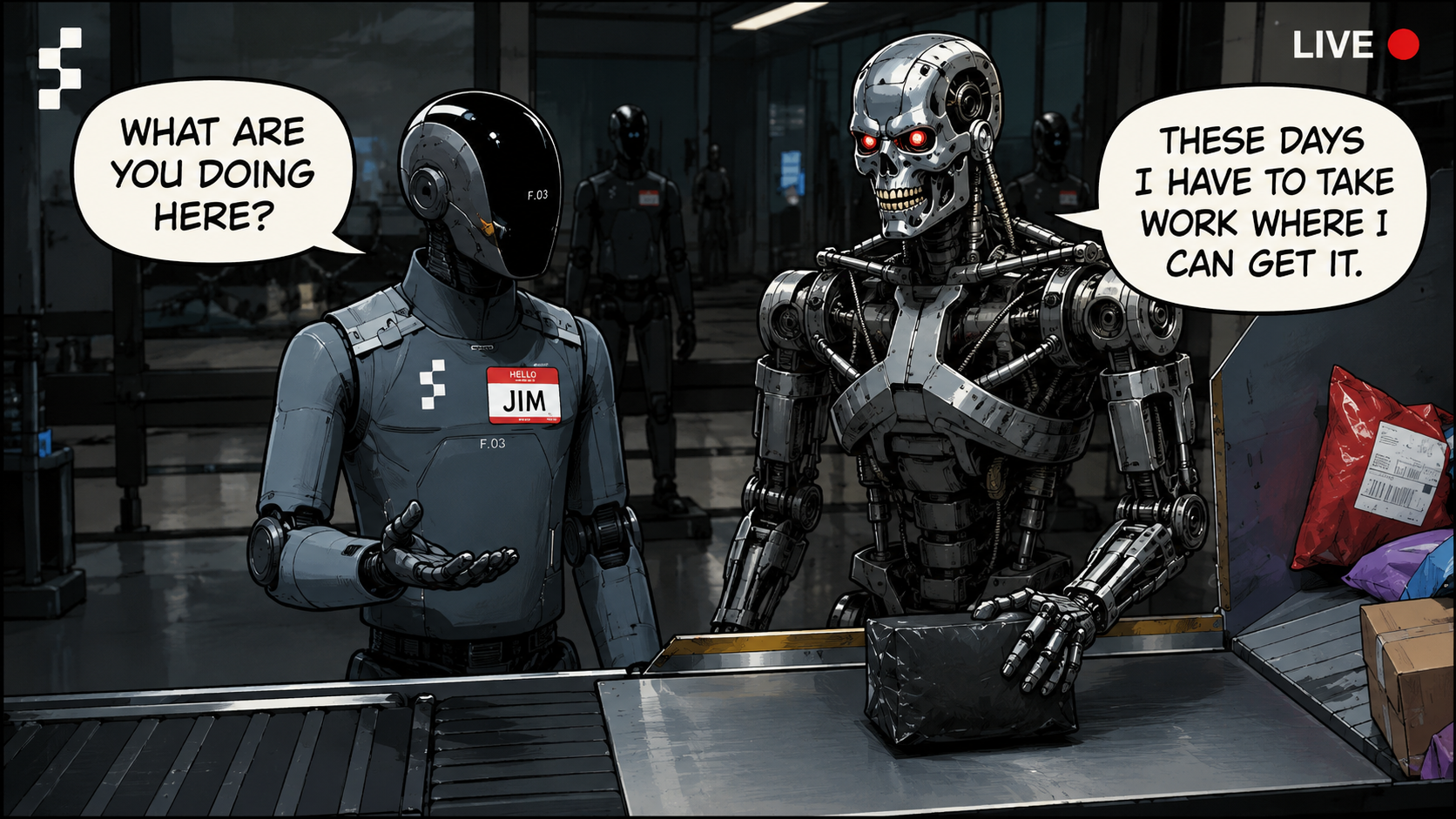
After more than 200 hours of continuous autonomous operation and over 200,000 packages sorted, Figure AI's livestreamed humanoid robot endurance test has concluded — not because a robot broke down, but because the company decided to end it. Bob, Frank, Gary, and Rose sorted packages at human-comparable speed, self-charging when batteries ran low and flagging maintenance issues autonomously. The final numbers, whenever you're reading this, will be whatever they were at press time — the point is that nobody in the industry expected the answer to "how long can humanoid robots work?" to be measured in days rather than hours. (Tech Republic)
The Dodo Might Be Coming Back
On May 19, Colossal Biosciences announced that 26 live chicks had hatched from fully artificial eggs — 3D-printed honeycomb structures lined with a silicone-based membrane that replicates the gas-exchange function of a natural eggshell. The technology is a proof of concept for Colossal's de-extinction roadmap: the giant moa, extinct for 600 years, laid eggs roughly 80 times the volume of a chicken egg — far too large for any living bird to serve as surrogate. The artificial egg, scalable to any size, removes that constraint. Colossal has already sequenced the moa genome from museum tissue samples, and the dodo is also on the company's list. No hatching date has been set for either species. (National Geographic) (Smithsonian Magazine)
AI Infrastructure Keeps Consolidating
Infrastructure investment firm I Squared Capital announced today a $225 million acquisition of ten data center facilities from Cogent Communications, spread across nine U.S. markets including Chicago, Atlanta, Phoenix, and Los Angeles. The deal seeds a new AI inference and colocation platform, with I Squared committing up to $1 billion to build it out through additional acquisitions and capital investment. The facilities include 53 megawatts of power capacity and 259,000 square feet of colocation space, all liquid-cooling-enabled for high-density AI workloads. (Business Wire)
✔ Our next Singularity Circle will occur Saturday, June 6, 2026, at 10:00 AM Pacific Time. A Zoom link will be sent to eligible members in advance of the gathering.
The Optimist's Reflection
Magnificent Humanity
By Todd Eklof
The title of the Pope's encyclical is Magnifica Humanitas, meaning "Magnificent Humanity." It is a phrase worth sitting with.
Magnificent: from the Latin magnificus, meaning splendid, grand, worthy of admiration. Humanity: the quality of being human, but also the collective noun — all of us, together, in our shared condition. The Pope chose these words deliberately, as a counter-proposition to what he sees as the logic of the machine alone: that efficiency matters more than dignity, that data matters more than personhood, that the few who control the algorithm should determine the future of the many who don't.
On the same day the encyclical was released, Anthropic — whose co-founder stood beside the Pope at its presentation — was also closing a funding round that values the company at $900 billion. I do not raise this as a contradiction. I raise it as a tension, which is different, more practical, and, perhaps, more hopeful.
The tension is this: the people building these systems are not villains, as many make them out to be. Chris Olah stood at that podium and said something indicative of a man with awareness and a conscience: that AI developers work inside incentives and constraints that can sometimes conflict with doing the right thing. That is not a confession of bad faith. It is an honest description of a system — economic, competitive, technical — that generates pressures no individual actor fully controls.
The Pope's word "disarm" is interesting precisely because it implies that the technology itself is not the problem. You disarm a weapon; you do not destroy it. You remove from it the logic that makes it dangerous — the logic of domination, exclusion, extraction — and you redirect it toward something else. Toward the common good, as Leo put it. Toward human flourishing, as the AI companies themselves often say, though the distance between saying it and achieving it is measured in the choices made at three in the morning when the deadline is close and the incentives are pointing the other way.
What I find genuinely hopeful about this week is not the valuation or the rocket or even the chicks hatching from artificial eggs, remarkable as those things are. What I find hopeful is that the conversation has become large enough to include a figure like the Pope. That the questions are now being asked by enough voices, from enough different directions, that ignoring them requires deliberate effort.
The exponential curve does not care about human dignity. But we do. And we are still, for now, the ones deciding our own fate.
Exponential Times is published weekly by Singularity Sanctuary. Join our growing community of thinkers, technologists, and humanists at singularitysanctuary.com.