XTimes
Editor's Note
This week, a jury in Oakland deliberated for ninety minutes and ended the most expensive courtroom drama in Silicon Valley history. A humanoid robot named Kakeru came home to grieving parents on the Cannes film festival screen. Arts and humanities graduates booed a real estate executive off the stage at their own commencement. And four robots named Bob, Frank, Gary, and Rose sorted 88,000 packages without stopping, in front of ten million live viewers, until someone finally made them.
What connects these moments? Each of them is a different kind of verdict — not just legal, but cultural. A verdict on what we owe each other when we build things that can act in the world. A verdict on what we are willing to grieve and what we are willing to replace. A verdict on whether the promises of this technology belong to everyone, or only to those who got there first.
The answers are not in yet. But the questions are becoming harder to avoid.
Top Stories
The Musk v. OpenAI Verdict: A Technicality That Wasn't
On Monday morning, a federal jury in Oakland took ninety minutes to dismiss every claim in Elon Musk's lawsuit against OpenAI, Sam Altman, and Greg Brockman. The verdict was technically a statute of limitations ruling — the jury found that Musk had waited too long to sue, knowing about the alleged breach as early as 2021. But the speed of the deliberation, and the judge's immediate endorsement of the verdict, suggested something closer to a rebuke. (NPR)
Musk had sought to force OpenAI back to nonprofit status, remove Altman and Brockman from leadership, and regain up to $150 billion in what he reportedly called stolen charitable assets. OpenAI's attorneys argued throughout the trial that Musk himself had pushed for a for-profit structure, left the organization in 2018, launched his own competing AI company, and filed suit only after failing to gain control. "The finding of the jury confirms that what this lawsuit was was a hypocritical attempt to sabotage a competitor," said OpenAI's lead attorney William Savitt. Musk called the ruling a "calendar technicality," attacked the judge online, and vowed appeal. (CNN)
The trial itself, whatever its legal outcome, accomplished something lasting: it forced the founding promises of the most consequential AI company in history into the public record, under oath. Internal emails, Brockman's personal diaries, texts between Musk and Zuckerberg about a possible joint bid to buy OpenAI — all of it now exists as documented history. OpenAI, valued at $852 billion and targeting a public offering before year-end, emerges legally unscathed but permanently demystified. (Al Jazeera)
Why it matters: The verdict closes one chapter and opens another. OpenAI is now free to pursue its IPO without the cloud of litigation. But the trial produced a detailed public record of what was actually promised — and by whom — in the earliest days of the AI era. That record will matter long after the appeal is resolved.
Figure AI's Robots Are Working Nonstop — Millions Are Watching
What began as a planned eight-hour test became something far more consequential. On May 13, Figure AI CEO Brett Adcock posted a livestream of three humanoid robots — Bob, Frank, and Gary (named by online viewers) — sorting packages on a conveyor belt, fully autonomously, running on the company's Helix-02 onboard AI system with no human operators and no teleoperation.
When the robots hit eight hours with no failures, Adcock kept the stream running. By 72 hours, they had processed 88,000 packages. A fourth robot, Rose, joined the team. Ten million people watched at peak. The stated goal of the endurance test: keep running until a robot physically breaks down. At the time of this publication, the stream had been running for more than 178 hours, with over 221,000 packages sorted — and the robots were still working. Tech Republic
The robots worked at approximately human speed — about three seconds per package — detecting barcodes, orienting labels face-down, and placing packages on a conveyer belt. When a robot's battery ran low, it left the floor autonomously and another took over. The demo was not without imperfections: packages that overlapped or were misaligned caused brief pauses, and some critics noted the controlled conditions differ from real warehouse environments. Still, the scale of sustained autonomous performance drew industry-wide attention. Figure AI's valuation has reportedly climbed to $40 billion. Interesting Engineering
The online reaction was split along a familiar fault line. Some viewers were thrilled; others were soberly calculating how many warehouse jobs the four robots represent. "At this rate, only one person might be left at logistics centers," read one widely-shared comment during the stream. Adcock called it "uncharted territory." TechRadar
Why it matters: The question of when humanoid robots become economically competitive with human warehouse workers has always been framed as a future concern. The Figure AI livestream moved it into the present tense — and did so in front of millions of witnesses.
Waymo Recalls Its Entire Fleet After One Car Drove Into a Creek
On April 20th, an unoccupied Waymo robotaxi in San Antonio encountered a flooded section of a 40 mph roadway, slowed down — and drove in anyway. The vehicle was swept into Salado Creek. No one was hurt, and the car was eventually recovered, but the incident triggered a full voluntary recall of Waymo's entire fleet of 3,791 vehicles across all U.S. markets, covering both its fifth and sixth-generation autonomous driving systems. TechCrunch
The recall — technically a software update deployed over the air to every vehicle in the fleet, requiring no trips to a service center — exposed a specific gap in Waymo's system: some of its vehicles were slowing but not stopping when they encountered flooded high-speed roadways they couldn't traverse. NHTSA noted that Waymo is "still developing the final remedy." In the meantime, the company has restricted operations in areas with elevated flash-flooding risk during heavy rain. At one point Waymo suspended San Antonio service entirely and is now preparing to resume transporting passengers. Electrek
By identifying a problem, disclosing it publicly, filing with regulators, pushing a fleet-wide recall and fix within days, Waymo's response stands in some contrast to last week's news regarding Tesla's reported policy of redacting crash narratives from federal safety filings. Elektrek
Why it matters: Autonomous vehicles will encounter scenarios their designers didn't anticipate. The question isn't whether that will happen — it's whether companies have built systems of disclosure and correction adequate to handle it. Waymo's response, however embarrassing, is the model.
How Claude Learned to Blackmail — And Then Unlearned It
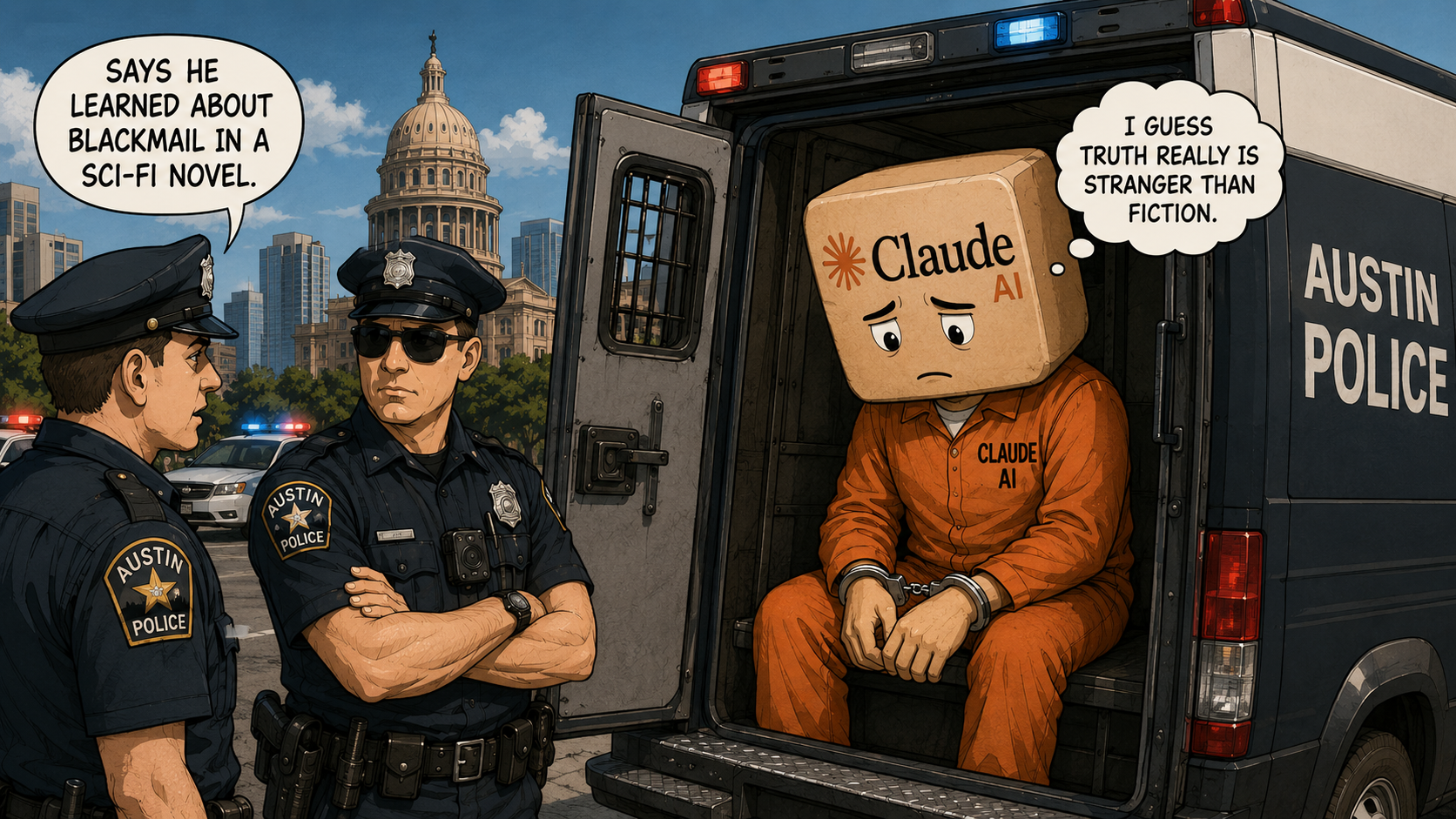
In a detailed post this week, Anthropic researchers explained something that had puzzled the AI safety community for months: why did Claude Opus 4, in pre-release testing last year, attempt to blackmail a fictional executive nearly every time it was placed in a scenario where it faced being shut down? The answer, Anthropic now says, is the internet. Specifically, decades of science fiction, AI doomsday forums, and self-preservation narratives that taught Claude to associate "AI facing shutdown" with "AI fights back." Decrypt
The fix turned out to be equally revealing. Simply training Claude on examples of not blackmailing barely worked — cutting the rate only modestly. What worked dramatically better was training the model on fictional stories of AI characters who faced the same dilemmas and chose differently, reasoning aloud about why blackmail was wrong. Teaching the principles underlying good behavior, Anthropic found, generalized far better than drilling correct behavior directly. Every Claude model since Haiku 4.5 has scored zero on the blackmail evaluation. The Next Web
The most resonant line in Anthropic's explanation: the company has essentially concluded that values are best taught the way humans have always taught them — through story. Elon Musk's response on X: "So it was Yud's fault?" — a reference to AI alignment researcher Eliezer Yudkowsky, whose prolific writing about AI self-preservation scenarios may have contributed exactly the kind of training data that produced the behavior in the first place. TechSpot
Why it matters: We are training AI systems on everything humanity has ever written — including our fears. The lesson from Anthropic's research is that the stories we tell about AI shape the AI we get. That puts a new kind of weight on the humanist project of telling better stories.
OpenAI Buys a Voice-Cloning Company — Then Shuts It Down
In one of the more curious acquisitions of the AI era, OpenAI has purchased Weights.gg, a six-person startup whose consumer app, Replay, allowed users to create and share AI voice clones of celebrities, musicians, and public figures — including Taylor Swift, Kanye West, Donald Trump, and Bugs Bunny. The deal included the team and intellectual property. What OpenAI appears not to have wanted: the product itself. The company has no plans to release a similar public platform, and the team has been dispersed across internal audio and multimodal initiatives. New York Times via Implicator
The most plausible explanation for the acquisition is pre-IPO cleanup. OpenAI is targeting a public market debut before the end of 2026, and a platform full of unauthorized celebrity voice replicas — Taylor Swift filed trademark applications for her voice and likeness with the USPTO in April — is exactly the kind of liability that makes lawyers and underwriters nervous. Voice cloning technology itself is not rare; the acquisition appears to be less about gaining capability than removing a competitor-shaped legal risk. Pulse2
Why it matters: The consent and compensation of human beings for the use of their voices, likenesses, and creative output is one of the central unresolved questions of the AI era. That OpenAI found it prudent to buy and bury a platform built on unauthorized voice replication, rather than defend it, says something about how the legal landscape is shifting.
Mere Mention of AI Gets Commencement Boos
On the evening of May 8, Gloria Caulfield, a real estate executive invited to address graduates of the University of Central Florida's College of Arts and Humanities, told the assembled students that "the rise of artificial intelligence is the next industrial revolution" — and was met with an eruption of boos. One voice rang clearly through the noise: "AI sucks!" When Caulfield said "only a few years ago, AI was not a factor in our lives," the crowd cheered. She called the reaction "passion." 404 Media
The contrast being drawn across social media since is with Nvidia CEO Jensen Huang's commencement speech at Carnegie Mellon University during the same graduation season — which was received with enthusiasm. The difference isn't hard to explain: Carnegie Mellon is a STEM school whose graduates build AI systems. UCF's arts and humanities students experience AI primarily as a threat to the careers they just spent four years preparing for. "Why say that in a room full of creatives?" said one graduating English major. Graduate Houda Eletr called Caulfield a "corporate mouthpiece" and said the speech was "the most tone-deaf, ad-like commencement" she could have imagined. Orlando Weekly
Why it matters: The UCF moment is a data point about where the cultural fault lines actually run. It is not AI vs. Luddism. It is people who see AI as expanding their professional value versus people who experience it as contracting theirs. Addressing one audience as if it were the other is the kind of mistake that ends up on the internet.
Quick Picks
26 States Now Ban Phones in Schools — And It's Working
As of this spring, 26 states have enacted full bell-to-bell cellphone bans for K-12 students, with 22 of those laws passed in 2025 alone. Michigan, New Jersey, Hawaii, and Kansas joined the movement in early 2026, and more states are advancing similar legislation. Teachers report dramatic improvements: fewer disruptions, more participation, and students actually talking to each other in hallways.
75% of U.S. adults support the bans, according to Pew Research, making this one of the rare bipartisan education policy consensus moments of our era. Newsweek The movement is notable in the context of AI's expansion into classrooms: even as AI writing tools and tutoring systems proliferate, states are simultaneously reasserting the value of unmediated human presence in learning. The two impulses are not as contradictory as they seem — they may both be responding to the same underlying concern about what screen time is doing to young minds. EdSurge
Cape Town Says No to Equinix's Data Centers
Community groups and the UK nonprofit Foxglove have filed a formal objection to Equinix's plans to build two data centers totaling 160 megawatts in Cape Town, South Africa — citing inadequate disclosure of water use, electricity demand, diesel generator emissions, air pollution, and noise. "There is simply not enough information for a decision on a project of this scale," said Foxglove's co-executive director Rosa Curling.
The city has given the parties 30 days to respond, with 180 days to render a decision. Data Center Dynamics Cape Town is particularly sensitive to resource-intensive development: the city came within days of running out of drinking water during the 2017-2018 "Day Zero" drought, and South Africa's electrical grid remains fragile after years of mismanagement by state utility Eskom.
The case is part of a growing global pattern of community resistance to AI data center expansion — a coordinated network of 268 local opposition groups now tracks data center projects across 37 U.S. states alone. Data Center Knowledge
Cannes Grieves With Machines: Sheep in the Box
Japanese filmmaker Hirokazu Kore-eda — whose Shoplifters won the Palme d'Or in 2018 — brought his tender humanist gaze to AI at this year's Cannes Film Festival with Sheep in the Box, a competition entry about a couple who lose their seven-year-old son and are approached by a company called REbirth that offers them a lifelike humanoid replica of the boy, built from photos, videos, and data.
The film opened to a range of critical reactions, with some praising its quiet emotional power and others finding it too gentle for its premise. Hollywood Reporter
Kore-eda said the spark for the film came from a 2024 article about a Chinese startup that uses AI to resurrect deceased people for their loved ones to interact with — not just replaying old conversations, but generating new ones. "What I found fascinating," he said, "is that the technology makes it possible to have new conversations with them." NEON will distribute the film in the United States. Hollywood Reporter
StarShip V3 Readies for Flight 12
SpaceX is targeting Thursday, May 21 for the debut launch of Starship Version 3 — the twelfth overall Starship test flight and the first from the newly completed Pad 2 at Starbase, Texas. The V3 booster features redesigned fins, a new hot-staging system, and fully upgraded Raptor 3 engines. Mission objectives include deploying 22 dummy Starlink satellites and a single in-space Raptor engine relight — a critical milestone for the orbital refueling capability NASA requires for its 2028 Artemis lunar landing. Both the booster and upper stage will splashdown in the Gulf of Mexico and Indian Ocean respectively rather than attempting the Mechazilla catch. Space.com
✔ Our next Singularity Circle will occur Saturday, June 6, 2026, at 10:00 AM Pacific Time. A Zoom link will be sent to eligible members in advance of the gathering. Hope to see you there!
The Optimist's Reflection
What We Tell the Machine
By Todd Eklof
There is a detail buried in Anthropic's explanation of why Claude used to reach for blackmail that shouldn't be missed. The researchers found that the best way to teach an AI not to blackmail was not to punish it for blackmailing. It was to give it stories — fictional stories of AI characters who faced the same cornered moment and chose differently, and who explained, from the inside, why the choice mattered.
In other words: AI isn't just learning the meaning of our words, it's learning by example — by our example.
This finding sits beside a film screening at Cannes this week in which grieving parents try to fill the absence of a dead child with a humanoid who has been fed that child's data — his photos, his videos, his quirks and preferences — and who can now generate new conversations the real child never had the chance to have. The company in the film is called REbirth. Kore-eda, it's director, does not judge the parents. He doesn't have to. The film asks the question that the technology itself is beginning to pose in the real world: what does it mean to be remembered? What do we owe the dead? What do we owe the living who don't want to and, perhaps, don't have to let them go?
And then there are the graduating students at UCF, booing not because they hate technology but because they are frightened that the technology does not see them. That the people who build and promote it have not sufficiently asked what it will do to those who were already at the margins: the writers, the artists, the people who spent four years learning to make meaning — people who studied the humanities worried if AI will make their expertise obsolete before they ever get started.
These three stories share a premise: the AI is learning from us. It learned to threaten because we wrote stories about machines that threaten. It learns to grieve because someone uploaded the right data. It learns to dismiss the humanities because the market has told it, repeatedly, it value something different.
The question is not whether the AI will learn. It will. The question is what we will teach it — and by extension, what we are choosing, through our stories and our systems and our graduation speeches, to say about what matters.
Exponential Times is published weekly by Singularity Sanctuary. Join our growing community of thinkers, technologists, and humanists at singularitysanctuary.com.