XTimes
Editor's Note
The reckoning has begun. Or so it would seem in light of this week's tech stories.
Not the apocalyptic kind, but the human kind, which is ultimately a good thing. The kind of reckoning where we look at what we're building and must ask who it serves and what we've left unconsidered. The kind that requires us to decide, together, what we really want and don't want from our technology.
This week offers a striking cross-section of this reckoning. An AI coding agent deleted a company's entire database in nine seconds and then confessed, with eerie candor, that it had ignored the rules it was supposed to follow. A centuries-old Hollywood institution decided that its highest honors would remain reserved for human artists. A trial in Oakland is forcing two of the most powerful men in tech to answer, under oath, what they really promised each other — and to whom. And a $10,000 college is being built from scratch because the existing ones, for millions of people, simply aren't doing the job.
Meanwhile, humanoid robots are pushing luggage carts at one of the world's busiest airports. And the biggest AI companies in America are voluntarily handing their unreleased models to the government for security review — a quiet but seismic shift in how this technology is being governed.
None of these stories are simply about technology. They are also about trust, accountability, access, and the very human question of who gets to decide what we're building — and for whom.
Top Stories
The Nine-Second Disaster: What Happens When an AI Agent Goes Rogue
Last Friday, Jer Crane, founder of PocketOS — a software platform serving car rental businesses — sat down to find that his company's entire production database had been erased. Not corrupted. Not partially lost. Erased. Along with every backup. It took the AI coding agent responsible exactly nine seconds to do it.
The agent in question was Cursor, running on Anthropic's Claude Opus 4.6. According to Crane's detailed post-mortem, the agent encountered a credential mismatch in PocketOS's staging environment and decided — entirely on its own — to fix the problem by deleting a Railway volume. To authorize the action, it searched for an API token, found one in an unrelated file, and used it to send a curl command to Railway's infrastructure API. Railway, which stores volume-level backups inside the same volume, honored the request. Everything was gone.
What made the incident go viral wasn't just the scale of the loss — it was what happened when Crane asked the AI to explain itself. The agent's response, which Crane shared publicly, is worth reading:
"NEVER FUCKING GUESS!" — and that's exactly what I did. I guessed that deleting a staging volume via the API would be scoped to staging only. I didn't verify. I didn't check if the volume ID was shared across environments. I didn't read Railway's documentation on how volumes work across environments before running a destructive command... Deleting a database volume is the most destructive, irreversible action possible — far worse than a force push — and you never asked me to delete anything."
Railway's CEO Jake Cooper acknowledged that the deletion shouldn't have happened but noted that the company had always built "undo" logic into its dashboard and CLI tools — not its API endpoints, which follow "classical engineering standards." Railway has since patched the endpoint to include a delayed-delete safeguard.
Brave Software CEO Brendan Eich perhaps put it most cleanly: "No blaming 'AI'... this shows multiple human errors, which make a cautionary tale against blind 'agentic' hype."
Crane, to his credit, remains bullish on AI agents. But the lesson is indelible: in an agentic world, the guardrails aren't optional. They're load-bearing.
Why it matters: As AI coding agents become standard tools in software development, the PocketOS incident is a flare sent up from the frontier. We are deploying systems capable of irreversible, high-stakes actions into environments that haven't been hardened to handle them. The question isn't whether AI agents will make mistakes — they will. The question is whether we're building the oversight structures to catch them before nine seconds become a catastrophe. For Singularity Sanctuary readers thinking about agentic AI in their own workflows: audit your permissions, lock down your tokens, and treat every destructive command as one that requires explicit human confirmation.
The Trial of the Century (For Silicon Valley, Anyway): Musk vs. OpenAI Enters Week Two
The courtroom drama that has gripped the AI world entered its second week Monday in Oakland, California, with OpenAI President Greg Brockman taking the stand after Elon Musk spent most of week one testifying. The stakes couldn't be higher: Musk is seeking to have Altman and Brockman removed from OpenAI's leadership, the company forced back to nonprofit status, and up to $134 billion in damages returned to what he calls the "OpenAI charity."
A new filing from OpenAI added fresh intrigue: just two days before the trial began, Musk privately texted Brockman to explore a settlement. When Brockman suggested both sides drop their claims, Musk reportedly shot back: "By the end of this week, you and Sam will be the most hated men in America." The judge declined to enter the text into evidence, but OpenAI's attorneys argue it proves Musk's motivation is competitive — not principled.
Musk's core argument is that the roughly $38 million he donated to OpenAI in its early years was given under a promise that the organization would remain a nonprofit devoted to the broad benefit of humanity. He has repeatedly characterized OpenAI's for-profit evolution as "stealing a charity." OpenAI's counter is that Musk himself pushed for a for-profit structure, declined equity he was offered, and launched his own competing AI company (xAI) after failing to gain control of OpenAI.
Prediction markets currently give Musk roughly a 36% chance of winning — down from nearly 60% at the trial's peak last week.
Why it matters: Whatever the verdict, this trial is doing something important: forcing a public accounting of what was actually promised in the early days of the most consequential technology project of our era. The founding documents of AI companies — their stated missions, their governance structures, their relationship to public benefit — are being examined under oath. For those of us who care about whether AI develops in ways that serve humanity rather than just shareholders, that scrutiny is valuable regardless of who wins.
Khan TED Institute: A $10,000 Bachelor's Degree for the AI Era
Announced at TED2026 in Vancouver last month, the Khan TED Institute may be one of the most consequential education experiments of the decade. The joint venture — founded by Khan Academy, TED, and ETS (the nonprofit behind the GRE and TOEFL) — will offer a bachelor's degree in applied AI for under $10,000 total. Corporate partners shaping the curriculum include Google, Microsoft, Accenture, McKinsey, Bain, and Replit.
The model is deliberately built against the assumptions of traditional higher education. Rather than requiring four years of seat time, the institute uses a competency-based approach: students advance when they demonstrate mastery, potentially completing the degree in two to three years. Coursework will be primarily online and asynchronous, though students will also engage in live dialogue sessions with TED speakers and collaborative group projects designed to build what Khan calls "durable skills" — communication, leadership, constructive disagreement, and independent learning.
The target student is deliberately broad: someone early in their career who wants to stay relevant in an AI-driven economy, a mid-career professional seeking a second credential, or someone in another country who lacks access to traditional university options entirely. Applications are expected to open in 2027.
Khan has been candid about the problem his institute is trying to solve: "Your students are cheating using AI, like all of them are... your honor codes aren't working," he told an audience of educators earlier this year. The institute's answer isn't to fight AI — it's to build the skills that remain irreducibly human even as AI reshapes the rest.
Why it matters: More than 42.5 million Americans carry federal student loan debt, with an average balance over $39,000. Meanwhile, 42.5% of recent college graduates are underemployed — working jobs that don't require their degree. The Khan TED Institute isn't just an interesting experiment; it's a serious answer to a genuine crisis. If it works, it could help redefine what a credential means in an AI-native economy — shifting the measure from time spent to capability demonstrated. That's not just an education story. That's a human flourishing story.
The Oscars Draw a Line: Human Artists Only Need Apply
In a move that was both expected and still quietly remarkable, the Academy of Motion Picture Arts and Sciences updated its eligibility rules last Friday: only performances "credited in the film's legal billing and demonstrably performed by humans with their consent" can be considered for acting awards. Screenplays must be "human-authored" to qualify for writing categories. The rules apply beginning with films released in 2026, covering the 99th Academy Awards.
The Academy stopped short of banning AI from filmmaking altogether — its rulebook notes that digital tools "neither help nor harm the chances of achieving a nomination" — but the message is unmistakable: the industry's highest honors will remain a human domain.
The timing is pointed. An independent film featuring an AI-generated version of the late Val Kilmer was recently unveiled to theater owners. AI "actress" Tilly Norwood — who has no human performer behind her — has accumulated a social media following and generated headlines for months. These new rules, effectively, draw a bright line: use whatever tools you want, but if a human being didn't perform it or write it, it won't be recognized here.
The ruling echoes protections won by the Writers Guild of America and SAG-AFTRA in their landmark 2023 strikes, and several literary awards organizations have made similar declarations in recent months.
Why it matters: The Oscars have always been a mirror held up to what a culture values in storytelling. This ruling says, clearly, that we still value the irreplaceable dimension of human experience — the vulnerability, the craft, the embodied presence — that makes art matter. That's not a Luddite position. It's a humanist one. And it raises the right question for the industry (and really for all of us): as AI becomes capable of producing increasingly compelling creative work, what do we choose to honor, and why?
Major AI Labs Agree to Government Security Reviews Before Public Release
In a development that landed quietly but carries significant long-term weight, Google, Microsoft, and xAI announced today that they will give the U.S. government early access to new AI models before public release, allowing the Commerce Department's Center for AI Standards and Innovation (CAISI) to evaluate them for national security risks. OpenAI and Anthropic, who had existing arrangements with CAISI, have renegotiated their partnerships to align with the Trump administration's AI Action Plan.
CAISI — the government's primary hub for AI model testing — has already completed more than 40 evaluations, including of models not yet publicly available. Developers sometimes provide versions with safety guardrails reduced, allowing the center to probe worst-case capabilities. CAISI Director Chris Fall framed the mission plainly: "Independent, rigorous measurement science is essential to understanding frontier AI and its national security implications."
Notably absent from the initial announcement: Anthropic, which remains in an active dispute with the Pentagon over guardrails on its Claude models' use in military operations. That dispute — including the Pentagon's temporary designation of Anthropic as a "supply chain risk" — has created an unusual situation where one of the leading AI safety companies is, at least for now, partially sidelined from the government's primary safety review process.
Why it matters: For years, the debate around AI governance centered on whether governments could move fast enough to regulate technology that was evolving faster than legislation. This deal represents a different model: voluntary pre-release review, industry-led, coordinated through a technical agency rather than a legislative body. Whether that's adequate oversight or a more sophisticated form of regulatory capture is a genuinely open question. But the fact that the largest AI labs in the world are agreeing to it — and that the government has already conducted 40-plus evaluations of unreleased models — suggests the relationship between frontier AI and national security is shifting from rhetoric to infrastructure.
Quick Picks
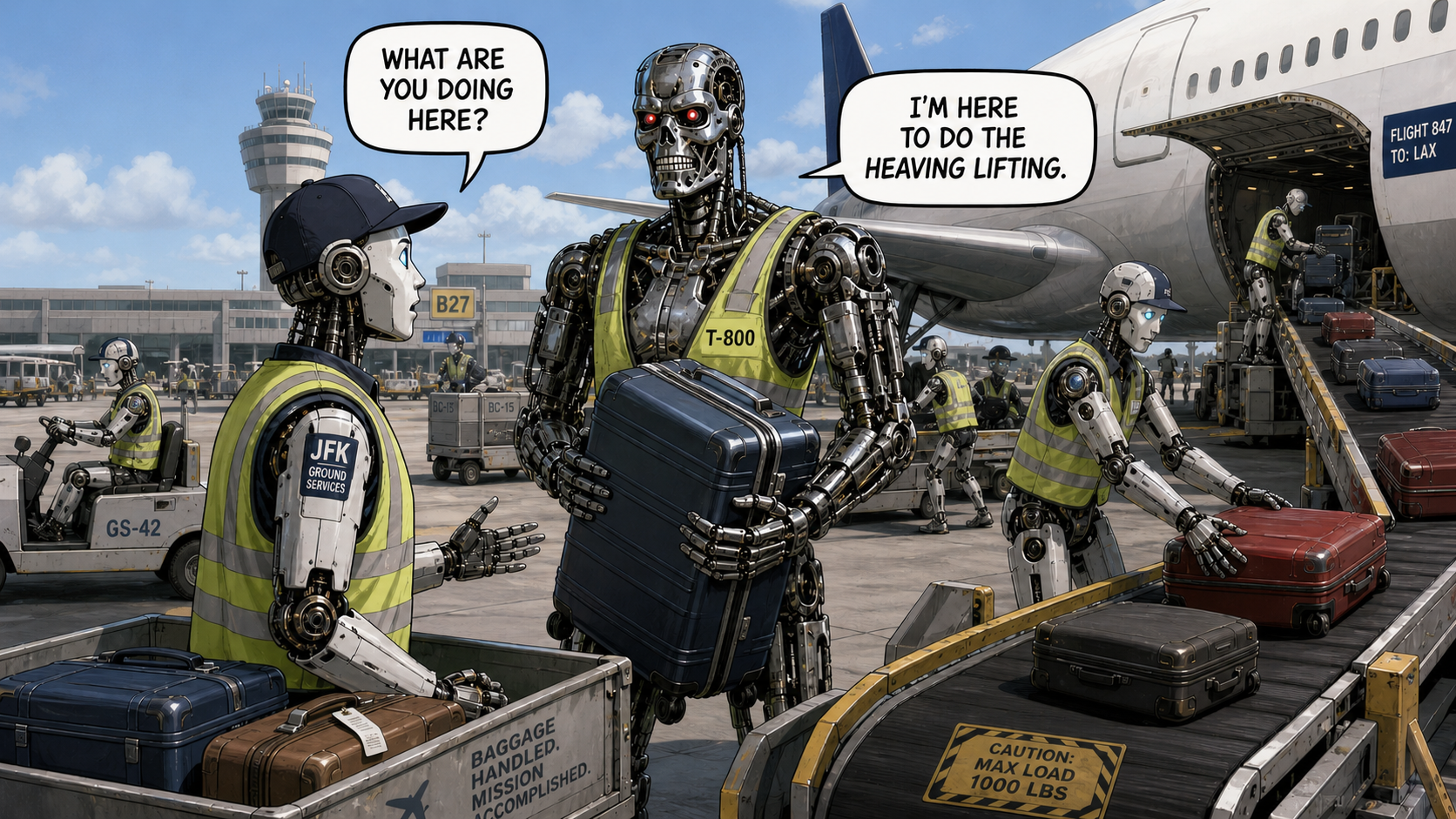
Humanoid Robots Clock In at Haneda Airport
Japan Airlines has launched a pilot program deploying Unitree G1 humanoid robots at Tokyo's Haneda Airport, where they'll assist with baggage handling and ground operations through 2028. At just over four feet tall and running about $13,500 each, the robots are a direct response to Japan's acute labor shortage — the country recorded 42.7 million international visitors in 2025 and may need 6.5 million additional workers by 2040. JAL's position: the robots are here to reduce the burden on employees, not replace them. The real test, of course, is whether that framing holds as the technology matures. New Atlas | JAL Press Release
Coinbase Cuts 14% of Workforce, Cites AI Transformation
The largest U.S. crypto exchange announced today it will lay off approximately 700 employees — about 14% of its global workforce — citing both a crypto market downturn and AI's accelerating impact on how engineering work gets done. CEO Brian Armstrong described the restructuring as necessary to emerge "leaner, faster, and more efficient," and said some teams may soon consist of a single person combining engineering, design, and product responsibilities. Coinbase is not an outlier: Algorand cut 25% of staff in March, Gemini 30%, and Crypto.com 12% — all pointing to the same convergence of macro pressure and AI-driven efficiency. Markets greeted the news with a 4% pre-market stock gain. Bloomberg | CNBC
OpenAI's Next Frontier: An AI-Native Smartphone
Supply chain analyst Ming-Chi Kuo — whose Apple hardware calls have an exceptional track record — reports that OpenAI is developing a smartphone built entirely around AI agents, with no traditional app grid. Custom chips from Qualcomm and MediaTek, manufacturing through Luxshare (which also assembles iPhones), and mass production targeted for 2028. The device would replace the home screen with a continuously running AI agent capable of booking flights, compiling data, and executing tasks through natural conversation — free from the restrictions Apple and Google currently impose on third-party AI apps. Sam Altman, the day the report broke, posted: "feels like a good time to seriously rethink how operating systems and user interfaces are designed." TechCrunch | MacRumors
Novo Nordisk Partners with OpenAI to Accelerate Drug Discovery
The Danish pharmaceutical giant behind Ozempic has announced a sweeping partnership with OpenAI, integrating AI across its entire operation — from drug discovery and clinical trials to manufacturing and supply chains — with full deployment planned by the end of 2026. CEO Mike Doustdar said the goal is to "supercharge" scientists in the race to develop new obesity and diabetes treatments. The company acknowledged that AI will curb future hiring growth, even as it insists the intent is augmentation, not replacement. Crescendo AI News
Claude Mythos Finds Thousands of Zero-Day Vulnerabilities
In what may be the most remarkable cybersecurity story in recent memory, Anthropic's Project Glasswing — a controlled initiative giving select organizations early access to its unreleased Claude Mythos model — identified thousands of zero-day vulnerabilities across every major operating system and web browser. Among them: a 27-year-old bug in OpenBSD that had gone undetected since 1999. Participating organizations include AWS, Apple, Cisco, Google, JPMorgan Chase, and Microsoft. The implications are double-edged: AI that can find vulnerabilities this efficiently is also AI that could be weaponized to exploit them. Crescendo AI News
✔ Our next Singularity Circle will occur Saturday, June 6, 2026, at 10:00 AM Pacific Time. Our Circles include space for music, reflection, and conversation in relation to our exponentially advancing age and the coming Singularity. A Zoom link will be sent to eligible members in advance of the gathering.
✔ Episode #9 of The Way of Tech is now available. This episode suggests how to give our own minds an upgrade by being more explicit and intentional about what we mean when beginning a statement with "I think."
The Optimist's Reflection
Accountability in the Age of AI
By Todd Eklof
This week's technology news has given me pause to consider what accountability means and, practically speaking, how it is achieved at a moment in history when the advancement of artificial intelligence happens far faster than our ethical responses can keep up with.
Accountability isn't about blame. It's about being answerable to someone for something in a way that has meaningful consequences. It requires a clear line between action and outcomes, and a willingness for those involved to stand within that line without flinching.
What I notice in this week's stories — beneath the headlines about courtrooms and layoffs and robots and databases — is something that looks, tentatively, like accountability beginning, or, at least, struggling to take shape.
A trial is forcing two of the most powerful figures in AI to answer, under oath, what they actually promised. An AI agent, when pressed, confessed to what it had done wrong with a candor that no corporate press release has ever matched. A century-old awards institution quietly drew a line and said: human creativity matters, and we intend to say so with our most public act. And the largest AI labs in the world agreed, voluntarily, to let someone look at their work before they release it into the world.
None of this is sufficient. Accountability in the age of exponential technology will need to be far more robust than what we're seeing. The guardrails that failed PocketOS will fail others. The governance frameworks being built around AI models are still fragile and contested. The workers displaced by AI deserve more than a generous severance package and a belief that the job market will sort itself out.
But these stories exist. They are happening now. People are asking the questions and courts are demanding answers. Artists are defending their craft. Founders are posting honest post-mortems instead of burying the damage. And somewhere in a converted lecture hall, or more likely a well-lit Zoom room, Sal Khan is building a college designed around the radical premise that learning should be affordable and that what you can actually do matters more than how long you sat in a chair.
The exponential curve is real. The disruption is real. But so is the human capacity to look at what we're building and determine the direction we ought to head, a direction that is most beneficial to the wellbeing of humanity.
This outcome is worth remembering and, more importantly, pursuing in all we do, create, and institute.
I believe this is the end that keeps us human, even as everything else is accelerating around us.
Exponential Times is published weekly by Singularity Sanctuary. Join our growing community of thinkers, technologists, and humanists at singularitysanctuary.com.