XTimes
Editor’s Note: Extending Care Without Losing Ourselves
This week’s developments point toward a subtle but significant shift: technology is extending human care and capability into domains once governed almost entirely by biological limits and human judgment. From neonatal medicine to energy infrastructure and education, these advances are less about spectacle than integration. They ask us not only what we can do, but how deliberately we choose to do it, and for whom. —TE
🧠 Top Stories
Dutch Startup's "Aquawomb" Could Keep Extremely Premature Babies Alive and Healthy
Researchers and engineers are developing artificial womb technologies designed to support extremely premature infants whose lungs and organs aren’t ready for air. The work involves systems that mimic the fluid, temperature, and nutrient conditions of a uterus and could extend the development time for babies born at the edge of viability. While clinical applications remain limited and ethically complex, prototypes under study are bringing this concept closer to potential human use. Source: The Guardian
Why it matters:
This isn’t speculative sci-fi anymore, it’s a real, grounded effort to change outcomes for babies born far too early. If these systems become safe and effective, they could reshape neonatal medicine, offering new paths to survival where none currently exist and raising deep questions about care, choice, and the limits of human intervention.
Artificial Womb Research Continues to Advance Neonatal Care
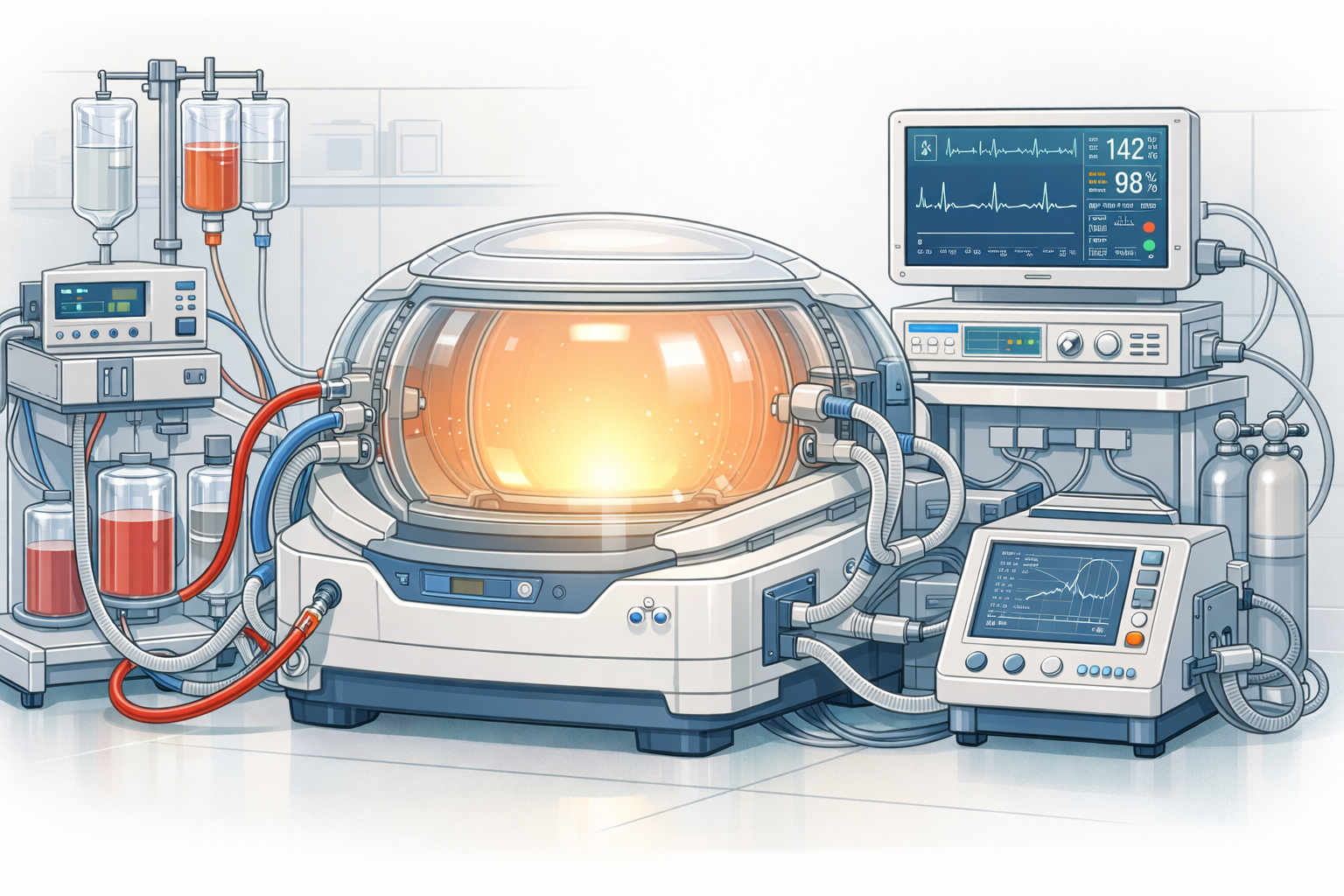
Following up on our previous story, other researchers are also continuing to refine artificial womb systems designed to support extremely premature infants whose organs are not yet capable of functioning independently. These systems replicate critical aspects of the uterine environment—including fluid suspension, oxygen exchange, and nutrient delivery—allowing development to continue outside the human body under controlled conditions.
While the technology remains in experimental stages, progress over the past decade has steadily moved the concept from theoretical possibility toward clinical relevance, particularly for infants born at the very edge of viability. Source: Nature
Why it matters:
This work reframes neonatal medicine from emergency intervention to developmental support. If translated safely into clinical practice, it could significantly improve survival and long-term outcomes for premature infants, while raising ethical questions about care boundaries, responsibility, and how society defines the earliest stages of life.

AI Helps Scientists See Inside One of the World’s Most Dangerous Volcanoes
Scientists have produced the first three-dimensional images of the interior of Mexico’s Popocatépetl volcano—one of the most active and closely monitored volcanoes on Earth—using a combination of dense sensor networks and artificial intelligence driven analysis. Researchers from Mexico’s National Autonomous University deployed an expanded array of 22 seismographs around the volcano and applied machine-learning techniques to interpret how seismic waves travel through the Earth.
By processing vast amounts of seismic data, AI models helped infer the internal structure of the volcano, revealing multiple magma reservoirs at different depths beneath the crater. This approach goes beyond traditional surface monitoring, allowing scientists to “see” inside a volcano without drilling or direct access. Source: ABC News
Why it matters:
This work demonstrates how AI is transforming Earth science by turning complex, noisy data into actionable insight. Better understanding a volcano’s internal structure can improve eruption forecasting and risk assessment—a critical advance for the roughly 25 million people living within range of Popocatépetl—while showing how intelligence systems increasingly extend human perception into places we physically cannot go.
AI’s Growth Challenges Energy and Infrastructure Limitations
The rapid expansion of artificial intelligence is driving unprecedented investment in data centers, specialized chips, cooling systems, and long-term energy contracts. AI’s growth is now tightly coupled to physical infrastructure, placing increasing strain on power grids and accelerating interest in nuclear, renewable, and grid-modernization projects.
What once appeared as a largely digital revolution is offering a reminder that intelligence at scale depends on material systems like steel, concrete, land, and electricity. Source: Reuters
Why it matters:
The future of AI will be shaped as much by energy policy and infrastructure planning as by algorithms. How societies power intelligence systems will influence costs, environmental impact, and who ultimately benefits from AI’s capabilities.
Education and Work Integrate AI — But at Uneven Speeds
Schools and workplaces continue experimenting with AI tutors, copilots, and assistants, but adoption varies widely. Some institutions are integrating these tools into daily workflows, while others remain cautious due to concerns about misuse, assessment, training, and equity.
This uneven adoption is creating a patchwork landscape in which access to AI-augmented learning and productivity differs significantly by institution and role. Source: Harvard Business Review
Why it matters:
Technological capability alone does not guarantee broad benefit. The pace and manner of AI adoption will shape who gains new skills, who falls behind, and how confidently people learn to collaborate with intelligent tools. But stories like this suggest AI is increasingly growing on us.
⚡ Quick Picks
AI Improves Early Disease Detection
Machine-learning models are increasingly capable of identifying subtle indicators of disease in medical imaging and clinical data, often before symptoms appear. As these tools enter healthcare settings, diagnosis may begin shifting toward earlier and more preventative intervention. Source: Science
AI Moves from Novelty to Daily Workflow Tool
A new global survey finds that 95 % of organizations now use AI regularly in workplace processes, with more than half reporting daily use of AI tools in tasks like document drafting, scheduling, and data summarization, making AI as common in the office as email or messaging platforms. The shift reflects AI’s transition from stand-alone assistants to embedded collaborators that quietly shape how work gets done every day.
Source: AMA
Predictive Maintenance Extends Renewable Energy Systems
AI-driven monitoring systems are helping solar and wind operators anticipate equipment failures before they occur, reducing downtime and improving long-term efficiency. These gains strengthen clean energy economics without requiring new installations. Source: Renewable Energy World
Courts Clarify Limits on Algorithmic Authority
Judicial systems are increasingly formalizing rules that restrict automated decision-making in high-stakes contexts, emphasizing transparency and human review. These policies reflect growing concern over accountability in algorithm-assisted judgments. Source: Thomson Reuters
Wearables Shift Toward Subtle Utility
New generations of wearables focus less on spectacle and more on practical assistance such as navigation, transcription, and contextual reminders. Adoption appears driven by usefulness rather than novelty. Source: The Verge
✔ Singularity Sanctuary now as a footprint on the social media sight X, to follow like-minded organizations, gain valuable input, and draw interest to what we're doing to ease undue anxieties about technology and promote the optimism necessary for us to create the future we want.
✔ Our first video course, Ethics and Technology is in the works and is scheduled to be completed and ready to roll out by the end of February. The short course will address the need to learn ethics rather than relying on our feelings and intuition; character development, the humanistic ethic, and how all of this applies to critical ethical issues surrounding the exponential development of powerful technologies.
✔ Speaking of firsts, our first Singularity Circle is happening on Zoom this Saturday, January 3, 2026 (Happy New Year!), from 10:00 to 11:00 AM PST. The Circle will include music, reflection, and conversation. The link for this event will be sent separately. Hope to see you there!
🌱 Closing Reflection: Extension + Intention = Wisdom
A pattern becomes apparent as we step back from this week’s developments. Technology isn't simply accelerating, it's extending our own human capabilities. Extending care beyond biological limits. Extending intelligence into infrastructure. Extending decision-making into systems that operate at scales no human mind can manage alone.
But extension is never neutral. Each extension reshapes our responsibility. When we extend neonatal care, we inherit deeper ethical obligations. When intelligence becomes infrastructure, reliability and governance matter as much as innovation. When AI enters classrooms and courtrooms, human judgment does not disappear but becomes more consequential than ever.
We also see this extension becoming quieter. AI now helps scientists see deep inside a volcano without ever entering it, and it increasingly works in offices not as a visible assistant but as background infrastructure—drafting, organizing, and anticipating needs. As these systems fade from view, their influence grows. What we no longer notice still shapes how we decide, prepare, and respond.
What distinguishes humane progress from reckless acceleration is not speed, but stewardship. Tools do not determine outcomes on their own; they amplify the values and priorities embedded within the systems that deploy them.
In exponential times, orientation matters more than prediction. The work ahead is not to slow progress nor to worship it, but to remain human within it—choosing care, accountability, and wisdom alongside capability.
[HELP US GROW BY SHARING THIS ISSUE WITH A FRIEND, OR SHARE ANYTHING ELSE YOU LIKE ABOUT SINGULARITY SANCTUARY!]