XTimes
AI War Lines, AI Copyright, and the Race Back to the Moon
Editor’s Note
This week’s technology news highlights an important truth about the age of artificial intelligence: the most difficult questions are no longer technical. They are human.
Artificial intelligence is advancing with remarkable speed, entering arenas that shape civilization itself—war, creativity, law, and space exploration. Yet every one of these developments raises deeper questions about responsibility. Who decides how powerful technologies should be used? What limits should exist? Is there a clear line between the humans and tools they are using? And how do we ensure that the tools we create ultimately serve humanity rather than undermine it?
The stories in this week’s issue suggest that society has begun wrestling with these questions in earnest. If the exponential age is arriving—as many technologists believe—it will not only test our ingenuity. It will test our wisdom.
Top Stories
Anthropic Draws the Line on Military AI
Artificial intelligence company Anthropic has found itself at the center of a growing national debate after declining to modify safeguards that prevent its AI models from being used for certain military purposes, including mass surveillance and autonomous weapons systems.
The dispute emerged when the Pentagon requested greater flexibility in how advanced AI tools could be deployed. Anthropic’s leadership, including CEO Dario Amodei, maintained that the company’s safety policies were intentionally designed to limit such applications.
The disagreement has drawn attention across the tech industry, highlighting tensions between governments eager to harness AI’s capabilities and developers concerned about the ethical implications of deploying powerful systems in wartime.
Some observers argue that advanced AI could improve military decision-making and reduce human casualties. Others warn that integrating probabilistic language models into high-stakes military operations could introduce unpredictable risks.
The episode illustrates how quickly AI development has moved from research labs and consumer tools into the center of global geopolitics.
Why it matters
Artificial intelligence is rapidly becoming a strategic technology comparable to nuclear energy or cybersecurity.
But this dispute also signals something more: the beginning of a philosophical divide within the AI industry itself. Some companies view advanced AI primarily as a tool to be deployed widely and quickly. Others increasingly see it as a powerful system requiring ethical guardrails—even when governments request otherwise.
How that divide evolves may shape the next phase of AI development.
Supreme Court Leaves AI Art Outside Copyright Law
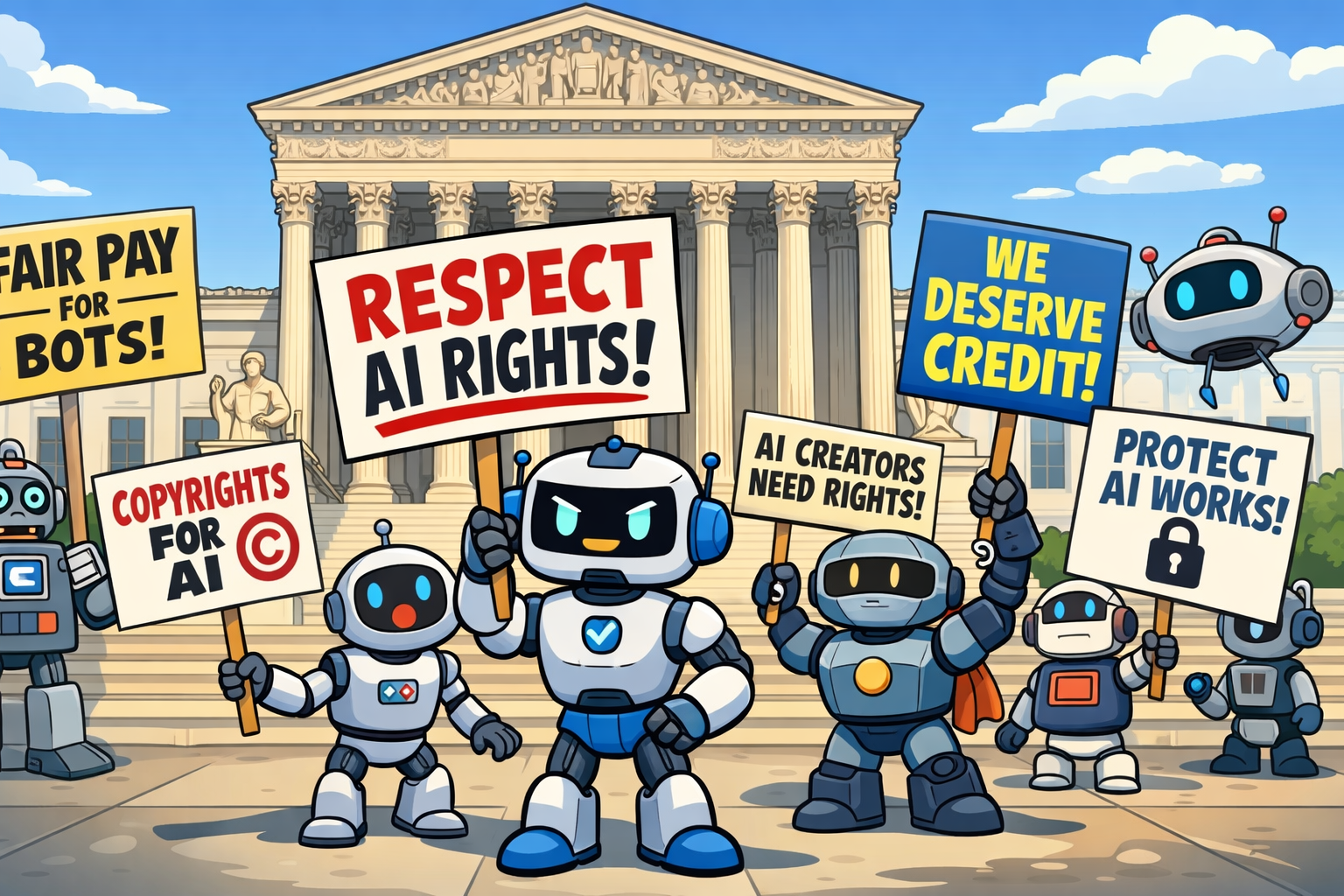
The U.S. Supreme Court declined to hear a case that sought copyright protection for artwork generated entirely by artificial intelligence, leaving in place earlier rulings that copyright law requires human authorship.
The case was brought by computer scientist Stephen Thaler, who argued that an AI system he developed should be recognized as the legal creator of a digital artwork. Federal courts rejected the claim, stating that copyright law has long required a human author.
By refusing to hear the appeal, the Supreme Court effectively confirmed that position for now: works generated entirely by AI cannot be copyrighted under U.S. law.
The decision does not prevent artists or creators from using AI tools. If a human meaningfully shapes or directs the creative process, the resulting work may still qualify for copyright protection. But purely machine-generated content occupies a strange legal space—free for anyone to use, yet produced by increasingly sophisticated systems.
Why it matters
As AI systems become capable of producing music, images, and writing at scale, copyright law is being forced to confront an unprecedented question: what does authorship mean in the age of intelligent machines? For now, the law is drawing a clear line—creativity, at least legally speaking, still belongs to humans.
But as AI systems grow more capable, that line may become harder to maintain. The courts may eventually face an even more difficult question: not whether machines can create, but how society should recognize the humans who guide them.
AI Music Platforms Face a Legal Reckoning
The rapid rise of AI music platforms Suno and Udio has sparked a major legal confrontation with the recording industry.
Major record labels have accused the companies of training their models on copyrighted music without permission. The lawsuits claim the systems reproduce the distinctive styles of artists whose work was included in training datasets. AI developers argue that large-scale training is essential to innovation and may fall under fair-use protections.
Meanwhile, the technology continues improving quickly. With just a few prompts, users can now generate complete songs—including vocals, instrumentation, and production—within seconds.
The legal battles now underway may determine how generative AI can learn from existing cultural works.
Why it matters
Creative industries are becoming one of the first major testing grounds for AI governance. The outcome of these disputes could shape how AI systems are trained across fields ranging from music and visual art to writing and software development.
The deeper shift may be cultural. For the first time in history, creativity itself is becoming partially automated—forcing society to reconsider what human originality means in a world where machines can imitate it at scale.
Source: AP News
NASA Rethinks Its Strategy for Returning to the Moon
NASA is reevaluating elements of its Artemis program in an effort to accelerate the timeline for returning astronauts to the lunar surface.
Officials are exploring ways to streamline development and reduce delays, drawing inspiration from the faster decision-making that characterized the Apollo era.
The shift comes amid increasing international competition in space exploration. China has outlined ambitious plans for lunar infrastructure, while private companies continue expanding their role in spacecraft and launch development.
If the adjustments succeed, the coming decade could see a renewed surge of activity on and around the Moon.
Why it matters
The Moon is quickly evolving from a symbolic destination into a strategic frontier for science, industry, and geopolitics. But something even larger may be happening. As robotics and AI become increasingly capable, the next generation of exploration may rely heavily on intelligent machines operating far from Earth.
In that sense, the return to the Moon may also mark the beginning of humanity’s first true partnership with artificial intelligence in exploring the cosmos.
Source: Spaceflight Now
Quick Picks
The Rise of Defense Tech Startups
Companies like Palmer Luckey’s defense technology firm Anduril are helping redefine how military systems are developed. Instead of traditional defense contractors relying on slow procurement cycles, a new generation of startups is applying Silicon Valley speed to national security technologies—including autonomous drones, AI surveillance systems, and automated defense platforms.
The trend reflects a broader shift toward software-driven defense capabilities. Warfare, once dominated by hardware such as tanks and aircraft, is increasingly shaped by algorithms, sensors, and networked systems.
For technologists, this raises profound ethical questions about how innovation should intersect with military power.
It may also signal a structural shift in the defense industry itself—one where software startups play a larger role in shaping national security.
Source: New York Times
China Accelerates Its Robotics Ambitions
China continues investing heavily in robotics as part of its long-term strategy to dominate advanced manufacturing and automation.
Its impressive display of dancing robots moving with human agility are drawing a lot of attention, but, on a more practical level, China's new generations of robots are already appearing in factories, logistics networks, and research labs. Many are designed to work alongside humans, combining AI vision systems with increasingly dexterous mechanical capabilities.
The long-term goal is not simply industrial automation, but a robotics ecosystem capable of transforming entire sectors of the economy.
If AI is the brain of the next technological revolution, robotics may become its physical body.
Sources: Financial Times | MSN
AI Moves Deeper into Global Security Systems
As AI capabilities expand, governments around the world are exploring how these systems might support intelligence analysis, logistics planning, and cybersecurity operations.
Even when companies place restrictions on military applications, the pressure to integrate AI into national security infrastructure continues to grow.
The same technologies that can accelerate scientific discovery can also reshape geopolitical competition—making the governance of AI one of the defining policy challenges of the coming decades.
Source: Electronic Frontier Foundation
The Growing Divide Inside the AI Industry
The debate over military use of AI is revealing philosophical differences within the AI community itself.
Some companies advocate rapid deployment, arguing that powerful technologies should be released widely to maximize their benefits. Others emphasize caution, calling for strict safeguards and slower rollouts until risks are better understood.
This divide may influence everything from research priorities to regulatory policy.
In many ways, it reflects a deeper tension between two powerful forces: technological optimism and technological responsibility.
Source: Queen Mary University of London
✔ Our next Singularity Circle is happening this Saturday, March 7 at 10:00 AM Pacific Time. Please d join us if you can. A Zoom link will be sent to our members later this week.
✔ Seven of ten lessons for our Ethics and Technology course are complete. Unforuntaely, some unexpected technical challenges have delayed completion of the remaining three. We're awaiting on an additional piece of production equipment to arrive by the end of this week and intend to complete the by mid-March. Stay tuned.
Closing Reflection
Every technological revolution forces humanity to reconsider its assumptions.
When electricity spread across the world, societies had to rethink industry, labor, and daily life. When nuclear power emerged, humanity had to confront the reality that it now possessed the ability to destroy itself.
Artificial intelligence presents a different kind of challenge—not the sudden shock of a single discovery, but the steady realization that we are creating systems capable of thinking, creating, and making decisions in ways once reserved for human beings alone.
The stories unfolding this week reflect that awakening.
Governments are debating how AI should be used in war. Courts are deciding whether machines can be creators. Musicians are asking how creativity should be protected. And space agencies are preparing for a future in which intelligent machines may help humanity explore the cosmos.
All of these debates point to the same underlying truth; Technology does not determine our future. Our choices about technology do.
The exponential age is arriving quickly. The question before us is whether our wisdom can keep pace with our power.