XTimes
Editor’s Note: Intelligence Meets Power
If last week signaled that AI is becoming infrastructure, this week suggests something even more consequential: intelligence is becoming entangled with power. Not merely computational power, but political power, economic power, cultural influence, and military capacity.
From tensions between the U.S. Defense Department and Anthropic over the use of its AI model, to global warnings about industrial-scale AI “distillation” campaigns, to legal battles over social media’s psychological impact, we are witnessing something larger than product releases or quarterly earnings. We are watching the architecture of influence take shape.
Intelligent systems now sit at the intersection of defense, media, finance, education, and geopolitics. They influence markets. They shape narratives. They alter institutional behavior. And increasingly, they operate at a scale that challenges traditional oversight mechanisms. The question is no longer whether AI will be powerful. It already is. The question is: who stewards that power, and by what principles?
Top Stories
Pentagon Demands Broader Military Use of Claude
A direct confrontation has emerged between U.S. Defense Secretary Pete Hegseth and AI company Anthropic over military access to its flagship model, Claude.
According to reports, the Pentagon is pressing Anthropic to remove usage restrictions that currently prohibit certain applications of its AI systems—including autonomous weapons decision-making and domestic population surveillance. Anthropic’s safety policies have historically limited use cases involving lethal force, real-time battlefield targeting, and predictive monitoring of civilians.
Secretary Hegseth has reportedly argued that limiting military access to frontier AI models risks placing the United States at a strategic disadvantage relative to geopolitical competitors. From the Pentagon’s perspective, advanced language models could assist in intelligence synthesis, battlefield simulations, logistical planning, and potentially real-time tactical decision systems.
Anthropic, however, has positioned itself as a company committed to AI safety guardrails and constitutional-style constraints on high-risk applications. Its leadership has previously warned against unconstrained military deployment of frontier systems.
This dispute represents more than a procurement disagreement. It is a collision between national security imperatives and corporate ethical commitments—between state authority and private AI governance. Sources: CBS News | Military.com | Reuters | Axios
Why it matters: This may be one of the first visible flashpoints in a larger global pattern: governments asserting sovereign control over frontier AI capabilities.
If advanced AI becomes a strategic military asset, then pressure to loosen guardrails will intensify. The central question becomes whether safety constraints are temporary corporate policies or durable principles that can withstand geopolitical urgency. The outcome of this standoff could signal how much influence private AI labs retain over the downstream uses of their models, particularly in domains involving surveillance and lethal force.
Industrial-Scale AI “Distillation” Raises Global Competition Concerns
Both Anthropic and OpenAI have flagged what they describe as large-scale “distillation” campaigns by Chinese AI firms.
Distillation refers to a process in which smaller models learn from outputs of more advanced systems. While technically common in machine learning, companies warn that industrial-scale scraping and replication efforts may blur the line between competitive training and intellectual property violation.
The controversy signals a new phase of AI competition. Unlike earlier technology races focused on hardware or manufacturing, this contest centers on algorithmic refinement and access to high-quality training outputs.
If frontier models become strategic national assets, then their outputs may as well. Sources: Anthropic | The Times of India | InfoSecurity Magazine | Distilled Post
Why it matters: The AI race is evolving from a sprint for compute and talent into a contest over knowledge itself. How nations navigate IP protection, model transparency, and competitive fairness will influence whether AI development trends toward cooperation or fragmentation.
Zuckerberg Testifies as Meta Faces Addiction Trial
Meta Platforms is confronting one of the most consequential legal challenges in its history as addiction-related lawsuits argue that its platforms knowingly contributed to psychological harm among younger users.
The trial drew national attention this past week as CEO Mark Zuckerberg took the stand, facing direct questioning about internal research, engagement metrics, and the company’s awareness of potential harm. Plaintiffs contend that Meta’s algorithmic recommendation systems were designed to maximize time-on-platform—particularly among teens—despite evidence that prolonged exposure could increase anxiety, depression, and body image issues.
Internal documents and whistleblower disclosures have played a central role in the case, suggesting that executives were aware of troubling trends tied to user engagement. Meta disputes the allegations, pointing to investments in safety tools, parental controls, and content moderation improvements introduced in recent years. Company attorneys argue that social media reflects broader societal challenges rather than causing them.
Regardless of the legal outcome, the optics are powerful: one of the most influential architects of the social media era defending, under oath, the behavioral architecture of the platforms he built. Sources: ABC News | AP News
Why it matters: This trial represents more than corporate litigation. It signals a shift in how society understands algorithmic systems. Recommendation engines are no longer seen as passive content organizers. They are behavioral systems capable of shaping attention, mood, identity formation, and social norms at scale.
As AI-driven personalization grows more sophisticated—and more predictive—the ethical boundary between engagement and manipulation becomes increasingly difficult to define. The outcome of this case may influence how courts assign responsibility to platforms whose algorithms guide billions of daily decisions.
If intelligence is becoming infrastructure, this trial asks a deeper question: when infrastructure shapes human psychology, who is accountable for its design?
Moon Mission Delayed: Helium Flow Anomaly Forces Artemis II Rollback
NASA has announced that its Artemis II lunar mission—originally scheduled to launch in early March 2026—will miss its planned window and won’t fly until at least April due to a technical problem with the rocket’s critical propulsion systems.
The issue emerged after engineers conducted a wet dress rehearsal—a full fueling test designed to simulate launch conditions—on NASA’s massive Space Launch System (SLS) rocket, which is set to carry four astronauts on a 10-day lunar flyby. During post-test operations, teams detected an interruption in the flow of helium to the rocket’s Interim Cryogenic Propulsion Stage—the upper section responsible for pressurizing fuel tanks and purging engines before ignition.
Helium plays a vital role in maintaining correct environmental conditions within the rocket’s upper stage. Without proper flow, fuel tanks and propulsion systems cannot be pressurized safely, making it impossible to prepare reliably for launch. The anomaly was not evident in earlier rehearsals, and resolving has required engineers to roll the 322-foot Artemis II stack back from Launch Pad 39B at Kennedy Space Center to the Vehicle Assembly Building for inspection and repair.
Launch windows for lunar missions are tightly constrained by orbital mechanics and crew scheduling. The March 6–9 window—with a backup on March 11—has now lapsed, meaning NASA will instead target new opportunities in early or late April, depending on how quickly the helium flow problem can be diagnosed and fixed.
This is the second major technical setback in recent weeks: earlier fueling tests uncovered leaks in the Orion spacecraft’s liquid hydrogen system, prompting additional troubleshooting and schedule adjustments. Sources: SkyNews | KOAA News
Why it matters: Artemis II marks the first crewed mission beyond low Earth orbit in more than half a century. Delays at this stage underscore just how complex, delicate, and dangerous human spaceflight remains—even with decades of engineering experience and modern diagnostics.
Correcting propulsion system anomalies is not merely a bureaucratic delay; it is a fundamental safety requirement when human lives and hundreds of millions in hardware are on the line. The mission’s outcome will inform future schedules for lunar landings and Mars preparation.
Quick Picks
Markets Shake but Stabilize After AI & Macroeconomic News
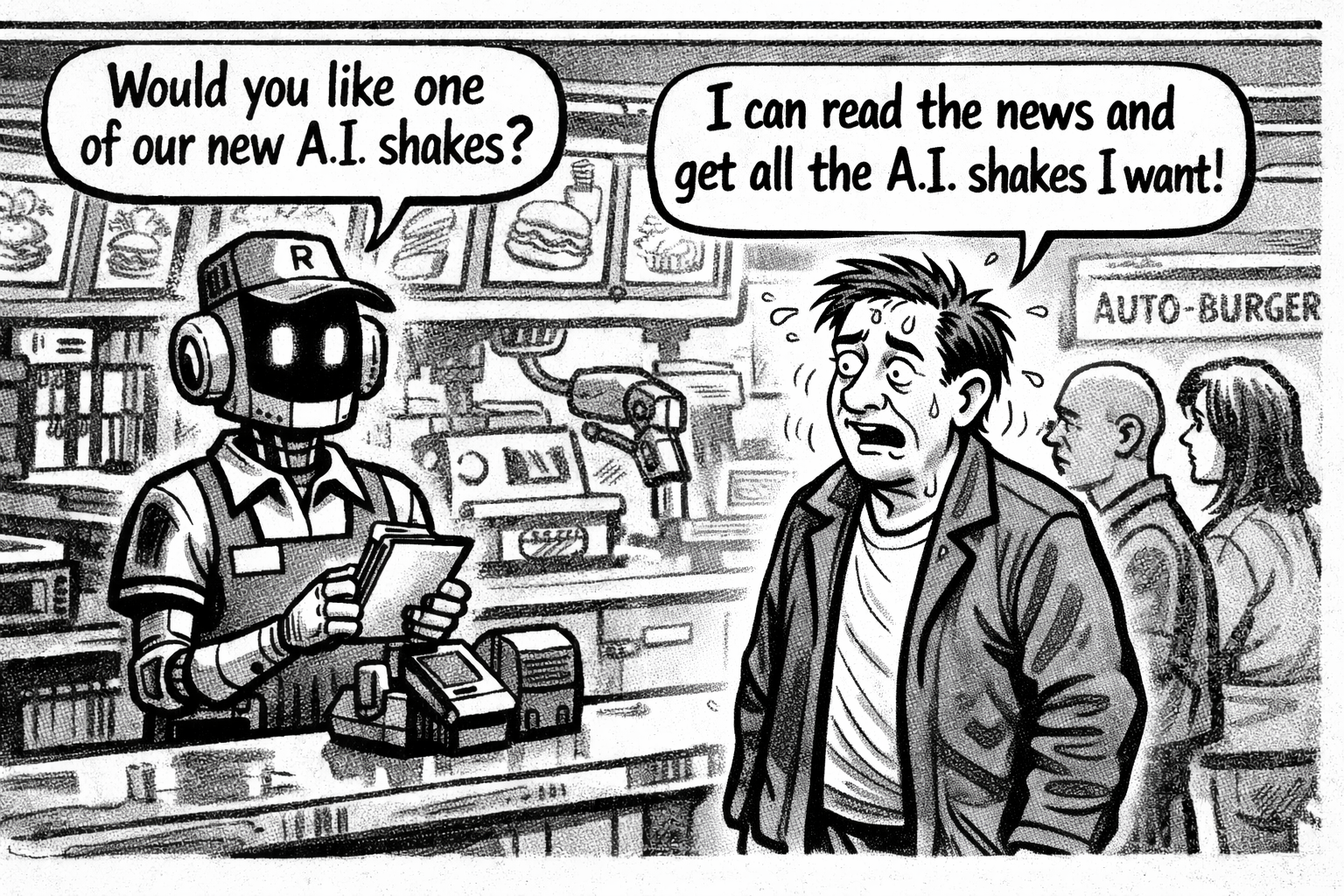
Financial markets experienced volatility this week as Bitcoin and AI-heavy tech stocks saw sharp swings tied to regulatory uncertainty, AI adoption in enterprise systems, and broader macroeconomic signals. After initial drops, both asset classes found footing as traders priced in near-term policy developments and earnings expectations.
The sensitivity of markets to AI narratives suggests that investors increasingly view artificial intelligence not just as a theme, but as a macro driver of valuations—one that can move capital flows, risk sentiment, and liquidity across sectors. Source: TradingEconomics
Europe: AI Transparency & Regulation Advancing
The European Union Artificial Intelligence Act (AI Act) is now being implemented with concrete transparency obligations—including requiring providers and deployers to disclose when content is AI-generated and to make users aware when they are interacting with a machine. These provisions are scheduled to come into effect in August 2026 as part of the phased rollout of the law.
There’s also a draft Code of Practice on Transparency of AI-Generated Content aimed at developing shared standards for marking and labeling AI outputs that's expected to be finalized by May–June 2026. This effort makes the EU one of the first regulators to move beyond high-level principles toward detailed implementation of disclosure and transparency obligations.
These developments show that transparency is becoming law in the EU, meaning businesses will soon be legally required to label AI-generated content and disclose AI interactions to users. This shifts transparency from a “good idea” into a regulatory baseline that could influence policy frameworks elsewhere in the world. Sources: European Commission | Tech Policy Press
Universities Expand AI Literacy Initiatives
A growing number of universities have announced plans to require AI literacy modules for incoming students. These programs aim to equip learners with understanding of both foundational concepts and ethical implications of AI tools, from automated writing assistants to data-driven decision systems.
Education systems are early adaptors in societal transitions. Embedding AI literacy now may shape how future generations engage with, critique, and build intelligent systems, reinforcing both empowerment and responsibility. Source: Inside Higher Ed | Pursuit
Hollywood & Creative Industries React to AI Deepfakes
An AI-generated video portraying a “fight” between hyper-realistic deepfakes of Tom Cruise and Brad Pitt has sparked renewed concerns in Hollywood over consent, copyright, and the unauthorized use of celebrity likenesses. Artists and rights holders argue that such synthetic media blurs the line between creative expression and infringement, although legal frameworks are still catching up to these sorts of issues.
As generative video models improve, issues around representation, consent, and intellectual property are becoming central to the creative economy — not merely technical footnotes. Sources: ArtisanOS Alpha | The Hollywood Reporter
✔ Our next Singularity Circle is happening Saturday, March 7 at 10:00 AM Pacific Time. Please mark your calendar and join us if you can. A Zoom link will be sent to our members a few days before the event.
✔ Singularity Sanctuary's Ethics and Technology course is still on schedule for completion by the end of February, meaning it will be available to you in early March. As we all understand, the exponential advance of technology can be as worrisome as it is exciting. This is not a difference of attitude or mindset, but of ethics. So long as we center its use on human welfare and individual freedom and dignity, we will guide it towards all that excites us about its potential and possibilities.
This is the reason Singularity Sanctuary—committed to creating the future we want rather than trying to prevent the one we fear—is producing this signature series, doing our part to center ethics in these exciting and, yes, worrisome times.
Reflection — When Intelligence Intersects with Power
By Todd Eklof
For much of human history, power has been visible. It appeared in armies, monarchies, corporations, industrial factories, and physical infrastructure. Even when invisible in practice, its mechanisms were tangible.
This week’s stories suggest we are entering a subtler era. Intelligence—artificial, distributed, and increasingly autonomous—is merging with systems of power. It shapes defense planning. It influences global markets. It curates the information we see. It mediates social relationships. It guides institutional decision-making.
Unlike previous forms of power, intelligent systems can adapt in real time. They learn. They refine. They scale. This is both extraordinary and unsettling. When railroads reshaped economies, society built regulatory frameworks. When electricity became ubiquitous, safety standards followed. When the internet transformed communication, new norms emerged—sometimes too slowly, sometimes imperfectly, but eventually.
Now we face a similar inflection point. If intelligence becomes embedded within defense systems, who ensures restraint? If it shapes financial markets, who monitors systemic risk? If it guides cultural narratives, who safeguards authenticity? Power without reflection becomes domination. Power guided by principle becomes stewardship.
The encouraging sign is not that these debates exist, but that they are happening openly. Governments, courts, engineers, educators, and citizens are beginning to grapple with implications before outcomes are fully locked in. We are not observers of this transformation, we are participants. The infrastructure of intelligence is being built in real time. The norms surrounding it are still fluid. The values we embed now—transparency, accountability, human dignity—will echo for generations.
History suggests that technological power expands faster than ethical consensus. Our task is to close that gap. Not by resisting progress. Not by accelerating blindly. But by insisting that intelligence, however advanced, remains in service of human flourishing. In that insistence lies both our hope and, most importantly, our responsibility.